









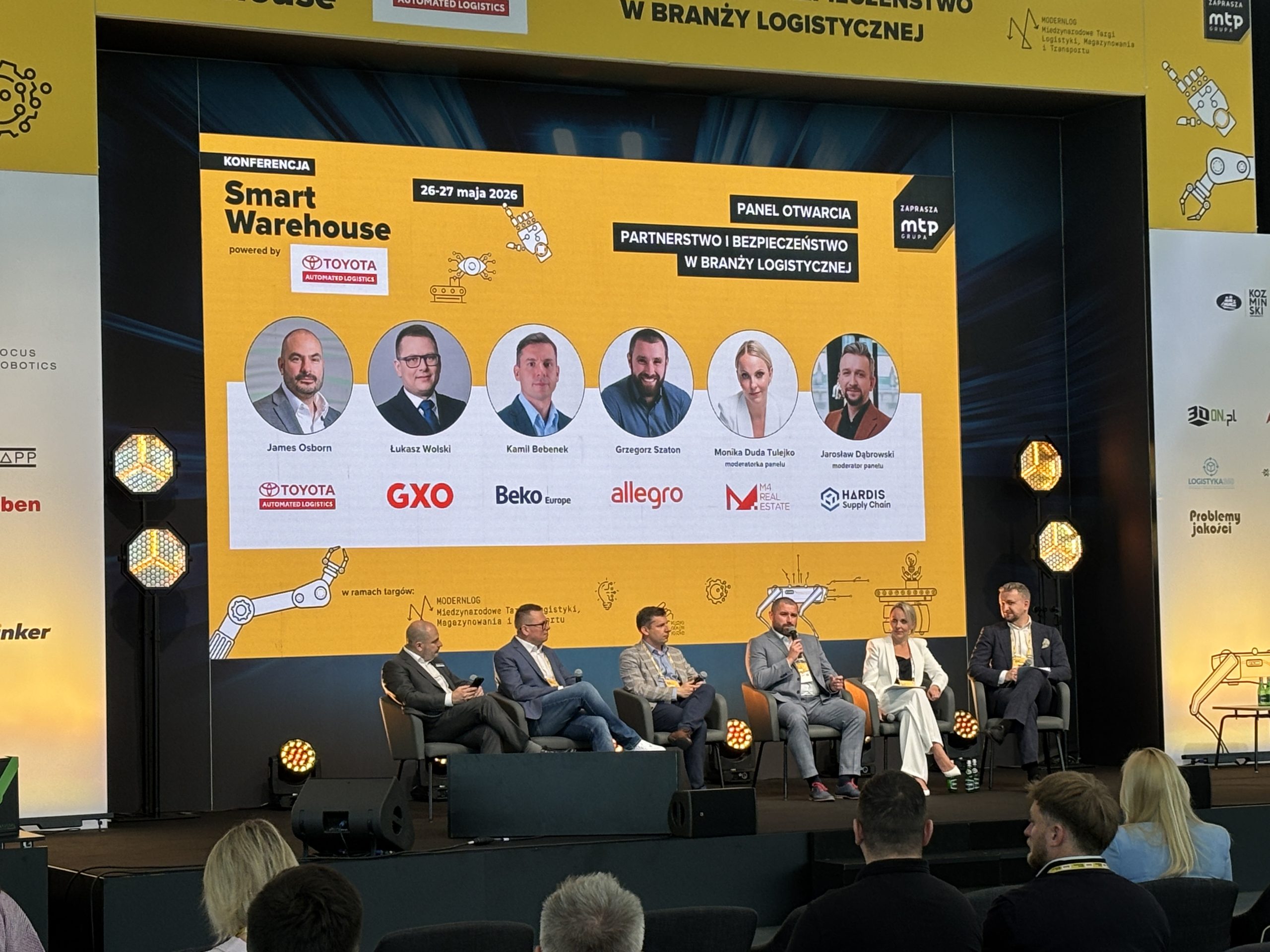
Supply chain resilience has ceased to be a strategy prepared solely for global crises. Today, it is a daily operational challenge. The partnership between an operator and a client is no longer just a matter of good relations, but the foundation of business architecture. Are security and cooperation still just cost items on the balance sheet, or have they become the main axis of competitive advantage?
During a panel discussion at the Smart Warehouse conference, which brought together experts representing key links in the supply chain – from the courier industry, through e-commerce platforms and logistics operators, to global manufacturers – a consistent picture of modern logistics emerged. The industry is undergoing a transformation: it is moving away from giant, centralized models and focusing on data verification.
Changing architecture: The end of the era of centralized giants?
The most urgent challenge for today’s logistics is diversification. As logistics industry representatives note, basing processes on single, giant sorting centers is a thing of the past. The current strategy is to build smaller, geographically well-distributed distribution centers. The goal is simple: in the event of a “bottleneck” or an unforeseen incident at one facility, the rest of the network seamlessly takes over the volume.
Moving away from large warehouses in favor of a network of operationally diversified hubs drastically shortens the response time to market shocks.
Tariffs, nearshoring, and European productivity
Global home appliance manufacturers (with factories in Poland, Turkey, or Romania, among others) are facing massive tariff pressure imposed by the EU on imports from Asia or the Middle East. The scale of the problem is enormous. For example: producing several thousand dishwashers a day, each containing over 30 kg of steel, generates huge costs given the current tariff rates on this alloy – says Kamil Bębenek, Director of Procurement and Logistics for the EMEA region at Beko.
The problem is multidimensional: the cost of efficient metal recovery in Europe is currently 7–9%, while in China it is only 1–3%. This leads to the erosion of manufacturers’ margins. Poland is doing well compared to the rest of Europe, but from a global perspective, productivity growth on the Old Continent is still too slow. Optimizing logistics processes is the most important lever for growth today.
Big Data and the art of saying “No” to clients
Increased efficiency allows for handling larger volumes, but logistics operators have changed their approach to acquiring new projects. The era of fighting for every tender at any cost is coming to an end.
Operators are increasingly refusing potential clients because they rely on hard data, not wishful thinking. If a client declares dynamic growth and pushes for warehouse automation, but their historical data shows huge volume instability, a responsible operator will not force a solution – experts argued during the panel discussion. – Without a coherent IT ecosystem and certainty regarding input data, it is impossible to guarantee a return on investment (ROI). First, you have to do your homework together.
Hard and soft security
In an environment of rapid business scaling, another factor emerges: security treated holistically. This means not only preparing for potential system failures (such as testing transitions to power generators in practice without stopping increased volume), but above all, caring for the human factor. In an era of accelerating project implementation, managing team fatigue, employee retention, and designing ergonomic processes are becoming as important as cybersecurity. Without this, it is impossible to maintain stable operations in the long term.
The contract goes into the drawer
All these technological and operational challenges ultimately boil down to one conclusion: the nature of the relationship between partners.
In the case of automation implementations or complex logistics projects, the source of failure is usually two elements. The first is errors in the initial specification. The second is relying too much on optimistic forecasts and forgetting how a human will behave when faced with a new process – adds Łukasz Wolski, Senior Operations Director at GXO.
How to build a long-term cooperation – one that lasts 20 years (as was the case with brands like Indesit and Whirlpool)? The recipe is radical honesty. The signed contract is simply put in a drawer, and on a daily basis, you manage relationships, trust, and flexibility in introducing innovations.
Today’s partnership requires a holistic approach. Even the most brilliant system sold by a salesperson will fail if, on the operational side, the process is implemented over 15 months and exceeds the budget. Market advantage is gained today by those operators for whom advanced analytics and rigorous cost control go hand in hand with a readiness to take responsibility when things take an unexpected turn. At the end of the day, one thing counts: whether the client, working with a logistics partner, can achieve more and more safely than by acting alone.
The article was based on an expert debate regarding resilience and security in supply chains, which took place during the Smart Warehouse conference.