










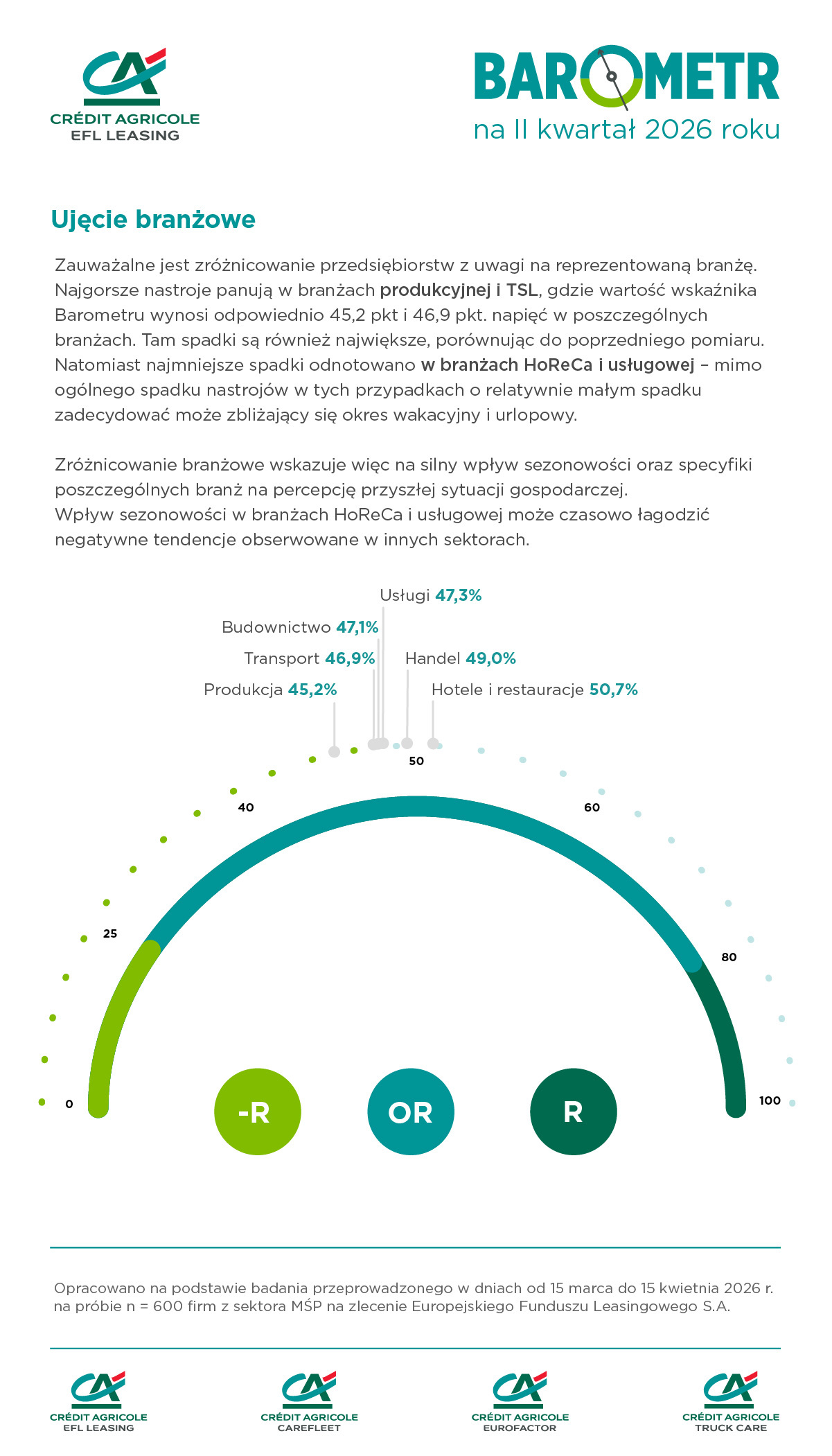
The industry sub-index of the EFL Barometer for transport, forwarding, and logistics for the second quarter of 2026 reached 46.9 points, which is 5.1 points lower quarter-on-quarter. This is the third consecutive decline in sentiment in the TSL sector and, at the same time, the lowest result since the fourth quarter of 2020, when the indicator stood at 45.3 points. Among the surveyed industries, only manufacturing recorded a lower result. Sales forecasts cooled the most: only 2.5 percent of TSL companies expect an increase in sales or orders, compared to 22.5 percent a quarter earlier. At the same time, 17.5 percent of entrepreneurs are planning larger investments, although every third company assumes they will be limited.
The EFL Barometer sub-index for the second quarter of this year for the transport, forwarding, and logistics industry reached 46.9 points, 5.1 points less than in the first quarter of 2026. This is the third consecutive quarter of declining sentiment in TSL. In the third quarter of 2025, the indicator was 54.4 points, in the fourth quarter 53.3 points, at the beginning of 2026 52 points, and it has now fallen below the 50-point threshold. The sector last recorded a lower result in the fourth quarter of 2020, when the sub-index was 45.3 points. In the current measurement, only manufacturing has a weaker reading, with a result of 45.2 points.
TSL entered the second quarter in a clear braking mode. At the beginning of the year, companies still saw a chance for an increase in orders; today, that group is almost non-existent. This shows that customer caution, cost pressure, and uncertainty in supply chains are severely limiting the willingness to plan for growth. At the same time, we are not dealing with a complete halt in investment. Some companies still want to increase spending, especially where the investment directly improves operational efficiency, reduces operating costs, or helps renew the fleet. Today’s picture of TSL is therefore very selective: entrepreneurs are securing liquidity, calculating the profitability of orders more carefully, and postponing decisions that do not have a quick translation into costs or revenues. For the industry, it will be crucial whether, after such a strong cooling of sales expectations, it will be possible to maintain financial stability and rebuild demand in the coming months.
– says Silvestr Ochrimovic, CEO of Truck Care.
EFL Barometer for the transport industry for the first quarter of 2026:
- Sub-index: 46.9 points (-5.1 points q/q)
- Investments: 17.5 percent plan larger investments (15 percent in Q1 2026)
- Sales: 2.5 percent forecast an increase in sales (22.5 percent in Q1 2026)
- Financial liquidity: 4 percent of entrepreneurs forecast a higher level of financial liquidity than in the first quarter of this year (11 percent in Q1 2026)
- External financing: 85 percent of entrepreneurs forecast demand for external financing at the same level as in the previous quarter (85 percent in Q1 2026)
Sales slump in TSL
The biggest change in the second quarter of 2026 concerns forecasts regarding sales and orders. Only 2.5 percent of TSL companies expect an increase, while a quarter earlier, 22.5 percent of entrepreneurs made such a declaration. The vast majority, 95 percent of those surveyed, expect sales to stabilize, and 2.5 percent predict a decline.
In terms of investments, the picture is more complex. 17.5 percent of TSL companies plan to increase spending on fixed assets, which is slightly more than in the previous quarter, when 15 percent of entrepreneurs declared such an intention. At the same time, 32.5 percent of companies anticipate limiting investments, and half assume they will maintain them at the current level.
Liquidity stable, financing without major changes
On the financial security side, there is a predominance of neutral responses. 4 percent of TSL companies expect an improvement in financial liquidity, compared to 11 percent in the previous quarter. 91 percent of entrepreneurs assume that liquidity will remain at a similar level, and 5 percent predict a deterioration.
Demand for external financing also looks stable. 85 percent of TSL companies expect it to remain at the same level as in the first quarter of 2026. 4 percent of entrepreneurs expect an increase in demand, while 11 percent assume a decrease. This is another signal that transport and logistics companies are not currently planning broad, externally financed expansion, but rather are maintaining their operational base and managing costs cautiously.
The value of the main EFL Barometer index for the second quarter of 2026 was 47.7 points. The level reached is 4.4 points lower than in the first quarter of 2026.
Source: EFL