









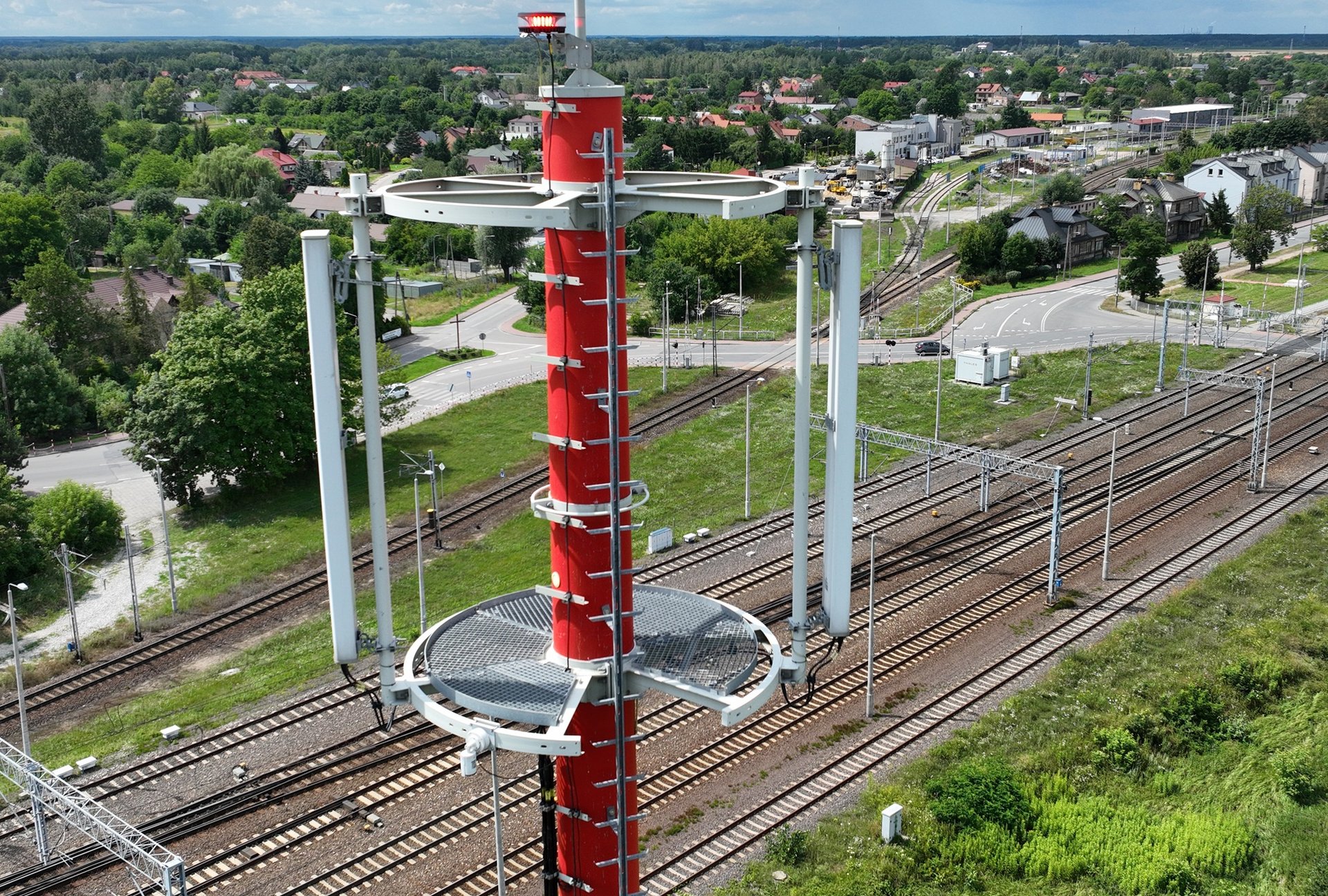
The installation of the final radio mast for the GSM-R system has begun on the Central Rail Line (CMK). The installation of the telecommunications tower in Secemin, in the Świętokrzyskie Voivodeship, marks the completion of the digital radio communication construction on one of the most important railway lines in the country. The culmination of this investment by Polskie Linie Kolejowe S.A. is a significant step towards a safer railway that complies with European standards.
The contractor for the GSM-R system, a consortium of companies: Nokia Solutions and Networks, Fonon, and SPC-2, has begun the installation of the final base station on the Central Rail Line (railway line no. 4). The work, carried out between April 16 and 17, includes the erection of a telecommunications tower that will complete the digital radio network on the key section connecting Warsaw with the south of the country, including Katowice, Krakow, and Wroclaw. A total of 35 radiocommunication facilities have been built along the approximately 224 km section of the CMK line. The next step will be equipping the radio facility with technological and network components. The launch and commencement of GSM-R tests on line no. 4 are planned for August 2026.
The construction of a unified GSM-R network is one of the most important modernization projects for the Polish railway. The installation of the final facility on the CMK shows that we are consistently strengthening the safety and reliability of train operations on the most important lines in Poland.
– said Piotr Malepszak, Undersecretary of State at the Ministry of Infrastructure.
The completion of the installation of the final GSM-R elements in Secemin brings us closer to a modern digital communication system that increases the safety and reliability of train traffic management. At the same time, the ETCS Level 2 system – along with the GSM-R system – is essential for trains to be able to travel on the CMK at speeds of 250 km/h. The ETCS Level 2 system, using GSM-R as a transmission medium, continuously monitors the driver’s performance and reacts if messages and warnings are ignored. If a train exceeds the permitted speed, ETCS will automatically stop the train. For this to happen, data must be transmitted between the control center and the train – this is exactly what the GSM-R digital radio communication provides.
Completing the construction of radio facilities on the CMK is a milestone in creating a nationwide GSM-R network. It is also a technology that will allow us to raise safety standards and prepare the infrastructure of line no. 4 for the implementation of the ETCS Level 2 system, in order to fully utilize the speed of Pendolino trains.
– said Krzysztof Drozdowski, Member of the Management Board, Director for Digital Transformation, PKP Polskie Linie Kolejowe S.A.
GSM-R ensures stable communication between train drivers, traffic controllers, and safety services. It also forms the foundation for the implementation of the European Rail Traffic Management System (ERTMS), which is to be mandatory on the main EU transport corridors. Thanks to the standardization of systems across the Union, it will be possible for trains to travel freely between member states.
We are pleased that as a technology partner, we could provide solutions that support the digital transformation of the Polish railway. The installation of the final base station on the CMK is proof of effective cooperation and the consistent implementation of a project of strategic importance.
– said Jarosław Kasperski, Member of the Management Board, Nokia Solutions and Networks Sp. z o.o.
The task carried out on the CMK is part of the project titled “Construction of the ERTMS/GSM-R system infrastructure on PKP Polskie Linie Kolejowe S.A. railway lines under the NPW ERTMS,” covering a total of approximately 14,000 km of railway lines, and is the largest telecommunications project ever implemented on the PLK SA network. Its value exceeds PLN 3 billion. The investment is applying for co-financing from EU funds under the European Funds for Infrastructure, Climate, Environment program.
The finalization of work on the CMK will translate into safer, more predictable, and more efficient journeys.
Source: PKP Polskie Linie Kolejowe S.A.