









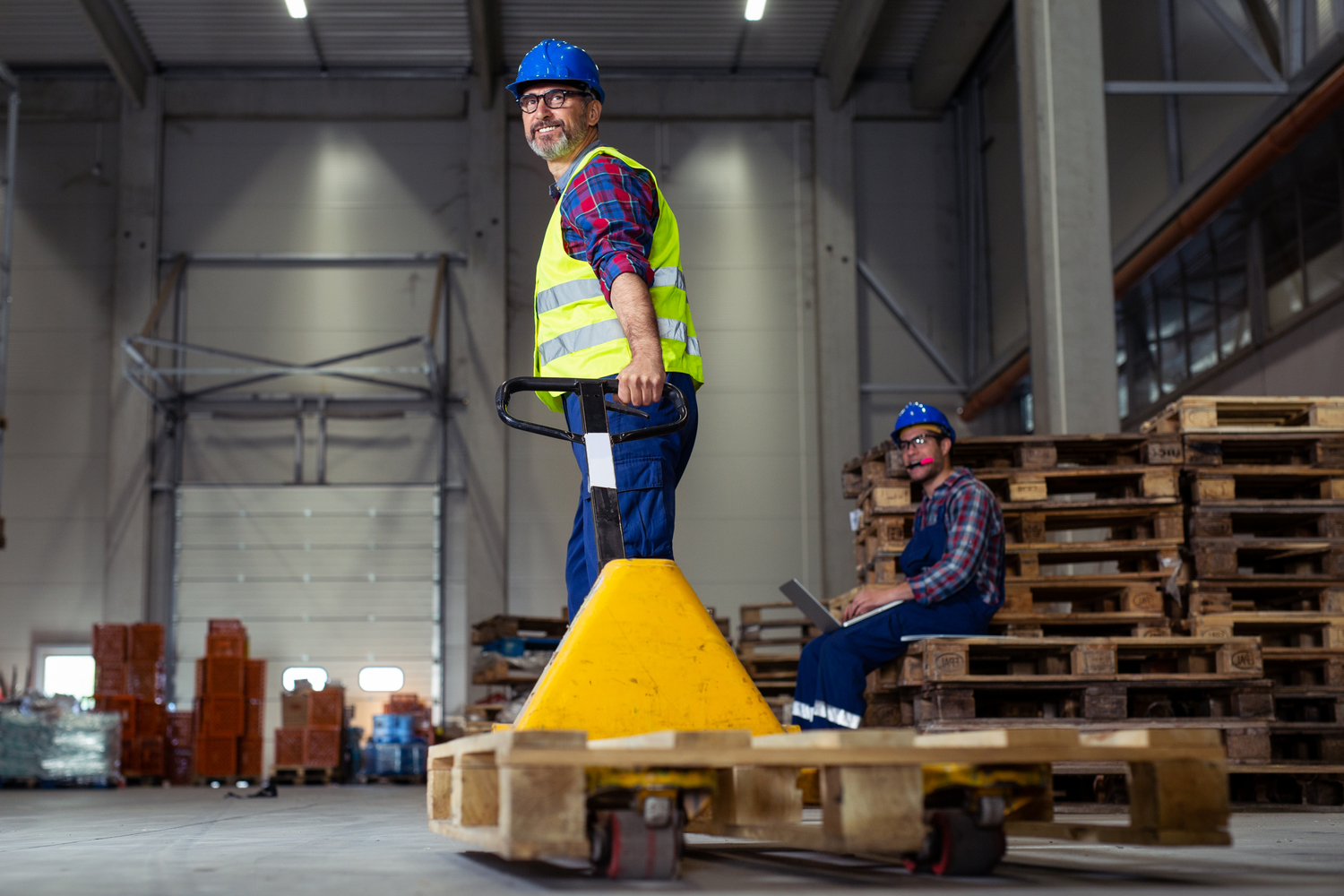
Handling goods – in a warehouse, on a production floor, in a workshop, or a large-format store – is one of the typical daily tasks. However, moving loads manually is not efficient. That is why pallet trucks are used for this purpose. See what these devices are and how to choose the right solution for your company.
What is a pallet truck?
A pallet truck is very easy to recognize. Its design is based on a pair of forks and a mechanism that lifts them slightly above the ground. These two elements allow for moving goods from place to place – efficiently, safely, and without physical effort on the part of the employee.
Although the basic construction of pallet trucks is similar, individual models differ from each other, e.g., in size, lifting height, or load capacity. Modern manual models, such as those offered by the Jungheinrich brand, are capable of carrying up to 3000 kg! This makes such devices widely applicable.
Where are pallet trucks used?
Pallet trucks are used to perform various tasks in the field of internal transport. They are well known, among other places, from large-format stores, where they are used by employees to stock shelves directly from pallets and other bulk packaging.
Popular “pallet jacks” are also a permanent piece of equipment in:
- warehouses and logistics centers – especially during the loading and unloading of delivery vehicles;
- production halls – they can be used, for example, to transport larger batches of components;
- workshops – they become essential when, for example, several tires for a truck or other heavy components need to be transported.
Pallet trucks – how do they differ?
In the catalog of pallet trucks, you can find very diverse models – from simple manual ones to advanced electric devices. To understand how diametrically different capabilities such equipment can offer, let’s compare, for example, two Jungheinrich devices: the simple manual pallet truck AM 15L and the electric stacker with tiller HC 110. Both models differ primarily in:
- drive – the manual truck is powered by muscle power when moving, while the electric one is powered by a gel battery with a built-in charger;
- lifting mechanism – in the manual one, it is hydraulic, and to lift the forks, it is necessary to “pump the tiller,” while in the electric one, you just need to press a button on the handle;
- ease of maneuvering – the electric model provides very high maneuverability and is also equipped with foot protection elements;
- price – purchasing the HC 110 involves a higher investment.
When it comes to load capacity, both models are designed to handle loads of up to 1 ton.
Pallet truck: manual or electric?
Both manual and electric pallet trucks have their advantages, and the choice of the right device depends on the needs of the facility and the specifics of the application. An example? If occasional lifting of goods is involved, and the distance the goods are moved is short (e.g., 10-15 m) – the manual version is perfectly sufficient. However, when the work to be done is more intensive, the distances to be covered are longer, and there are slight inclines in the facility – an electric device will be a good choice.
To clear up any doubts, it is best to contact a sales representative of the manufacturer and take advantage of professional help in matching internal transport equipment.