









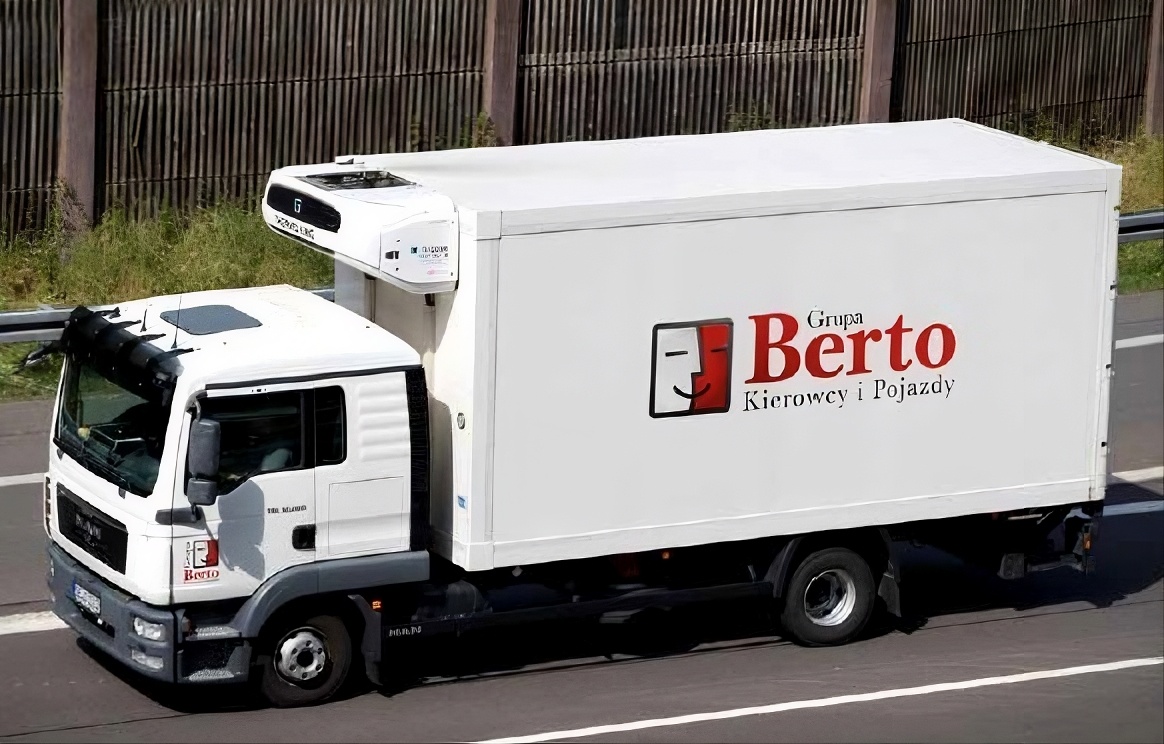
Transport companies in Poland are failing not because of a lack of orders, but because of how they are settled. Financial liquidity is dragging road hauliers down. Today, in an era of geopolitical turmoil, it has become the biggest risk factor and is worsening month by month. With average payment terms ranging from 4 to 6 weeks, many carriers can no longer afford to cover current operating costs. It does not have to be this way – argues the Berto Group, an expert in implementing logistics projects for FMCG and pharmaceuticals. Shorter, predictable payment terms should be the standard, as they are an element of stability for the entire supply chain, not an exception to the rule. It is time for the TSL industry to wake up – appeals the Berto Group.
A report by Faktura.pl summarizing the payment situation in 2025 shows that the transport and logistics services sector currently has the longest payment terms in the entire economy. They range on average from 21 to even over 42 days, compared to an economy-wide average of 13.7 days for businesses in general. Importantly, despite a relatively good economic climate, these terms are not shortening. In some areas of transport and logistics services, they have even lengthened.
The lengthening of payment terms shows that we are dealing not with a temporary phenomenon, but with an established market practice. The settlement model functioning in the TSL industry has for years been based on deferred payments. In practice, this means that a large financial gap is created between the time the service is performed and the receipt of payment, which the carrier must cover. It is this gap that most heavily burdens small and medium-sized transport companies today.
– says Mirosław Andrzejewski, Vice President of the Board at Berto KM Trans.
Payment terms as a source of the greatest risk
This financial gap causes a loss of financial liquidity and directly affects operating costs, i.e., fuel, driver salaries, leasing, and fleet maintenance. The carrier must bear these costs because they cannot be deferred, while their income is in many cases delayed by several weeks, if it is not consumed by the costs of loans or credits taken out to cover fixed costs.
In this model, the carrier not only performs the service but also finances it. With current costs and market volatility, this is ceasing to be neutral, as it begins to directly affect the company’s stability, and it does not have to be this way – it is time for the TSL industry to wake up and say stop to such practices.
– comments Ellina Lolis, General Director of Berto Polska.
Liquidity as a condition for further development
In conditions of rising fuel costs and high market volatility, financing operations for several weeks becomes a real limitation to development for many transport companies, and sometimes a condition for survival. A lack of liquidity does not only translate into accounting problems. It means limited capacity to fulfill subsequent orders, pressure on driver wages, the postponement of investment decisions, and growing dependence on external financing.
This is the moment when payment terms begin to affect the quality of transport operations, not just their financial result. Here, one must say stop and look at the business environment with which a given transport company cooperates. Although the trend of delaying payments is noticeable, not everyone follows the same practices. It is worth looking for a solid principal.
– emphasizes Mirosław Andrzejewski from Berto KM Trans.
Financial liquidity and supply chain stability
Certainly, the extended payment model is not the only one possible. There are business relationships on the market where settlement occurs in a shorter time and is treated as the basis of cooperation, not an area for negotiation after the service is performed. Berto KM Trans, as part of the French Berto Group, operating in Poland since 2018, belongs to that group of companies that have adopted this way of working as the standard for their operations. Berto carries out settlements with its subcontractors (road hauliers) within 7 or 14 days, or even earlier if agreed upon.
This is not a matter of exceptional conditions or the specifics of the business. This is a decision about how we build relationships with partners. If we want a stable supply chain, we must also take responsibility for its financial side.
– says Mirosław Andrzejewski from Berto KM Trans.
Without financial liquidity, there is no cooperation
In practice, this means changing the approach to cooperation with carriers. Not only in the context of rates or volumes but also financial principles. According to representatives of the Berto Group, an increasing part of the market is beginning to perceive payment terms as one of the key parameters of cooperation – alongside price and resource availability.
Carriers have every right to expect shorter payment terms. This is not a demand, but a natural element of balance in a business relationship – emphasizes the Vice President of Berto KM Trans.
Liquidity as a shared responsibility
In conditions where the transport industry is facing increasing cost and operational pressure, financial liquidity ceases to be an individual problem for single companies. It becomes an element that affects the functioning of the entire supply chain. Increasingly, it is the method of settlement that determines whether cooperation is stable and long-term, or requires constant risk management. It is time to wake up and normalize payments in road freight transport.
Source: Berto Group