









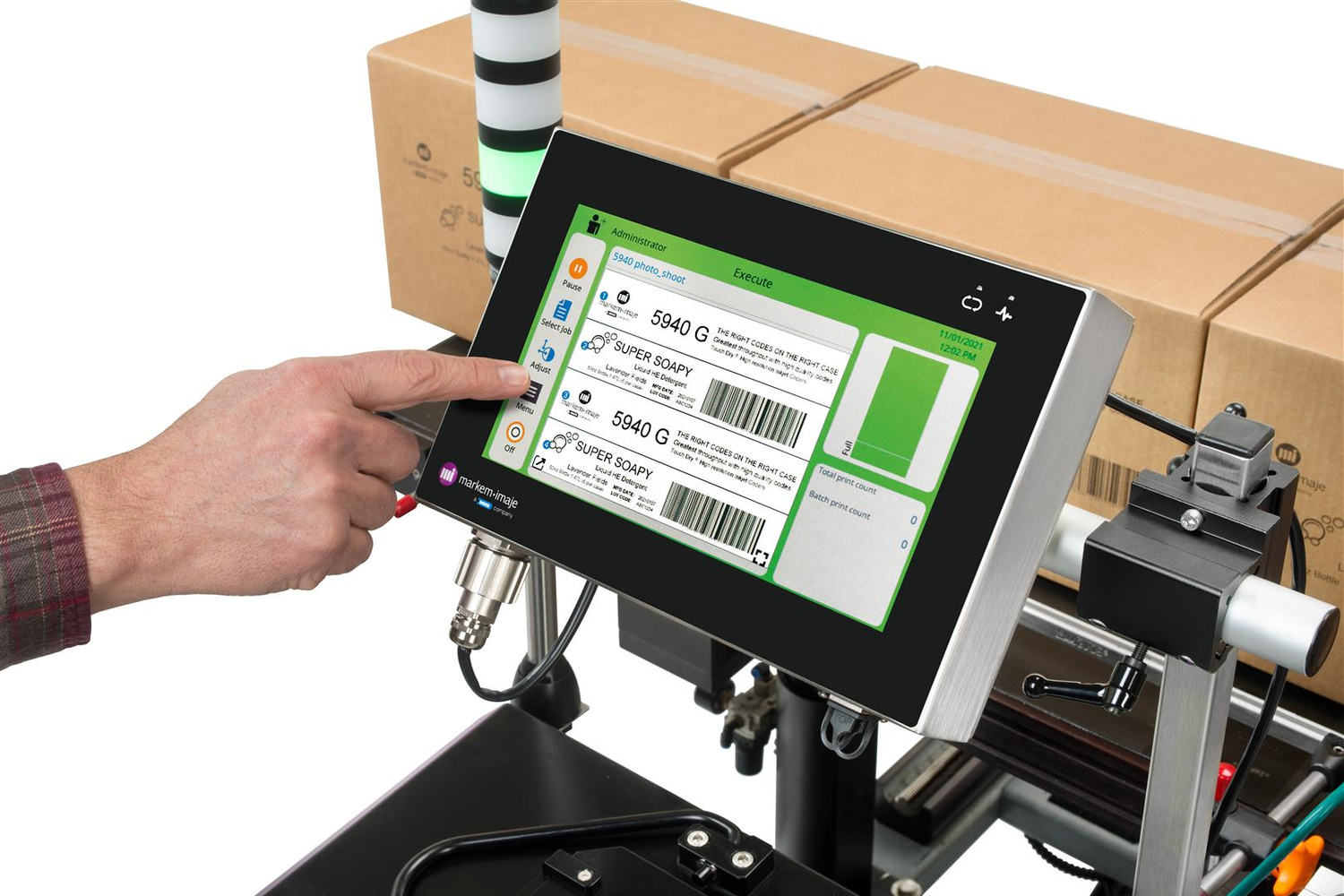
The growing importance of 2D codes, the need to eliminate errors, and the pressure to reduce costs mean that companies are increasingly investing in modern marking technologies. In practice, this means having to choose between various solutions – from industrial inkjet printers and laser systems to printers for marking secondary packaging.
Each of these technologies has its specific applications, advantages, and limitations, and their proper selection can directly translate into a company’s operational efficiency. In this article, we present an overview of the most important solutions used in industrial marking and point out what to pay attention to when choosing them in the context of production and logistics.
Industrial inkjet printers and their importance in product identification
Every product coming off the production line must be marked. The type of data applied depends on the specifics of the production – different data will be required for FMCG products, such as food, cosmetics, household chemicals, or hygiene products, and different for industrial sectors and products such as cables, pipes, electrical goods, construction materials, etc.
How do industrial inkjet printers (CIJ) work?
Continuous Inkjet (CIJ) technology involves generating a continuous stream of ink in the printhead, which is then broken into individual droplets. These droplets are selectively electrically charged and pass through an electrostatic field, where they are deflected. Charged droplets hit the marked surface to create a print, while uncharged droplets are captured and returned to the ink circulation system in the printer.
Advantages of CIJ inkjet printers
- versatility of materials (plastics, metal, glass, cardboard, paper, etc.)
- suitable for any production line speed
- flexibility (variable data, black and colored inks, ability to rotate between production lines)
- cost-effective marking method
Limitations of CIJ inkjet printers
- consumables (inks, solvents) and associated costs
- need for maintenance
- generate waste in the form of packaging from chemical consumables
https://coleman.pl/kategorie_produktow/drukarki-inkjet-malych-znakow/
Popular applications of inkjet printers
Industrial inkjet printers are widely used in the food, beverage, cosmetic, and chemical industries, as well as for all types of extruded products. They perform well on high-speed production lines and where high-contrast printing is required due to dark substrates. They are also used in logistics, in the co-packing sector, where products often packed in bundles or sets receive their own identification marking.
Laser markers and their growing popularity in industry
A few years ago, laser markers dominated industrial sectors where permanent marking ensuring reliable identification was required, e.g., in the automotive, aerospace, and electrical component industries. Today, more and more manufacturers, including those in the FMCG sector, are choosing this technology.
How do laser markers work?
Laser marking technology involves using a focused, high-energy light beam that interacts with the material’s surface. As a result of this process, a local change in the material’s properties occurs – it can be evaporation, burning, foaming, or color change. Controlling the laser beam allows for precise application of marks, such as codes, text, or graphics, without contact with the product surface. CO2, fiber, and UV lasers dominate in applications.
https://coleman.pl/kategorie_produktow/znakowanie-laserowe/
Advantages of laser markers
- durability of markings and resistance to abrasion
- no ink or solvent – elimination of chemicals and operating costs
- high quality and precision of coding
Limitations of laser markers
- high investment cost
- dependence on the marked material and therefore less flexibility
- dependence of print size and line speed (the more extensive the print, the longer the marking time)
Popular applications of laser markers
In addition to the aforementioned industrial sectors, laser markers are increasingly used in the food, cosmetic, and chemical industries, etc. An important aspect here is, on one hand, the durability of the markings, and on the other, the elimination of operating costs and chemicals from production. An additional aspect, especially in the case of luxury goods, is the high quality of marking that corresponds to the brand’s prestige.
https://coleman.pl/kategorie_produktow/drukarki-duzych-znakow-wysokiej-rozdzielczosci/
Printers for cartons and their importance in logistics processes
Secondary packaging is often a logistics unit. Clear, reliable marking is a guarantee of visibility in the supply chain and efficient logistics processes. An alternative method to printing and applying labels is printers that mark directly on secondary packaging, specifically high-resolution printers using piezoelectric technology.
How do carton printers using piezoelectric technology work?
Piezoelectric printing technology, used in printers for marking cartons, involves precise ink dosing using piezoelectric elements placed in the printhead. Under the influence of an electrical impulse, the piezoelectric element changes its shape, which causes an ink droplet to be pushed through the nozzle onto the packaging surface. This process allows for very accurate character formation and application of data, such as barcodes, logistics markings, and high-resolution graphics without contact with the substrate.
Advantages of carton printers
- elimination of labels (cost savings)
- easier packaging recycling
- fast logistics marking
- integration with warehouse systems
- flexibility, versatility, and personalization of cartons at the final stage of marking
Limitations of carton printers
- more stringent requirements regarding carton positioning
- substrate color can affect barcode readability
Popular applications of carton printers
High-resolution printers for direct printing on secondary cartons print high-resolution barcodes, graphics, text, markings, etc.; they are chosen by companies with high production volumes due to significant savings compared to using labels. FMCG companies dominate – food, cosmetic, chemical, hygiene – also due to the high flexibility provided by print personalization at the final packaging stage and the ability to adjust the size of the marking regardless of the label format in stock.
Industrial inkjet printers work well on fast production lines with varied materials, laser markers ensure durability of markings, while carton printers are an ideal solution in logistics and marking of secondary packaging.
How to choose the technology for your own production and logistics processes?
In practice, the choice between industrial inkjet printers, laser markers, and carton printers depends on the specifics of production and logistics requirements. When choosing a product and packaging identification technology, several key factors should be analyzed.
Selection criteria:
- material from which the product packaging or secondary packaging is made
- production line speed
- data to be printed on the product or secondary packaging
- durability of markings
- investment and subsequent operating costs (CAPEX vs OPEX)
- industry requirements (specific to particular industries)
- environmental aspects (lower CO2 emissions, ease of recycling, reduction of chemical use, etc.)
Market trends in product identification and importance in logistics processes
Following the Industry 4.0 concept, Logistics 4.0 is also developing, which transfers the idea of digitalization, automation, and system integration to the supply chain area. Modern logistics is based on the use of real-time data and supports the digital flow of information, enabling inventory monitoring, product traceability, and full visibility of processes in the supply chain.
Summary
Modern marking technologies play a key role in effective production and logistics management. The choice of the right solution – inkjet printer, laser, or carton marking system – should always be tailored to the specifics of the process, material, and operational requirements. Aspects related to digitalization, product traceability, and cost optimization are becoming increasingly important. In practice, this means that companies are increasingly combining different technologies to ensure maximum flexibility, marking quality, and full integration with a modern, digital supply chain. When analyzing needs and choosing the right technology and supplier, it is worth working with an experienced partner who offers a wide portfolio of solutions. An example is Coleman International, a company with over 30 years of experience in the field of product and packaging marking.
