









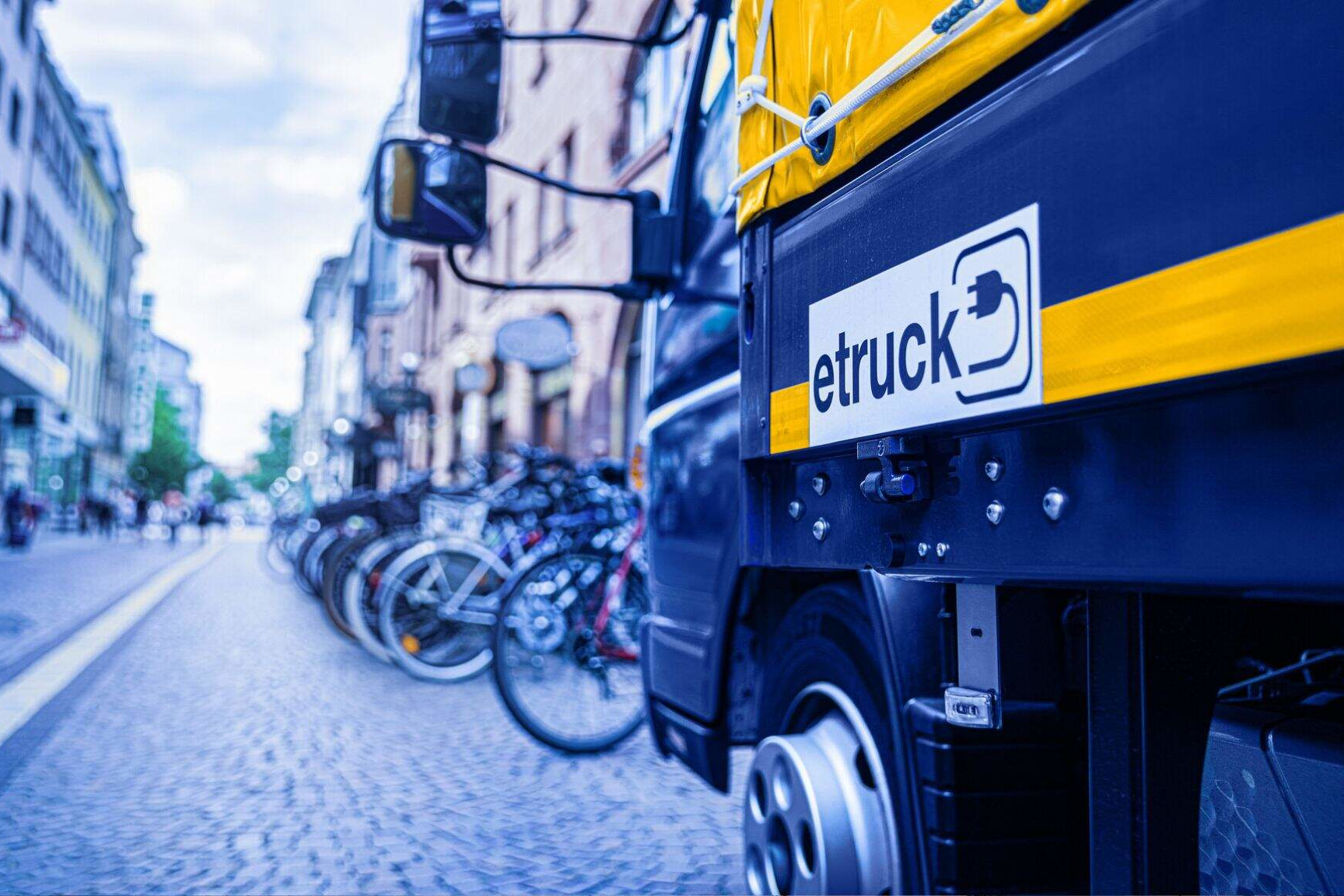
At the beginning of 2023, DACHSER announced a plan to double the number of emission-free urban delivery zones in Europe within three years. This goal was achieved by the end of 2025. In 25 major European cities and metropolitan areas across ten countries, the company has designated city-center areas where it delivers groupage shipments (without temperature control) emission-free. In doing so, the company has implemented another element of its long-term climate strategy.
The concept is based on the use of electric trucks and electrically assisted cargo bikes, as well as the opening of logistics microhubs located near city centers. Currently, the company uses 60 electric vehicles and 13 cargo bikes in 25 cities. In 2025, these vehicles covered a total of approximately 1.8 million kilometers without greenhouse gas emissions, which is an average of about 7,000 kilometers per day. This has reduced emissions by approximately 1,000 tons of CO2e. The reduction in emissions for electric vehicles depends on the source of energy that powers them. When using green energy, the savings amount to 1,544.75 tons of CO2e (well-to-wheel). In the case of calculations based on the German energy mix, it is 986.06 tons of CO2e.
The DACHSER Emission-Free Delivery program was created at the company’s branch in Kornwestheim and was first implemented in Stuttgart in 2018. In the same year, the pilot project received an award from the German Federal Ministry for the Environment in the national Sustainable Urban Logistics competition.
It is thanks to DACHSER Emission-Free Delivery that we began to systematically incorporate climate action into our daily logistics operations. We are introducing solutions that work in practice and help us decarbonize logistics.
– emphasizes Stefan Hohm, Chief Development Officer at DACHSER.
At the beginning of 2023, when the company launched the “Mission Doubling” initiative, twelve emission-free delivery zones were already in operation. Expanding the program to 25 cities (one more than originally planned) was possible thanks to a modular implementation concept adapted to local conditions. The development also incorporated employee ideas submitted during a global climate action campaign. Through this concept, DACHSER contributes to improving air quality in heavily polluted urban areas, as electric trucks and cargo bikes do not emit greenhouse gases locally. Additionally, as a result of the project, working conditions for drivers have improved – electric vehicles are much quieter and do not generate engine vibrations. The project has also been positively received by customers, residents, and local authorities.
The DACHSER Emission-Free Delivery program is also a response to the growing number of bans on combustion-engine vehicles in European city centers. The company closely monitors vehicles used in emission-free zones and documents all unplanned deviations. In 2025, the reliability rate for emission-free deliveries was 95%.
Cooperation in the European network
The program has been implemented in 25 cities:
Amsterdam, Barcelona, Berlin, Cologne, Copenhagen, Dortmund, Dublin, Düsseldorf, Freiburg im Breisgau, Hamburg, London, Madrid, Malaga, Munich, Oslo, Paris, Porto, Prague, Rotterdam, Stockholm, Strasbourg, Stuttgart, Toulouse, Vienna, and Warsaw. The size of the emission-free delivery zones depends on the size of the city – they usually cover busy city-center areas, such as shopping districts or historic centers. In Freiburg im Breisgau, the emission-free zone has been gradually expanded and currently covers the entire city. Depending on local conditions, DACHSER uses different types of vehicles.
The expansion of our DACHSER Emission-Free Delivery program is another step confirming the accelerating transformation of urban logistics in Europe. We are pleased that Warsaw has joined the group of cities covered by this solution. For us, this is not only about taking action to reduce local emissions, but also an opportunity to gain practical experience in using electromobility in urban distribution and developing more sustainable supply chains.
– says Aneta Sakowicz, Environmental and Sustainability Coordinator at DACHSER Poland.
A key factor enabling the implementation of the concept in subsequent cities was the growing availability of suitable series-produced vehicles – especially electric trucks with appropriate payload capacity and a developed service network. When we started this project, our options were much more limited.
– explains Alexander Tonn, COO Road Logistics at DACHSER.
Over time, a project community of participating branches was formed, which exchanges experiences and develops local solutions. “Integrating DACHSER Emission-Free Delivery into existing network processes was a key step in moving this concept into daily operational business,” adds Tonn. “Thanks to the modular concept and expert support, branches can choose the solutions best suited to local conditions and incorporate emission-free deliveries into their processes.”
Decarbonization as a long-term goal
Despite the milestone achieved, the development of emission-free deliveries in city centers and the transformation toward climate neutrality remain a long-term task for the family-owned company DACHSER.
For us, decarbonization is part of our business responsibility – a technology-neutral approach based on facts and focused on process and energy efficiency. We want to be an impulse for sustainable logistics, not create symbolic declarations that cannot be put into practice.
– emphasizes Stefan Hohm.
Sustainable logistics must be economically justified and based on realistic implementation plans, stable regulatory conditions, and the pace of organizational development.
We are consistently implementing our decarbonization strategy to reduce emissions step by step while simultaneously strengthening the company’s competitiveness.
– concludes Hohm.
Sustainability in numbers
DACHSER uses 60 electric vehicles and 13 cargo bikes in 25 cities. In 2025, these vehicles covered a total of approximately 1.8 million kilometers without greenhouse gas emissions, which is an average of about 7,000 kilometers per day. This has reduced emissions by approximately 1,000 tons of CO2e.
Source: Dachser