









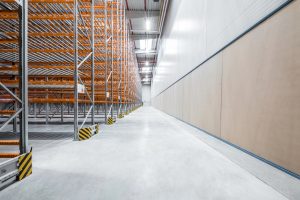
Urban warehouses have become an essential element of “last-mile logistics” in the largest Polish metropolitan areas, accounting for approximately 5 percent of the total logistics and industrial space in the country. Although this segment, totaling nearly 2 million sqm, offers real benefits in terms of delivery speed and labor availability, it remains a solution dedicated to specific business models rather than a universal alternative to large “big box” warehouse centers. It is most frequently used by courier companies, e-commerce, and distributors of fast-moving consumer goods (FMCG).
Urban warehouses are logistics facilities located within city limits, primarily serving the purpose of rapid distribution of goods to end customers – so-called last-mile logistics. Unlike traditional large-scale warehouse centers outside metropolitan areas, they offer smaller modules adapted to the specifics of urban deliveries and are a relatively new format on the Polish market. A strong, albeit short-lived, development impulse was provided by the turmoil associated with the outbreak of the Covid-19 pandemic, when a large number of new online stores were created and existing ones recorded record orders. A significant portion of trade shifted to the web at that time. In April 2020, online transactions accounted for approximately 11.9% of the total value of retail trade, while in February 2019 it was only 5.6%. Although e-commerce is currently stabilizing at the level of 9-10% of all purchases, the demand for urban warehouses has remained. According to JLL estimates, the total area of warehouses located within the administrative boundaries of the five largest metropolitan areas is over 4 million sqm. However, not all of them perform “urban” functions. It is estimated that warehouses actually responding to the needs of so-called city logistics total less than 2 million sqm, which is about 5% of all such space in Poland.
Largest tenant groups
Urban warehouses are primarily leased by logistics operators and courier companies, for whom the efficient execution of the “last mile”—delivering ordered goods to the end customer—is particularly important. Similar needs are shared by companies in the e-commerce, FMCG, and pharmaceutical sectors, which require quick access to their recipients—retail stores and medical facilities. Among other significant tenant groups, it is also worth mentioning industry distributors (e.g., power tools) serving customers in cities, as well as luxury and specialized goods retailers. Here, in turn, consumer purchasing power (generally high in large metropolitan areas) and access to employees with rare skills, who are harder to find in non-urban locations, are important.
Supply characteristics
What does the offer of urban warehouses look like for the aforementioned tenants? We can divide it into three groups. The first consists of older buildings from a bygone era, whose main (and sometimes only) advantage is their location in relative proximity to the center. The second consists of revitalized or converted older warehouse facilities. The third consists of new investments, designed from the beginning with urban logistics in mind. Often, due to the limited size of the plot, their area does not exceed 20,000 sqm, and the offered SBU (Small Business Units) modules range from 500 to 1,500 sqm, although there are proposals starting from as little as 300 sqm. It is worth noting here that owners of typical large-scale warehouses outside metropolitan areas rarely agree to lease space smaller than 3,000 sqm.
What else distinguishes urban warehouses from typical big boxes? – They usually have more loading docks adapted to smaller delivery vehicles, as HGV traffic in cities is subject to numerous restrictions. A significant feature of urban warehouses is also the availability of high-quality office space, as many companies work in a “office plus warehouse in one place” model. This provides additional savings in rental costs compared to offices in the city center, while ensuring a similar, high standard. – explains Karol Gajewski, Senior Consultant, Industrial Agency, JLL.
Furthermore, city logistics warehouse projects are increasingly tasked with fitting into the urban fabric. Common trends in “placemaking” and sustainable development are not limited only to residential or office properties. Today’s warehouses should put the needs of their users and ecology first. This is reflected in the growing share of various amenities within the warehouse park. In publicly accessible spaces, around collection points and showrooms, there are, among other things, bicycle parking, electric vehicle charging stations, and widely understood greenery.
Advantages and disadvantages – a comparison
What benefits do urban warehouses provide? First and foremost, a reduction in the time and distance of delivery to the end customer. Another benefit is operational flexibility, i.e., the ability to react quickly to changes in demand, as well as handling various delivery models (e.g., cargo bikes, vans, sometimes also personal pickups) and several sales channels simultaneously (B2B + e-commerce + quick commerce, a model focused on express product delivery, usually within 15-60 minutes of ordering). A significant advantage is also access to qualified employees, who are necessary for working with luxury or specialized goods. A location in relative proximity to the center means they can commute using public transport.
However, urban warehouses are not just about benefits. Their tenants must reckon with higher rental rates. For such facilities in Warsaw, these currently amount to approximately €5.5-8/sqm/month. For comparison, the cost of renting space just outside the capital is €4-5/sqm/month. For example, in Warsaw, the average size of new lease transactions since 2018 has been approx. 2,400 sqm (city), compared to 6,600 sqm in suburban locations. Operating costs and utilities are also higher (higher wages, waste disposal costs, more expensive electricity, water, utilities, and heating). Traffic jams or, conversely, restrictions on heavy vehicle traffic in cities can also be a nuisance. When making a decision about a warehouse location, it is also worth remembering the possibilities of potential expansion within the same facility—some logistics parks in cities may not provide such opportunities.
An interesting trend we have observed in recent years is the leasing of space in urban facilities to companies that do not conduct any warehouse activity there at all. These are all kinds of showrooms, playrooms, or indoor sports fields, such as padel, which has recently been gaining great popularity. – comments Ewa Graff, Senior Consultant, Industrial Agency, JLL.
Susceptibility to changes in “green” law
The urban warehouse sector in Poland will continue to develop as a specialized segment of the logistics real estate market, responding to the needs of last-mile logistics, e-commerce, and industries requiring quick access to end customers and a qualified workforce. In the coming years, modern, flexible city logistics facilities, designed with integration into the urban fabric, high-standard office space, and meeting sustainable development requirements in mind, will gain key importance. At the same time, due to higher rental and operating costs, limited expansion possibilities, and transport restrictions, urban warehouses do not constitute an optimal solution for companies operating on large volumes that require intensive heavy vehicle traffic.
It is also worth noting that the urban warehouse sector may be significantly affected by all kinds of legal changes related to the “Green Deal” and environmental issues. – Solutions related to sustainable development and environmental protection introduced by local authorities and companies themselves will likely cause some disruptions in existing supply chains. An increasing portion of distribution will be carried out by electric vehicles, which will further influence interest in small logistics facilities located in the city – explains Ewa Graff, Senior Consultant, Industrial Agency, JLL.
The introduction of clean transport zones would force companies to reorganize their supply chain—either through investments in zero-emission vehicles or by creating urban warehouses on the outskirts of such zones, enabling ecological distribution to the city center. – adds Karol Gajewski, Senior Consultant, Industrial Agency, JLL.
Urban warehouses will continue to be a niche but strategically important segment in Poland. Their development will be decided by the growth of online trade and the climate policy of cities. Companies will face a choice between higher rents for urban locations and increasing expenditures on transport from the outskirts and environmental restrictions.
Enterprises that invest early in urban warehouses will gain a competitive advantage in serving demanding consumers—this applies particularly to e-commerce operators and courier companies, for whom delivery speed is becoming a key success factor. In the future, it may turn out that other companies will be forced to reorganize their distribution models—either through investments in electric vehicles or by creating their own urban points.
Source: JLL