









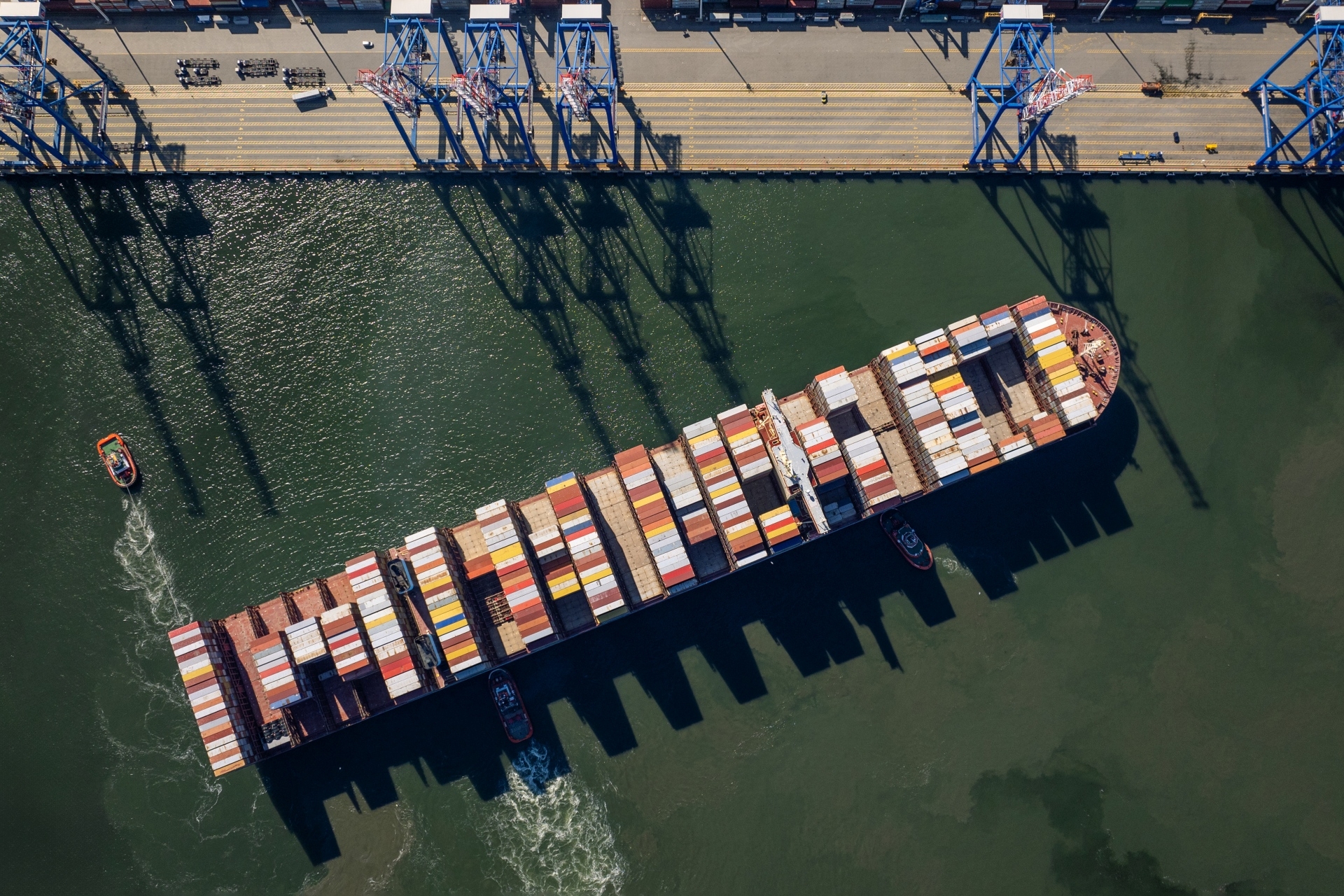
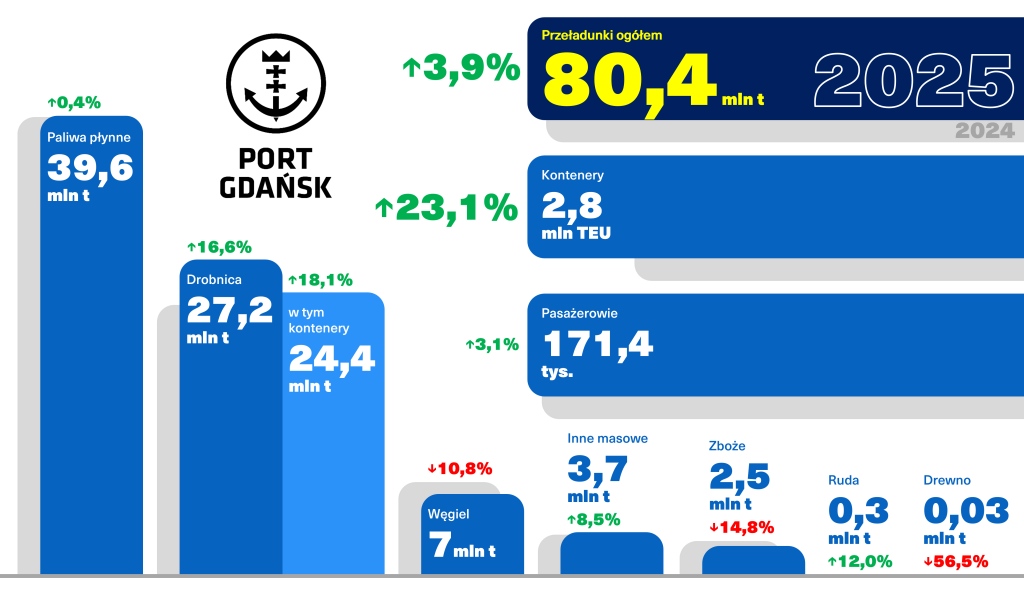
The Port of Gdańsk concluded 2025 with a very strong cargo handling performance, confirming a long-term upward trend. In 2025, a total of 80.4 million tonnes of cargo were handled at Poland’s largest seaport, representing an increase of nearly 4 percent compared to 2024, when the handling volume reached 77.4 million tonnes. This result clearly indicates that the Port of Gdańsk remains the most dynamically developing port in the region and a strategic transport hub for the markets of Central and Eastern Europe.
In 2025, a total of 4,394 vessels called at the Port of Gdańsk, an increase of 4.2 percent year-on-year. The number of commercial vessels reached 3,650, which is 2.5 percent more than in 2024. At the same time, the average GT of commercial vessels increased by 3.8 percent, indicating that the Port of Gdańsk is increasing the utilization of its deep-water infrastructure by handling increasingly larger vessels.
Liquid fuels maintain a dominant position
Liquid fuels constitute the largest group in the cargo structure of the Port of Gdańsk. In 2025, their handling reached 39.6 million tonnes (an increase of 0.4 percent compared to the previous year) and accounted for 49.3 percent of the total cargo handled by the Port of Gdańsk. Thus, it remains a key element of its operations and a vital link in the national energy security system. Handling of crude oil alone, carried out by Naftoport, amounted to 37.4 million tonnes, compared to 36.6 million tonnes the year before, which is the best result in the history of this terminal. Naftoport handled 379 crude oil tankers and 84 tankers with petroleum products, confirming its key role in securing energy raw material supplies for Poland and the region.
Containers as a growth engine
The second most important cargo group in 2025 was general cargo, which recorded one of the highest growth rates. Its volume increased from 23.3 million tonnes in 2024 to 27.2 million tonnes in 2025, an increase of 16.6 percent. The share of general cargo in total handling was 33.8 percent, confirming the growing importance of this cargo group for the further development of the port. The Port of Gdańsk achieved particularly good results in the container segment, which remains one of the main engines of its growth. In 2025, nearly 2.8 million TEU were handled in container terminals, an increase of 23 percent compared to the previous year, with the Baltic Hub Container Terminal alone accounting for 2,766,475 TEU. At the same time, the mass of containerized cargo increased by 18 percent, to 24 million tonnes. These data confirm the dynamic development of the Port of Gdańsk as a significant link in international maritime trade.
Divergent trends
In the dry bulk cargo group, there was a clear divergence in results. For the second consecutive year, coal handling decreased – by 10.8 percent compared to 2024, to a level of nearly 7 million tonnes. This is half the volume handled in 2022. The share of this raw material in the port’s cargo structure was 8.7 percent, confirming the systematically decreasing role of coal in our country’s energy mix.
The situation was different for ore, where handling increased by 12 percent, reaching 326.7 thousand tonnes. The category of other dry bulk cargo also recorded an increase of 8.5 percent, to 3.7 million tonnes.
Significant declines occurred in timber, where handling decreased by as much as 56.5 percent, to 31.2 thousand tonnes, as well as in grain, where the volume fell by 14.8 percent, to approx. 2.5 million tonnes.
In 2025, a decrease in handling was also recorded in the ro-ro segment. The volume of handled vehicles decreased by 15 percent, to 118 thousand units.
On the other hand, results in the passenger segment were positive. Last year, the Port of Gdańsk handled 171.4 thousand passengers, an increase of 3.1 percent compared to 2024. These data confirm stable interest in ferry connections and tourist traffic (266 ferry calls, 57 cruise ships).
The results achieved by the Port of Gdańsk in 2025 confirm the Port of Gdańsk’s ability to adapt and build resilience to changing conditions affecting international maritime trade and supply chains. The Port of Gdańsk Authority invests in port infrastructure in a sustainable manner and ensures cargo diversification. Our consistent actions contribute to strengthening the position of the Port of Gdańsk in the Baltic Sea region and in Europe, especially regarding the handling of liquid fuels and containerized general cargo. As a result of the actions taken, the Port of Gdańsk is positioned as one of the key transport hubs in Central and Eastern Europe, influencing its environment as a port prepared to handle the growing demand for specialized port services, in particular thanks to ongoing investment projects that create solid foundations for the further dynamic and pragmatic development of the port.
– emphasizes Dorota Pyć, President of the Port of Gdańsk.
Investments driving further development
The year 2025 also brought a significant investment impulse. Construction of the sixth liquid fuel handling berth began at Naftoport, which will be the second berth adapted to handle the world’s largest tankers, over 300 meters long and with a draft of up to 15 meters. Construction of an installation terminal for offshore wind farms, a floating FSRU gas terminal, and the expansion of quays in the Inner Port are also underway at the Port of Gdańsk. The year 2025 was also a time for finalizing key investments for the development of the Port of Gdańsk, including the construction of the T3 terminal at Baltic Hub and the expansion of the Bytomskie Quay.
Combining solid operational results with consistently implemented infrastructure investments strengthens the position of the Port of Gdańsk as one of the most important logistics hubs in the Baltic Sea region and a vital element of the European transport system.
Source: Port of Gdańsk Authority S.A.