









In the face of new legal obligations, rising costs, driver shortages, and increasingly complex supply chains, entrepreneurs are asking themselves: how can road transport be managed effectively today?
The beginning of 2026 clearly shows that existing management models for the TSL industry are reaching their limits. Digital twins of road transport may be the answer to these challenges. How do they work? Aleet, a technology company revolutionizing land transport management globally, provides the answers.
The start of the year in the EU brings further regulatory and operational changes to the road transport industry, increasing pressure on efficiency. From mid-2026, vehicles with a GVW of 2.5 to 3.5 tonnes performing international transport will be required to use smart tachographs. This is a significant change, especially for express and last-mile transport. At the same time, the latest EU statistics show that road transport still accounts for about 75 percent of all land freight transport in the EU. This means that the key challenge for companies will be answering the question: how to manage it more effectively under conditions of cost pressure, driver shortages, and growing operational complexity? Additionally, longer heavy-duty vehicle combinations of up to 25.25 m are being allowed on Polish roads as part of a pilot program. While this may increase transport efficiency, it also creates new challenges—changing route planning, fleet utilization, and operating costs. Given these changes, it is worth asking: where should one look for margins today, and what development decisions should be made in the long term?
Where to find margins and how to manage transport today?
The answer seems simple—margins can be “found” in highly advanced technologies. A road transport digital twin is the latest solution, available and already being implemented in Poland, as the first in Europe. It is a dynamic operational-economic model that replicates the actual performance of a fleet, transport processes, and costs, and then allows for simulation-based testing of decisions before they are implemented.
The biggest change in transport management using a digital twin is that we discuss transport with a full picture of the dependencies between costs, fleet utilization, and planning decisions, thanks to generating the best scenario out of thousands calculated. Importantly, this solution integrates with existing and any other systems, including TMS, and its implementation time is measured in weeks.
Thanks to this, digital transformation becomes realistic not only for the largest operators but also for medium-sized and, in the future, smaller transport companies, especially in the express delivery segment—says Dr. Katarzyna Marczuk, CEO of Aleet, a technology company and creator of the road transport digital twin.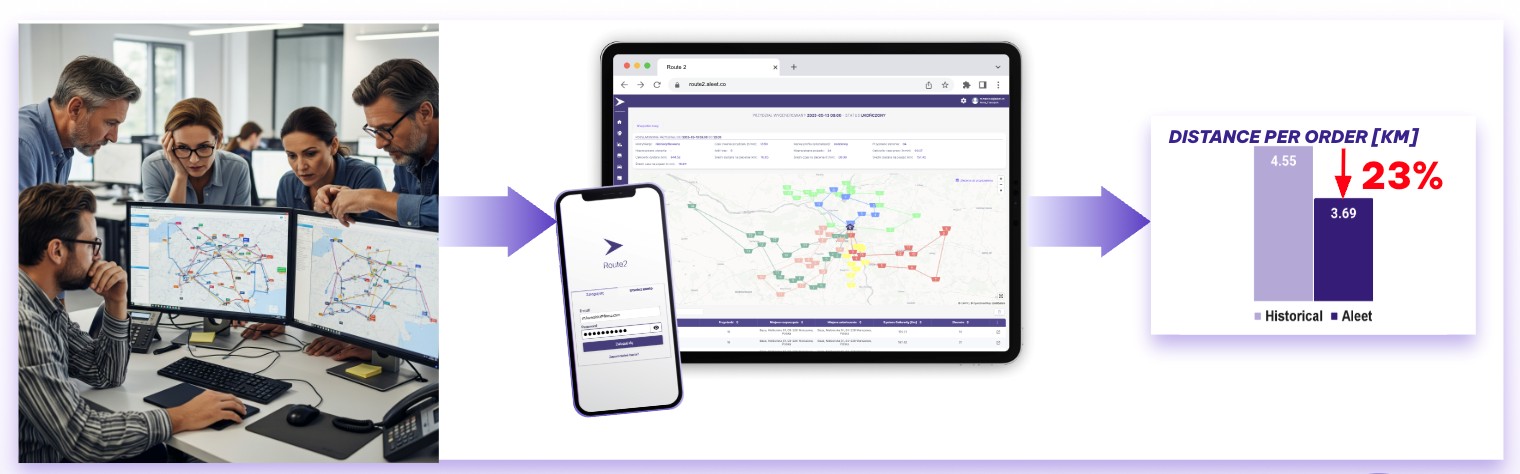
How does a road transport digital twin work and how much does it cost – a case study
Implementing a digital twin does not require huge financial outlays or a revolution in IT infrastructure. Practically every medium and large transport company, regardless of fleet size, can implement it. A digital twin is an investment that pays off quickly. That is why both road carriers and courier companies are turning to it. And the return on this investment and the margin result from, among other things, reducing empty runs, better matching orders to the available fleet and drivers, and cost transparency at the route and customer level. In courier and last-mile services, the greatest value comes from the strategy of staffing regions, time windows, delivery priorities, and the impact of volume changes on fleet utilization and service quality. In practice, an investment in a digital twin usually pays for itself within 3 to 6 months, and in cases of large-scale operations or high costs of empty runs, even within 1 to 2 months.
The process of creating a digital twin begins with collecting data, e.g., information on order fulfillment, driver working hours, cost structure, etc. Based on this, a model is built, which is then adjusted to the specifics of a given organization—type of routes, customer profile, operational and regulatory constraints, etc. The next step is to define business goals, such as reducing empty runs, better fleet utilization, or cost stabilization. Then, AI algorithms analyze thousands of operational scenarios in real-world conditions and indicate those that best achieve the set goals. Without costs and without risk.
– explains Jan Białas, Head of Product at Aleet.
An example is a road transport carrier/operator that simultaneously handles 3 large contracts: a retail chain (many points, high pressure on deadlines), a manufacturer (fewer points, but long loading times), and e-commerce (large fluctuations in orders).
Until now, planning was based on the dispatcher’s “experience,” and costs were settled collectively. The digital twin covered three variants in its simulation:
- maintaining the current fleet division,
- dedicating some vehicles to the most unstable customer,
- shifting some volumes to other time windows and changing the loading sequence. The system showed that one of the contracts was “eating up” the margin through expensive overtime and empty return runs.
After implementing the recommended scenario, the company reduced empty kilometers, improved driver utilization within working hours, and regained profitability at the level of individual routes and customers.
Another example is the dilemma: buy or rent additional vehicles before the season. In the November-December period, the company considered renting additional vehicles but was afraid it would not be able to cover the costs if there were not enough loads. The digital twin allowed for safely testing scenarios with volume fluctuations of +10% to +20%, with different fuel rates, driver availability, working time restrictions, and variants with subcontractors. The simulation result indicated at what point it is more profitable to strengthen the fleet and at what point it is better to change the route structure (e.g., consolidation) and limit empty runs. Thanks to this, the decision was not intuitive but based on transparent costs and risks, without affecting current contracts.
The benefits are measurable. A digital twin enables the safe testing of hundreds of operational decisions without financial risk or errors, in order to choose the most effective solution. This means a real chance to reduce costs by up to 30 percent and increase profits by several dozen percent. In the face of new regulations, the continued dominance of road transport, and growing operational complexity, digital twins, just as in warehouses, are becoming a tool in road transport that allows carriers to move from reacting to problems to designing transport in a predictable, data-driven, and market-resilient way.
Source: Aleet