









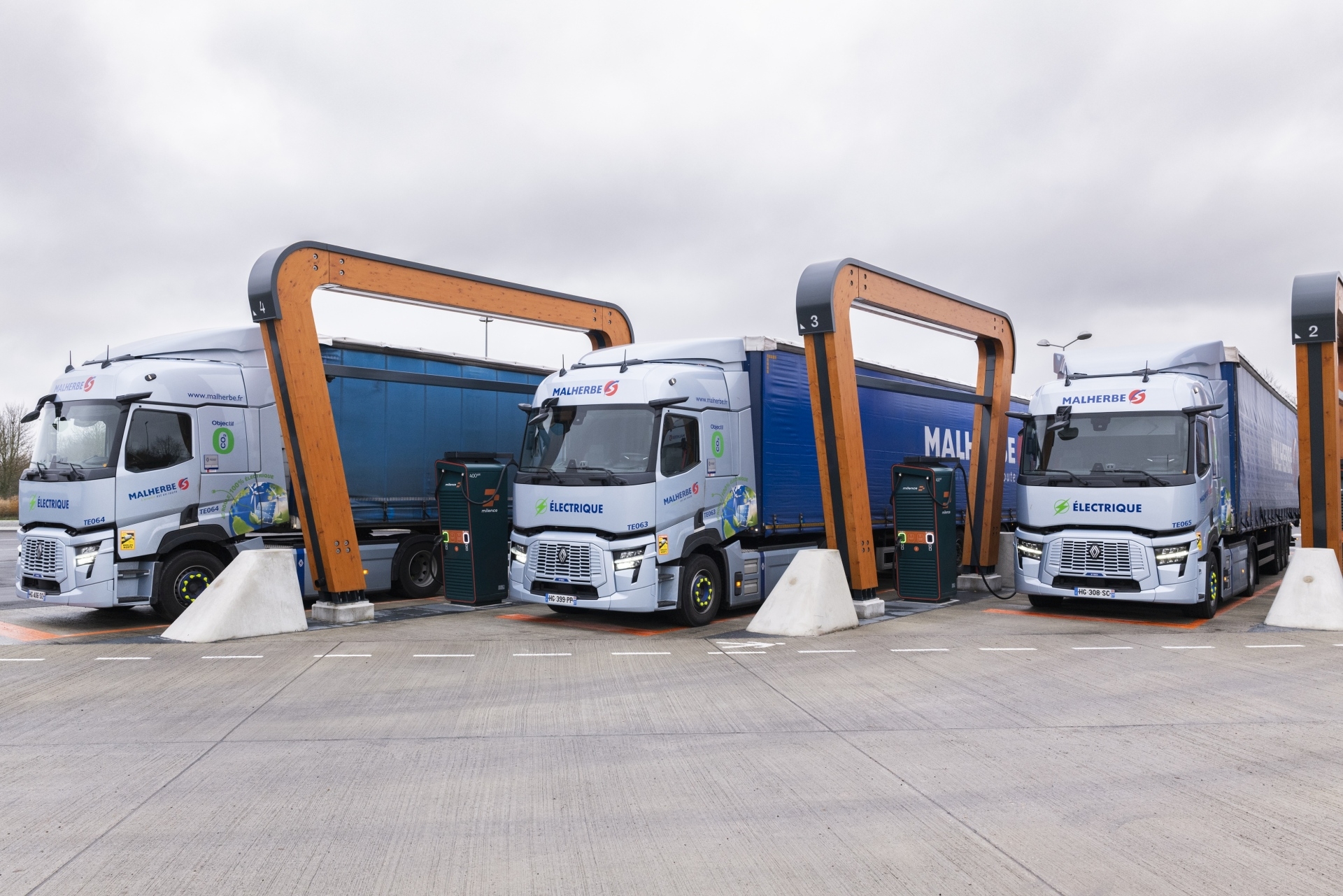
A year after decarbonizing transport between its Lyon and Bourg-en-Bresse plants, Renault Trucks is taking another step in the electrification of its internal logistics. In collaboration with the carrier Malherbe, the manufacturer is working on implementing an electric corridor for transporting cabs, engines, and axles between its facilities.
The Renault Trucks logistics corridor connecting Blainville-sur-Orne (Calvados), Bourg-en-Bresse (Ain), and Lyon (Rhône) operates according to a “just-in-time” methodology and handles continuous parts deliveries to assembly lines based on demand:
- Cabs for heavy-duty vehicles produced in Blainville-sur-Orne are transported to Bourg-en-Bresse for assembly.
- Engines and axles produced at the Lyon plants are transported to Blainville-sur-Orne for assembly in medium-duty trucks.
This strategic logistics process is now almost 100% handled by electric trucks.
A relay consisting of 22 Renault Trucks T E-Tech vehicles
To reduce carbon emissions in the transport of cabs for heavy-duty vehicles and engines and axles for medium-duty vehicles, Renault Trucks and Malherbe have organized a fleet of 22 electric Renault Trucks T E-Tech trucks:
- 11 vehicles on the northern loop (Blainville – Vironvay – Auxerre and back)
- 11 vehicles on the southern loop (Auxerre – Mâcon – Bourg-en-Bresse – Lyon
and back)
By scheduling several stops (to swap tractors, drivers, and trailers), each truck covers a daily distance of 810 km on the northern loop and 704 km on the southern loop. The system allows for long-distance travel without the need to stop the cargo.
Transport continuity through meticulous detail
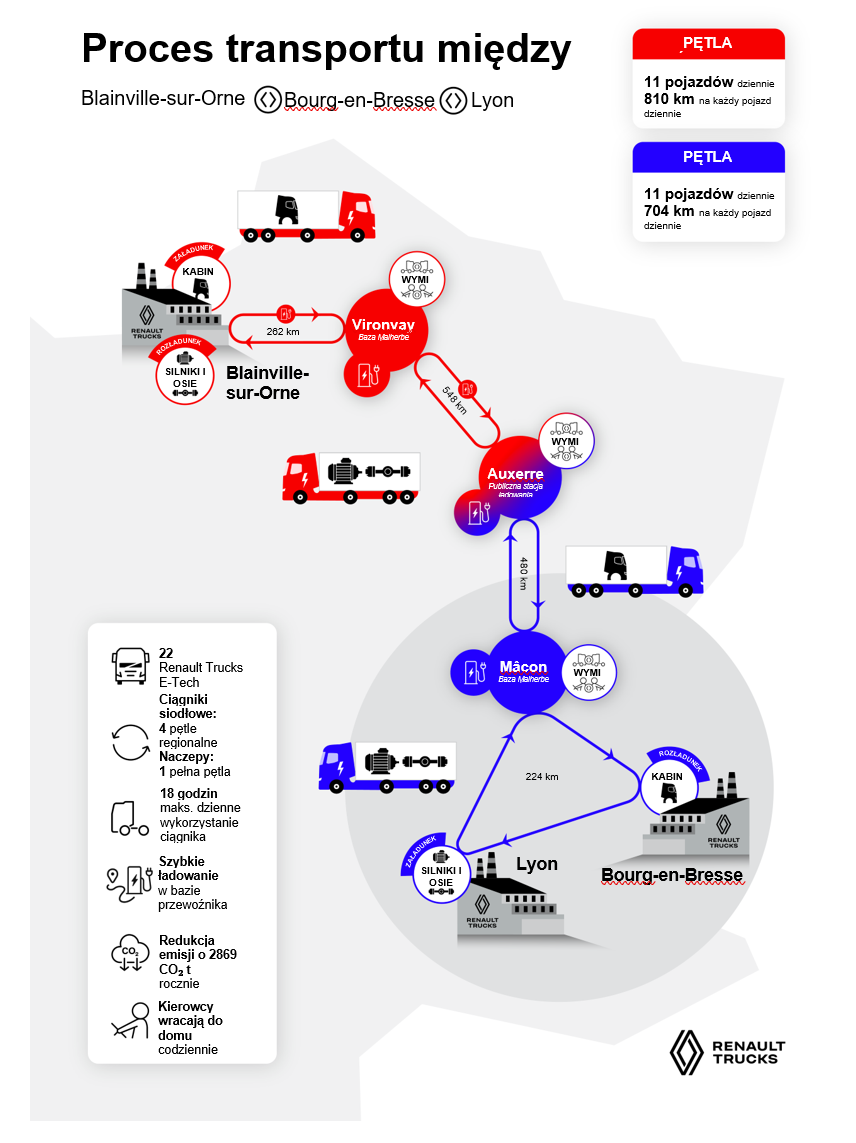
The system is based on four driver loops, four electric tractor loops, and one full loop for the cargo (cabs one way, engines and axles the other way):
- Electric trucks depart from the Malherbe base in Vironvay and deliver engines and axles from the Lyon factories to the Renault Trucks factory in Blainville-sur-Orne.
- They depart from the factory loaded with cabs. In Vironvay, Auxerre, and Mâcon, electric tractors and drivers are swapped to maintain transport continuity.
- Batteries are charged at each stage during driver rest breaks, thanks to Malherbe investing in its own charging stations at strategic points along the corridor.
- The vehicles reach Bourg-en-Bresse and then return to Lyon, where the trailers are loaded with engines and axles, and the process repeats.
All stages have been planned to maximize vehicle usage time (up to 18 hours a day) and ensure drivers can return home, making the job more attractive to potential candidates.
The 100% electrification of this key process is proof of the reliability and maturity of the Renault Trucks electric vehicle offering and has allowed for a reduction in annual CO₂ emissions by 2,869 tons.
Source: Renault Trucks