









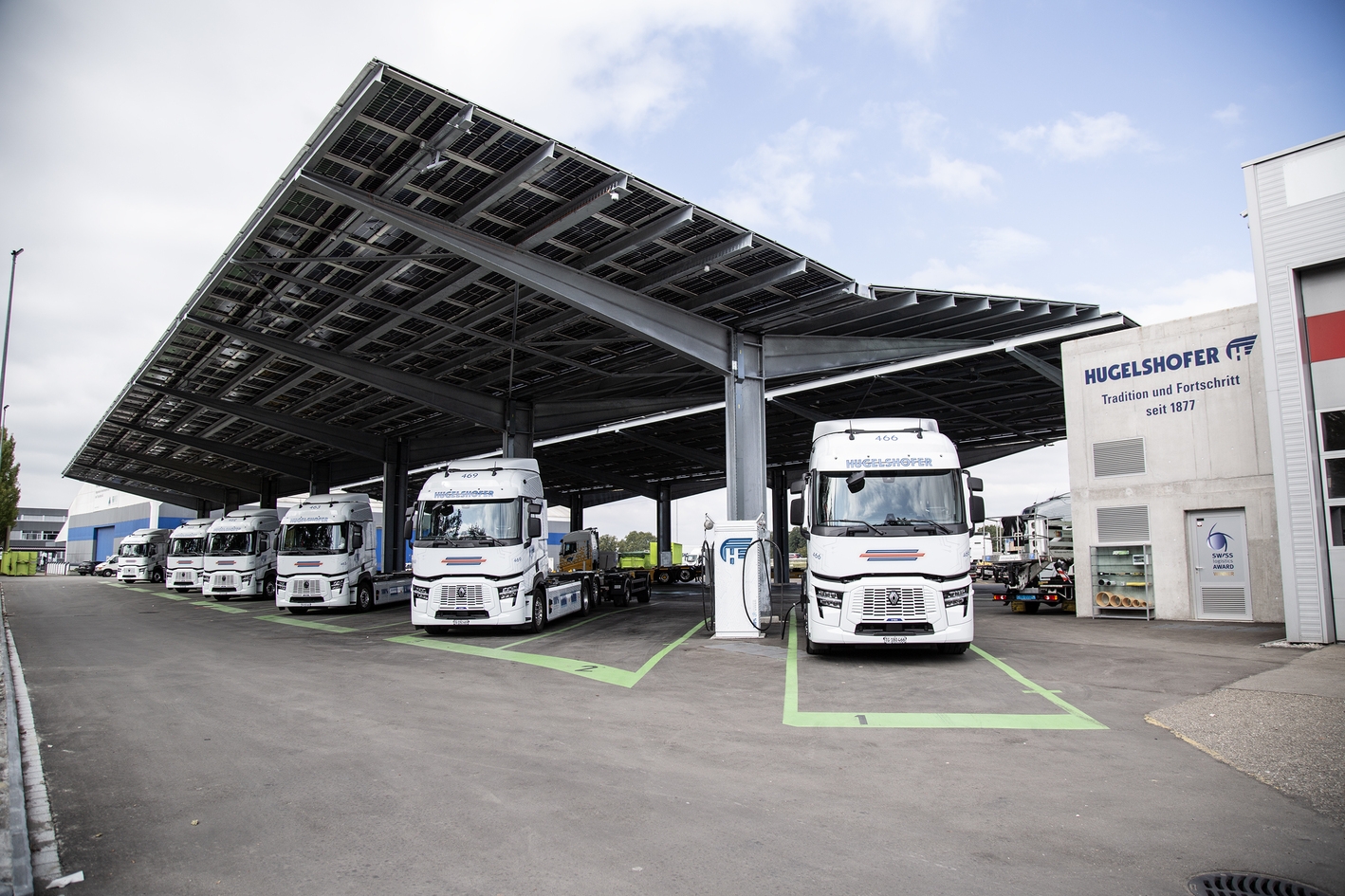
A Renault Trucks T E-Tech vehicle with a nominal range of 300 km has covered over 1000 km in a single day. The example of the Swiss transport company Hugelshofer Logistik shows that the efficiency of electric trucks depends on the overall operational strategy, not just battery capacity.
The key issue is not the maximum range of the truck, but how it is integrated into transport operations. By adjusting routes and charging strategy, we are able to maximize the daily operating time of our electric trucks, making them a real asset for the industry, perfectly adapted to our business. – explains Martin Lörtscher, CEO of Hugelshofer Logistik AG.
Logistical operability designed for maximum utilization of electric vehicles
Hugelshofer has a fleet of 220 trucks, including 80 electric trucks. A total of 150 drivers employed by the company use electric trucks on a daily basis.
To maximize the uptime of their electric trucks and thus optimize the Total Cost of Ownership (TCO), the Swiss transport company Hugelshofer Logistik uses double-manned crews in their Renault Trucks T E-Tech vehicles. Drivers perform intermediate charging during mandatory rest breaks, and full charging takes place at night at the depot. Thanks to this approach, each electric truck can cover over 600 km in a typical working day, despite a nominal range of 300 km.
The record holder is one of the Renault Trucks T E-Tech vehicles belonging to the Swiss operator’s fleet, which covered as much as 1007 km in 24 hours. These results show that intensive use is entirely possible when the purpose, area of operation, and charging strategy are clearly defined. They also highlight the importance of correctly selecting battery capacity – depending on the application, it is not always necessary to choose the maximum available capacity, as it can be adjusted to maintain payload and efficiency. Therefore, Renault Trucks works closely with its customers to determine the most appropriate configuration, in accordance with their constraints and actual operational needs.
Charging infrastructure that increases operability
The performance of Hugelshofer’s Renault Trucks T E-Tech vehicles depends in particular on an optimized charging infrastructure. At its headquarters in Frauenfeld, the carrier has installed 30 fast-charging stations with a maximum power of 480 kW, capable of charging up to 100 trucks per day. This infrastructure is supported by a photovoltaic system that generates 1.2 million kWh annually, and three transformers ensure grid stability. As a result, 95% of charging now takes place directly at the base, which ensures cost control, operational reliability, and smooth daily operations.
Switzerland – favorable conditions for the electrification of heavy-duty vehicles
Hugelshofer Logistik achieves operating costs for its electric trucks that are about 30% lower than those of comparable diesel-powered vehicles. These results are due to the carrier’s strategic and operational decisions,
but they are also possible thanks to Swiss regulatory standards that favor the electrification of trucks.
In Switzerland, zero-emission trucks benefit from significant exemptions under the LSVA road tax, making electric vehicles economically competitive compared to conventional vehicles. At the same time, the Swiss Confederation has announced a 20 million Swiss franc investment program for 2026–2030 regarding the implementation of charging infrastructure for trucks.
The Swiss model is particularly favorable to the electrification of heavy trucks – in the first eleven months of 2025, Switzerland recorded an electrification rate of 14.7% for vehicles over 16 tons, which is almost eight times higher than the European average of 1.9%.
For Renault Trucks, electromobility is a key factor in achieving the goals of decarbonizing road freight transport. The example of Switzerland shows that the transition to electric trucks can accelerate when vehicles, infrastructure, organization, and public policy go hand in hand. European countries should therefore draw inspiration from this model to create the conditions necessary for large-scale electrification.
Source: Renault Trucks