









In discussions regarding the CPK, and more recently “Port Polska”, impressive numbers are appearing. Tens of billions in investments, thousands of kilometers of new lines, and record travel times between the largest cities. This captures the imagination. However, the future of the project will not be decided in the cabins of high-speed trains or in the departure terminal. It will be decided much closer to the homes of ordinary people, at a bus stop in a small town and at a small railway station. Without efficient access and a refined last-mile model, the entire architecture of the port will remain a system designed not for the citizens, but alongside them.
Lower Silesia, a region that in theory should be one of the greatest beneficiaries of the project, is a particularly instructive example here. Vast, in many places still devoid of rail, consisting of hundreds of towns of varying sizes and development dynamics. It is nearly 20,000 square kilometers full of differences that are difficult to ignore. As the analysis of transport connections shows, a large part of the residents will in practice only be able to reach a high-speed rail (HSR) station or the airport thanks to an efficiently organized bus network that would allow them to reach the railway stations scattered across the province. This role is crucial, yet often underestimated in the debate. Railway infrastructure alone is not enough. Without plannable access from smaller towns, high-speed rail will become a solution only for residents of large urban centers.
European mobility studies add a general dimension to this. As many as 83 percent of EU citizens believe that transport connections between regions need improvement. 77 percent declare that they would willingly choose a high-speed train instead of a plane, provided that the entire transfer system were coherent, predictable, and sufficiently dense. This is important – it is not about the train itself, but about access to it. Studies and reports on high-speed rail clearly show that modal shift does not happen in a vacuum. It must be accompanied by complete feeder infrastructure, integrated tickets, and a unified passenger information system.
Without these elements, high-speed rail remains an impressive artery, but one disconnected from reality.
This is best seen in the example of Heathrow, an airport that in a sense resembles a transport organism more than an airport. It is there that the largest bus station in the UK was built, handling over 1,600 departures daily and serving passengers heading to over a thousand towns. Heathrow has an impressive number of routes and openly publishes data on how many passengers actually use buses. This is about 13 percent of all travelers, which translates to 10–11 million people annually. A number that exceeds the traffic of some airports operating on the Old Continent. The airport also records a dynamic increase in the importance of buses in the late evening and early morning hours, as evidenced by a more than 100 percent increase in the number of arrivals after 11 PM and before 4 AM between 2021 and 2023. These data are not a curiosity. They show that even in a country with a developed metro and rail network, the bus remains the foundation of accessibility.
Frankfurt operates on a different model, but the conclusions are equally interesting. The airport, serving over 60 million passengers annually, is primarily a huge transfer hub. More than half of the journeys there take place “without going to the surface”. At the same time, thanks to its regional and long-distance railway station, it is a model example of air-rail integration. Frankfurt does not currently publish precise modal split data breaking down ground traffic into bus, rail, car, and taxi. However, available European analyses suggest that a hub with such a strong rail offer and dominated by transit passengers naturally generates a lower share of buses than Heathrow. But it is precisely the contrast between these two models that is key. Heathrow shows the function of the bus where rail is poorer. Frankfurt shows the function of the rail where it is strongest. In both cases, the hub works because the entire access system is designed and coordinated.
Poland is still facing the question of what role bus transport is to play in serving “Port Polska”. And this answer should come quickly, because without it, it is easy to fall into the trap of investing only in the most spectacular elements of infrastructure. What is most lacking today is a clear, nationwide concept for a bus network tailored to HSR stations and the airport. Not a rough sketch, but a concrete indication of which districts are to be connected to the stations, with what frequency, how they are to be contracted, and how they are to be integrated with the railway passenger information system. There is also a lack of a single data standard that would allow for trip planning from the front door to the departure terminal. Without such consistency, fragmented solutions will emerge, dependent on local decisions or the entrepreneurship of carriers and susceptible to sudden changes. And this, in turn, threatens the creation of new, even more severe “white spots” on the country’s map.
The most serious risk concerns transport exclusion. If buses are missing or operate irregularly, a large part of Poland will not only fail to benefit from the CPK, but will actually find itself even further from the main axis of mobility than it is today. From the perspective of a passenger from a small town, the ability to reach an HSR station is a basic condition. Without it, the port will become an elite project existing mainly for cities that already have rail or for citizens who can afford to travel by car. And yet, the idea of this investment was to open up the country, not to further segment it.
The true symbol of the success of “Port Polska” will therefore not be trains reaching 250 km/h or an impressive terminal. The symbol will be a bus stop in a small town from which buses depart daily towards the HSR station. Running reliably, regularly, and in a coherent, integrated system. Heathrow and Frankfurt teach us that accessibility begins much earlier than at the security checkpoint. Poland has a chance to build a modern transport hub.
The condition is that it must be accessible not from the perspective of satellite photos showing the scale of the project, but from the perspective of a resident of a village or a small town.
It is from that perspective that it will be decided who will actually reach the port.
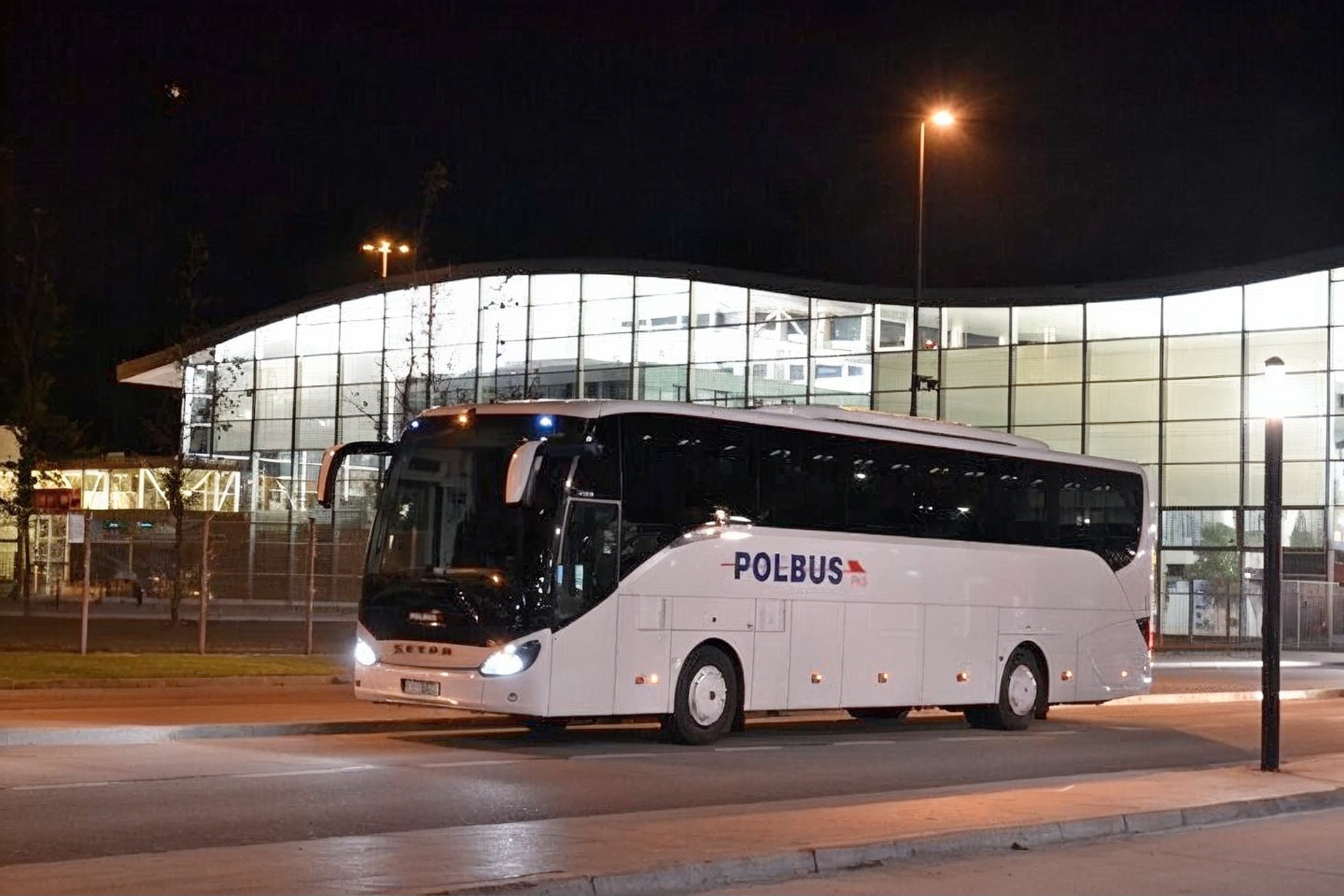
Source: Polbus-PKS sp. z o.o.