








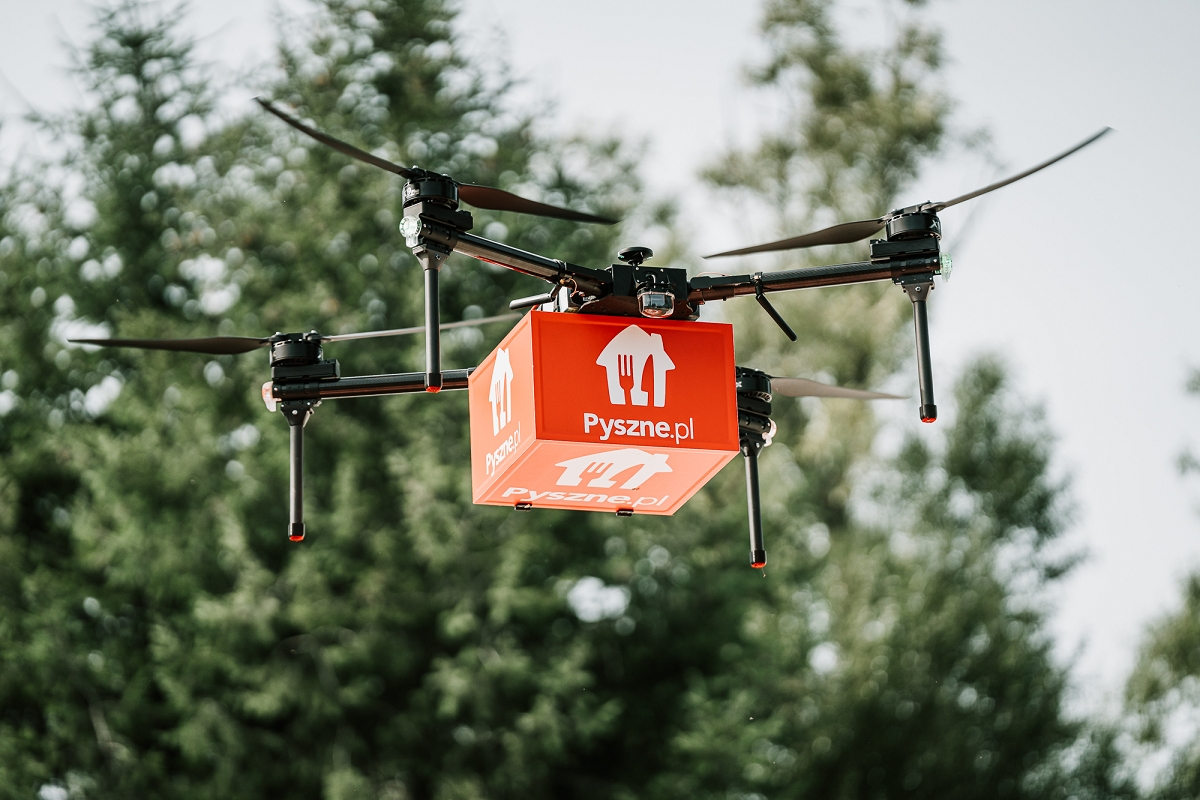
Autonomous vehicle fleets, pizza drones flying over meadows, zero-emission deliveries, or logistics fully integrated into the “smart city” fabric. And in all of this, the courier as an operator of an intelligent logistics network. This is not a science-fiction movie script, but a real vision for the next 15 years. In the latest “Future of Delivery” report, Pyszne.pl, together with experts, predicts a revolution that will forever change the way we receive food and shopping.
The demand for “here and now” deliveries is growing at a rapid pace. According to the World Economic Forum, the demand for last-mile services will increase by 78% by 2030. Consumers, accustomed to convenience, expect everything that fits in a backpack – from hot pizza, through medicines, a gaming laptop, to a new pair of shoes – to reach them within a few dozen minutes, not several hours. How to meet these expectations without paralyzing cities and harming the planet?
Pyszne.pl seeks answers to this question in the “Future of Delivery” report, prepared in cooperation with Prof. Arkadiusz Kawa from the Poznań University of Economics and Business. The analysis looks 5, 10, and 15 years into the future, identifying key technological, demographic, and social trends that will define the future of door-to-door delivery logistics.
In recent years, there has been a dynamic increase in demand for “on-demand” deliveries. Consumers who have access to music or movies here and now increasingly expect not only a wide selection of physical products but also their fast, or even immediate, delivery.
– says Dr. hab. Arkadiusz Kawa, professor at the Poznań University of Economics and Business.
This change is a challenge that Pyszne.pl perceives not as a barrier, but as a driving force for innovation and a natural stage in the sector’s evolution.
As a leader and pioneer of the delivery market in Poland, we feel responsible not only for responding to changes but for actively shaping them. 15 years ago, we co-created this market from scratch in Poland. Today, we look to the future to understand how to reconcile the growing appetite for convenience with the idea of sustainable development and a smart city – says Arkadiusz Krupicz, Managing Director and co-founder of Pyszne.pl.
– This report is our contribution to the discussion about the future of logistics.
2030: electrification and mass-scale optimization
As Prof. Kawa predicts, the coming years will be marked by the consolidation of current trends. The q-commerce market in Poland will consolidate, and same-day delivery will become increasingly popular, even outside the largest metropolitan areas. Technology will be the key to handling the growing volume of orders.
- Intelligent optimization: Artificial intelligence will become the brain of logistics operations, planning routes in real-time, combining orders, and predicting demand to minimize empty runs.
- Green fleet: By 2030, up to 45% of last-mile deliveries in large cities will be carried out by light electric vehicles (including delivery vans and e-cargo bikes). This is the result of rapid technological development and a response to increasingly restrictive clean transport zones.
- Micro-hubs and “ship-from-store” model: City centers will fill up with small, local warehouses from which couriers will deliver parcels over short distances. At the same time, brick-and-mortar stores will themselves become mini-logistics centers, fulfilling online orders from local outlets.
At Pyszne.pl, we don’t wait for the future – we are actively testing it. As pioneers of new technologies in Polish conditions, we approach them pragmatically. Our tests of an autonomous robot in Warsaw and Katowice and drone tests over Lake Zegrze showed one thing: the technology is ready, the problem lies in the regulatory and infrastructural environment.The robot proved that it can support couriers over short distances during peak hours, and the drone showed the potential for deliveries to hard-to-reach places, such as beaches or recreational areas. This is not a replacement for a human, but their support. We are ready for an autonomous revolution, but we know that in addition to technology, a legal ecosystem and social change are needed, which we want to co-create.
– comments Robert Schmidt, Country Manager Logistics Poland at Pyszne.pl.
10-year perspective (until 2035): Courier-robot enters cities
In this decade, automation will cease to be a curiosity and will become an everyday occurrence. According to Prof. Kawa, the reason will be rising labor costs and demographic changes, i.e., an aging society and an increasing number of single-person households. As a result, robots and drones will be used more and more frequently in deliveries to customers.
The vision of a swarm of autonomous robots and drones that will completely replace humans is still distant. In a 10-15 year perspective, synergy will be key. Robots will take over repetitive, tedious tasks, such as transport over longer distances, freeing up human potential for handling more complex, non-standard deliveries and customer interaction.
– adds Prof. Kawa.
- Autonomous deliverers: Small, self-steering robots moving on sidewalks will become a common sight in densely populated districts, delivering food, shopping, and smaller parcels.
- Drones in the suburbs: Drone deliveries will enter regular use in suburban areas and hard-to-reach regions, bypassing traffic jams and delivering urgent parcels in a dozen or so minutes.
- Hyper-personalization and subscriptions: An intelligent refrigerator will order missing milk itself, and our home voice assistant will replenish dog food supplies. Deliveries will become fully integrated with the smart home device ecosystem.
Last-mile logistics is a global challenge that requires a holistic view. Observing the markets where Just Eat Takeaway.com is present, we see that the future belongs to integrated systems, where technology combines with intelligent urban planning and an understanding of demographic needs.
– explains Magdalena Stępniak, Senior Director Southern Europe & Israel / Delivery Logistics at Just Eat Takeaway.com.
Demographic changes will also have an increasing impact on the market
The growing population of seniors, the so-called “silver economy”, will create huge demand for the delivery of medicines and shopping with additional services, such as carrying in or unpacking. In turn, an army of singles will drive the market for ready-made meals and small, frequent orders. Our task is to build operational models that are flexible and scalable, but also to cooperate with cities, local governments, non-governmental organizations, and local authorities to jointly create infrastructure: from dedicated parking spaces and micro-hubs to regulations for drones and autonomous vehicles.
– adds Magdalena Stępniak
15-year perspective (until 2040): Fully integrated, zero-emission “smart city”
Although looking 15 years ahead seems like forecasting straight out of science fiction, time flies fast. Today we are closer to 2040 than to 2010, which seems to be the not-so-distant past. As Prof. Kawa notes, in 15 years we should enter an era in which logistics becomes a process that should intelligently support the urban fabric. Subsequent greenhouse gas emission regulations will put pressure on delivery companies to switch to a zero-emission fleet. To handle a several-fold higher volume of parcels without traffic paralysis, a complete reconstruction of the system will be necessary.
- Climate neutrality: The entire delivery fleet will be zero-emission – fully electric with elements of hydrogen vehicles.
- Convoys of delivery vehicles and multi-level traffic: Deliveries between districts may take place at night using autonomous vehicles moving in convoys in dedicated lanes, or even in underground tunnels.
- New role of the courier: Humans will not disappear from the system. Their role will evolve towards an operator and controller of an autonomous vehicle fleet. Couriers will intervene in problematic situations and handle deliveries requiring human contact.
The future of fast deliveries is a fascinating journey from optimization, through robotization, to full autonomy within an intelligent and ecological urban fabric. The biggest challenge will remain achieving a balance between speed and sustainable development. The road to this future begins today, and dialogue between business, local governments, and the consumer community is the key to its success.
Report in abbreviated version HERE. Report in full version HERE.
Source: Pyszne.pl / Just Eat Takeaway.com