









The year 2025 has been marked by significant challenges for the TSL industry in Poland. According to market analyses, the entire sector is currently in a stabilization phase with limited momentum. It is not generating clear growth, but it is also not recording further deepening declines. Although the end of the year brought a seasonal recovery, the overall condition of the industry remains weaker than in previous years.
In this demanding environment, DKV Mobility, a leading B2B platform for payments and road transport solutions, is consistently expanding its offer with new, advanced digital tools and supporting carriers in adapting to dynamically changing laws and market realities.
TSL 2025: volumes down, debt up
- Key market indicators confirm that 2025 brought numerous turbulences to the transport industry.
- Employment in transport fell from 10.29% in January 2024 to 10.10% in mid-2025, signaling a cooling of the labor market (according to data from the Polish Development Fund).
- Road transport volumes in the first half of 2025 decreased by as much as 13.4% year-on-year, confirming the further deepening of declines (according to data from Statistics Poland).
- In the first quarter of 2025, the industry recorded further declines, including in road transport by -14.4% (according to data from Statistics Poland).
- The debt of TSL companies reached 16.4 billion PLN, which is one of the highest results in history (according to data from the National Debt Register).
This year has shown how difficult it is to conduct transport operations in an environment of rising costs, declining volumes, and unprecedented sector debt. Carriers today operate in conditions that require high operational efficiency while simultaneously rapidly implementing digital tools and process automation. The year 2025 was a time of intensive digitalization of services and strengthening of toll interoperability for DKV Mobility. New solutions such as DKV TMS or DKV Fleet Management Software, as well as the launch of the EETS system in the Czech Republic, make life easier for drivers and fleet managers.
– says Anna Biekionis, Country Manager DKV Mobility
In 2025, DKV Mobility expanded its offer with two key digital tools: DKV Transport Management Software (DKV TMS) and DKV Fleet Management Software (DKV FMS). The TMS-type system allows companies to centrally manage transport orders, monitor routes, and better utilize the fleet, and thanks to full integration with DKV Cockpit and the DKV app, it streamlines the entire chain of operations from planning to settlement.
DKV Mobility strengthens its digital offer: DKV TMS and DKV FMS
DKV FMS, in turn, provides a single platform for managing vehicles, drivers, and documentation, offering automatic reminders for inspections, checks, and cost accounting. The tool supports companies in meeting compliance requirements and is constantly being developed with new features.
Czech Republic: tolls in the EETS system available from October 2025
A significant event of 2025 was the launch of support for Czech tolls by DKV Mobility within the European Electronic Toll Service (EETS). Thanks to this, Polish carriers can use a single on-board unit in many countries, manage payments more easily, and increase operational efficiency during international trips.
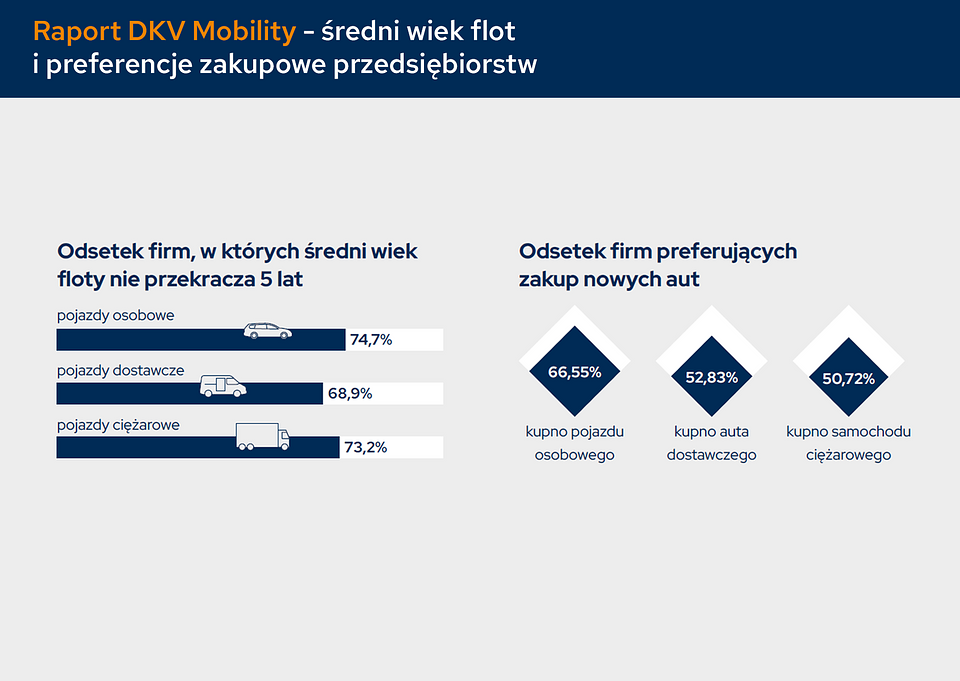 DKV Mobility report “Business challenges for truck and passenger fleets in Poland”
Legislative challenges 2026: digitalization, emissions, and tightened controls
The next two years will bring an exceptionally intense period of legal changes for the industry. From 2026, the transport sector will be covered by the ETS2 system, under which companies will be required to monitor and report vehicle emissions, which is preparation for purchasing allowances from 2027. In parallel, the EU’s ICS2 system will become fully operational, tightening security control obligations for shipments and requiring full integration of TMS and ERP systems.
In 2026, the preparatory phase for the implementation of electronic transport documents compliant with eFTI regulations will also begin, which will force logistics companies and carriers to invest in certified IT platforms. Additionally, the industry faces further consequences of the Mobility Package, including new rules for posting drivers, higher reputational requirements, the obligation for G2V2 tachographs, and full operational status of the SENT system with tightened control of sensitive goods transport. All this means that 2026 will be a time of intensive digitalization for carriers and the necessity to precisely adapt operational procedures to evolving regulatory frameworks.
DKV Mobility serves approximately 425,000 active customers in over 50 countries across Europe, employing approximately 2,800 people. We are a leading B2B platform for drivers, with a history of development spanning over 90 years. We offer access to one of the largest acceptance networks in Europe, covering approximately 73,000 fuel stations (including 6,000 in Poland), 1 million electric vehicle charging points (including 11,000 in Poland), and 25,000 alternative fuel stations (including 4,300 in Poland). DKV Mobility is also a leading provider of toll solutions and VAT refund services. In 2024, we generated a transaction volume of 19 billion euros and revenues of 839 million euros. Our goal is to support the transformation towards an efficient and sustainable future of mobility.
Source: DKV Mobility