









The government has confirmed the average projected salary, which will amount to PLN 9,420 in 2026. This is important information for the transport industry, as it is this amount that is most often used to calculate ZUS (social security) contributions for drivers performing international transport. For entrepreneurs operating under persistent financial pressure, this means another noticeable increase in costs. In practice, this could increase monthly expenses per driver by as much as several hundred zlotys.
The value of the average projected driver salary, which appeared in the draft law a few months ago, has been officially confirmed by the Ministry. Compared to 2025, the amount has increased by PLN 747, which directly translates into higher social and health insurance contributions. For carriers settling drivers’ pay in accordance with the new mobility package regulations, this is another stage in a process that has been consistently increasing employment costs for several years.
How will the cost of employing a driver change?
The increase in the base for calculating contributions means an increase in ZUS charges alone by PLN 313 per month. However, this is only the first element of the cost puzzle. In international transport, a remuneration model where the employer guarantees the driver a specific net amount is very common. In such a case, the entrepreneur fully covers the rising contribution burdens and the higher advance income tax payment. In practice, raising the average projected salary automatically increases the total cost of one full-time position.
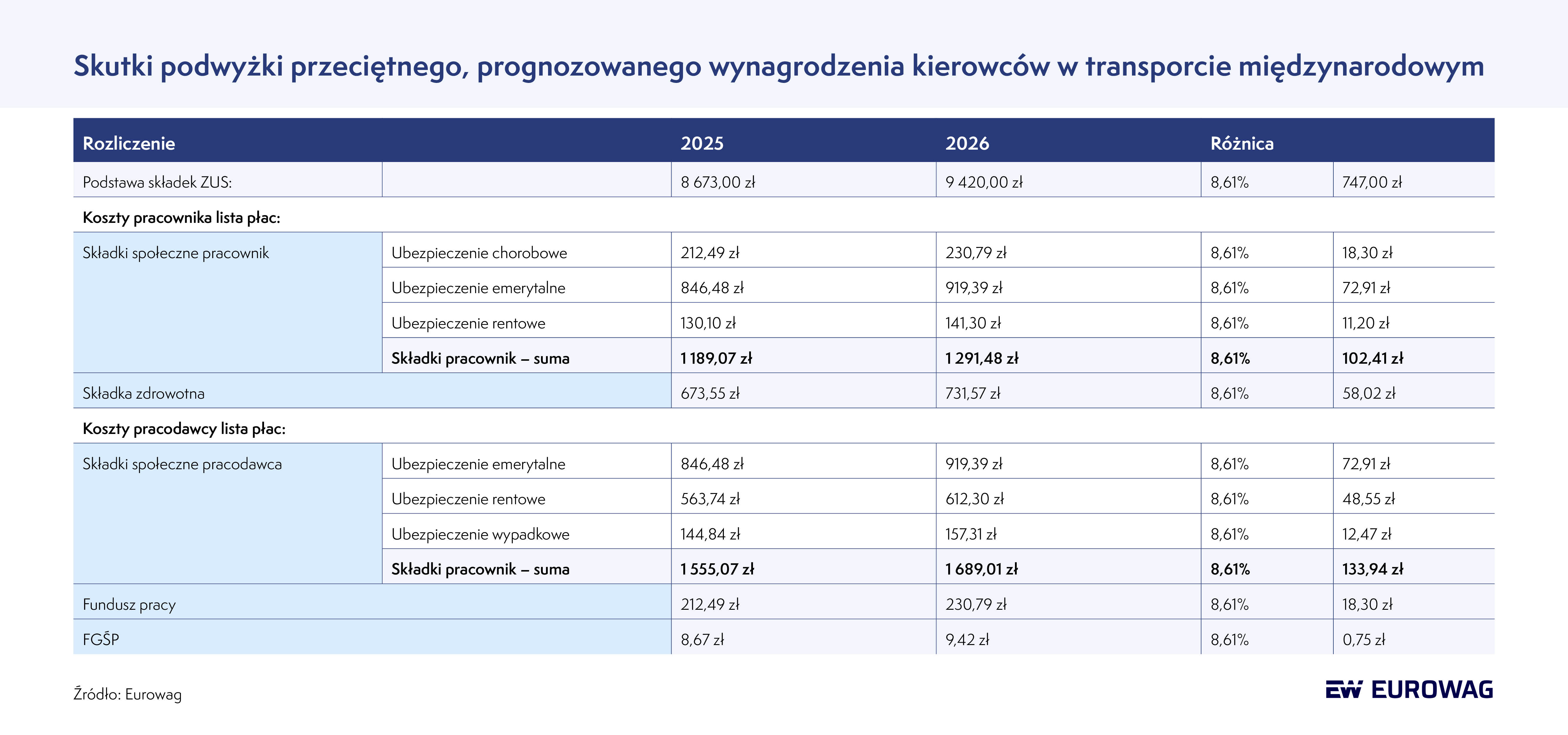
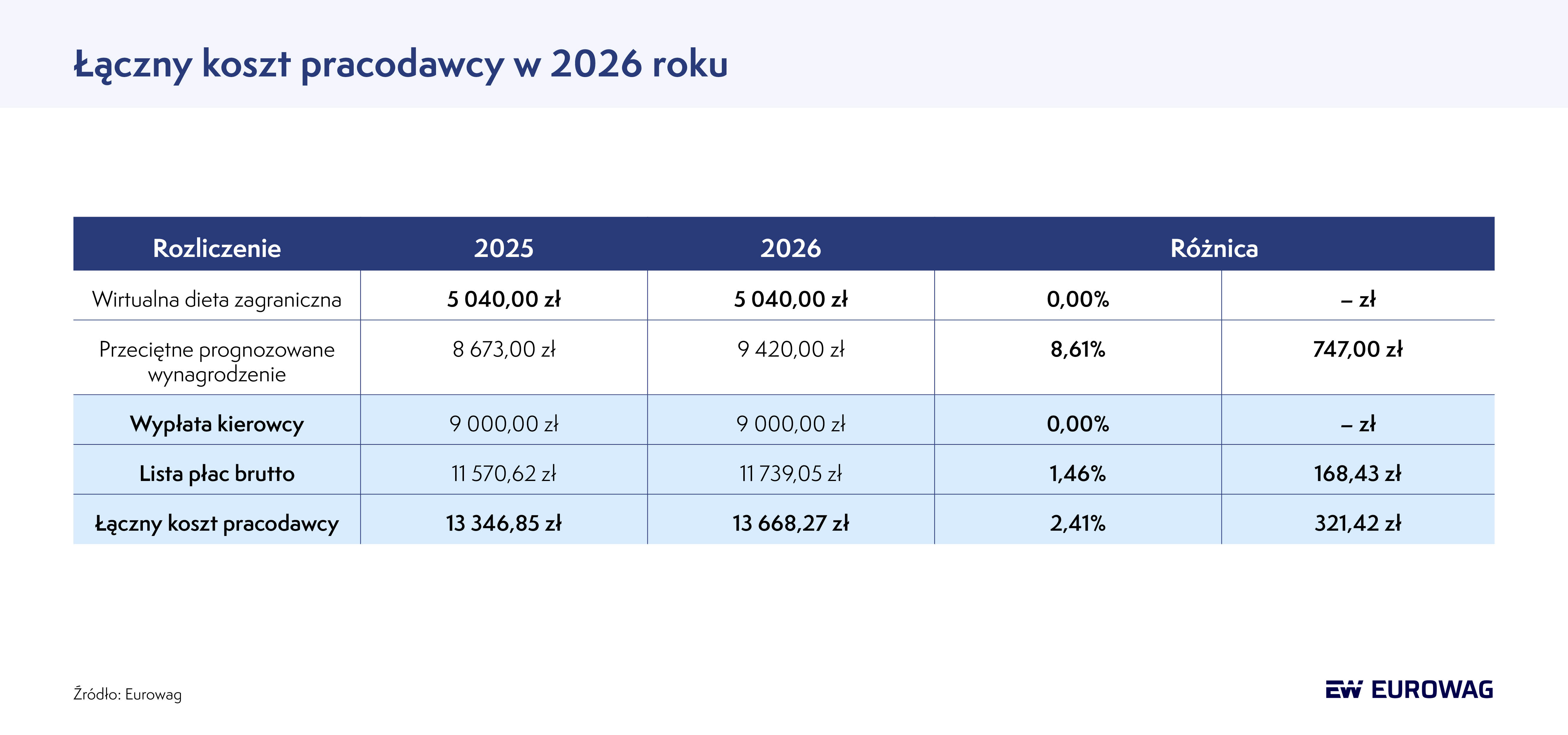
For example, a driver who earned PLN 9,000 net and worked about 20 days abroad in 2025 cost the employer PLN 13,346. After the changes, i.e., in 2026, this cost will increase to PLN 13,668. The difference of PLN 321 per month results not only from increased social security contributions but also from an increased advance income tax payment, which is calculated from a higher gross salary. From the perspective of transport companies, only the sum of these elements gives a full picture of the growing burden.
– comments Bartłomiej Zgudziak, Deputy Chief Expert for Analysis and Settlements at the Eurowag Group.
Expert Bartłomiej Zgudziak from the Eurowag Group also emphasizes that raising the average projected salary affects not only current contributions but also payout costs related to absence from work.
A higher base may mean, among other things, a gradual increase in sick pay, the amount of which is usually an average of the contribution assessment base from the last 12 months. The increase in the average salary for drivers also affects higher amounts when determining holiday pay from so-called variable components used to calculate this type of benefit. Companies should include these consequences in their budget planning for the entire year 2026 – he adds.
Also important is the rule that the date of salary payment, not the period it covers, determines the applicable contribution base. This means that the salary for December 2025 paid, for example, by January 10, 2026, will also be calculated according to the new, higher amount. For companies that make payments at the turn of the month, this is an important element of cost planning – notes Bartłomiej Zgudziak.
2026 with another wave of cost pressure
The rising ZUS contribution base joins a series of other costs that have been burdening transport companies for several years. Entrepreneurs are simultaneously affected by several factors: modernization of tachographs according to new requirements, fuel price volatility, rising road toll rates in Europe, and the need to maintain competitiveness in conditions of low margins. Subsequent increases in ZUS contributions are therefore becoming one of the key elements affecting the financial stability of enterprises.
On an annual scale, the increase in the average projected salary can increase the employment costs of one driver by several thousand zlotys. For transport companies employing a larger number of employees, the sum of these liabilities can be significant. This is a good moment to treat the situation as an impulse for reorganization, verification of remuneration policies, re-negotiating rates with contractors, and optimizing operating costs. In practice, this may also require changing settlement models with drivers or a more detailed analysis of the profitability of individual orders and transport routes. In such situations, it is worth seeking help from our OCRK specialists, who will indicate how to correctly calculate driver remuneration after the changes. Companies that approach this strategically will be able to maintain competitiveness despite the growing cost pressure in 2026.
– adds Bartłomiej Zgudziak from the Eurowag Group.
In the face of the already approved ZUS contribution base for 2026, entrepreneurs should include rising costs in their financial plans. Even if the changes seem small on a monthly scale, they represent significant burdens for the company’s budget over the year. Strategic preparation will allow for limiting financial risk, streamlining processes, and better managing costs. Companies that want to operate in accordance with current regulations and avoid errors in settlements can use the support of experts in the field of salary and ZUS contribution analysis. Such an approach helps in correct budget planning and in maintaining competitiveness in difficult market conditions.
Source: Eurowag / INELO