








Range on a single charge (33.6%) and high purchase costs (33.3%) remain the biggest barriers to purchasing an electric car, according to the 9th edition of the New Mobility Barometer, a renowned study conducted in cooperation with OTOMOTO, GreenWay Polska, SW Research, and F5A New Mobility Research and Consulting. Over 9 years, the authors of this cyclical public opinion survey, which illustrates the changes taking place in the domestic new mobility market, have analyzed over 1.34 million data points from nearly 11,000 surveys, in which more than a thousand questions were asked. The full version of the report will be available from January 22, 2026.
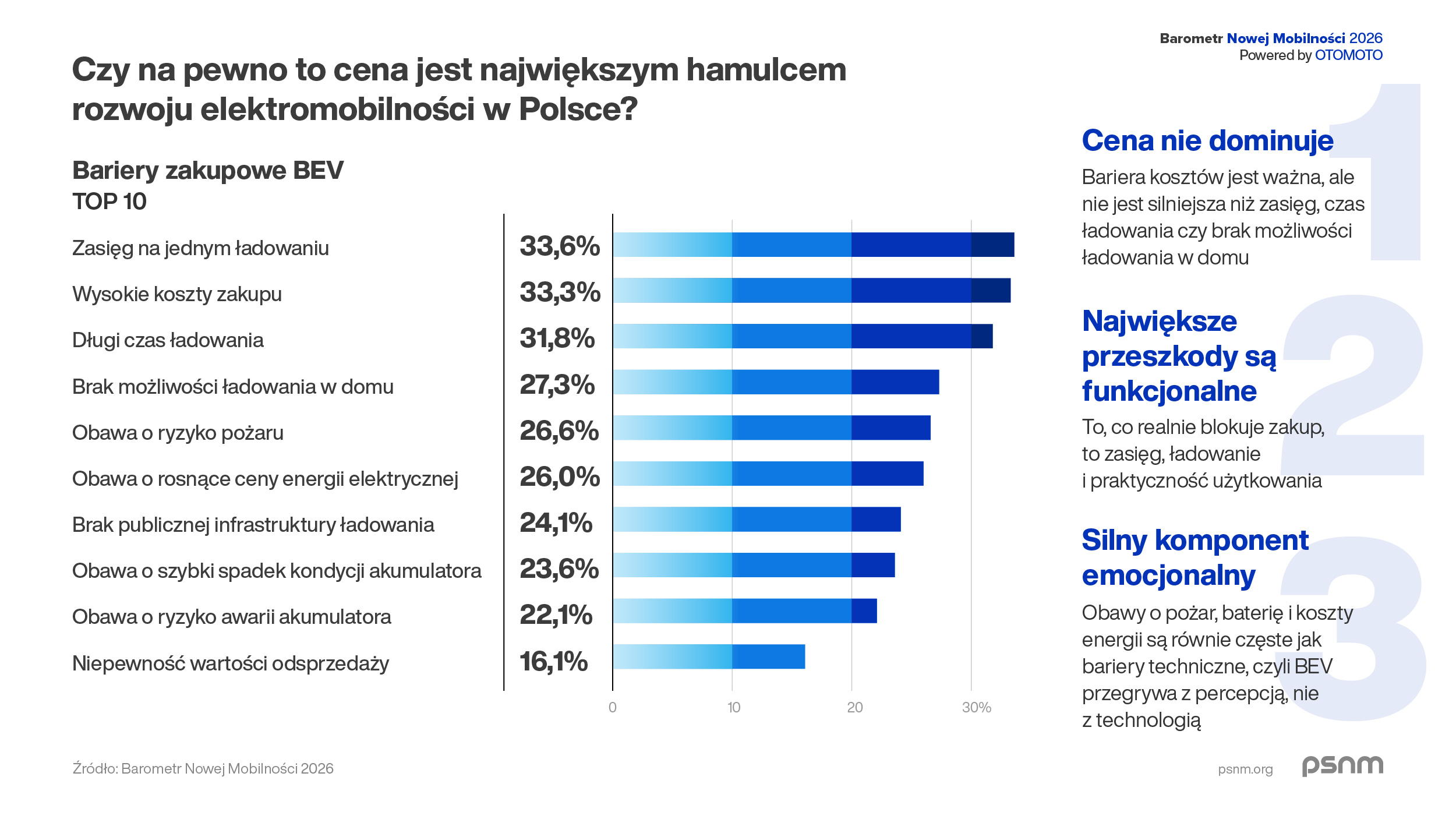
The latest edition of the New Mobility Barometer powered by OTOMOTO, prepared by F5A New Mobility Research and Consulting for the Polish Alternative Fuels Association (PSNM), shows that although purchase costs remain one of the most significant barriers to choosing a battery electric vehicle (BEV) (33.3% of responses), the greatest barriers are functional parameters. As many as 33.6% of respondents indicated range as the main purchase barrier. Charging time (31.8%) and the lack of home charging options (27.3%) proved equally important. Concerns about fire, battery life, and energy costs appear just as often as technical barriers – BEVs often “lose” to perception, not technology. Only 16.1% of respondents declared uncertainty about the vehicle’s value upon resale.
Technology as a differentiator
The New Mobility Barometer points to a shift in competition from price to innovation: as many as 43.4% of new car buyers are willing to choose an unknown brand if it offers better technological solutions. The perception of a vehicle solely as a means of getting from point A to B is changing: every third new car buyer treats the vehicle of the future as a technological device. 68.3% expect OTA software updates as an important feature. This is a signal that innovations (OTA, fast charging, autonomous systems, digital ecosystem) are becoming the decisive purchase motivator.
The latest edition of the New Mobility Barometer confirms that the transformation of the Polish automotive market towards zero-emission powertrains is currently taking place primarily through utility and technology – consumers want certainty that an electric car will solve their daily needs. Our study shows that although price remains key and will continue to play an important role, the first signs that innovations and the service ecosystem are beginning to gain importance as a factor attracting customers are becoming increasingly clear. Social concerns regarding charging have remained almost unchanged for several editions of the study, even though the number of charging points has increased by 625% over the last 5 years and currently stands at over 11.3 thousand points.
– says Albert Kania, COO of F5A New Mobility Research and Consulting.
2025 – a breakthrough in sales
The gap between “maybe I’ll buy an electric car someday” and “I bought one” has narrowed this year, indicating that the market has entered a phase of real development. In 2025, interest in purchasing an electric vehicle increased by 3 percentage points (from 24% to 27%), while the number of first registrations of new BEVs in Poland from January to November increased significantly – by as much as 140%. The “NaszEauto” subsidy program played a key role, the effects of which will still be visible at the beginning of 2026. According to estimates by the Polish Alternative Fuels Association (PSNM), more than 40,000 new electric passenger cars will be registered by the end of this year.
The year 2025 is a turning point: more and more driver declarations are turning into registrations, which is best confirmed by November 2025, when a historic, over 10-percent share of electric vehicles in the first registrations of new cars in Poland was achieved. This is a good sign for the market. However, for the transformation to be lasting, we must focus on eliminating functional barriers. Expanded and publicly accessible charging infrastructure and procedural facilitation for building garage (home) charging points remain priorities for policy and investment.
– says Jan Wiśniewski, Director of the PSNM Research and Analysis Center.
Specific challenges of the secondary market
The used electric car market did not record as spectacular growth in 2025 as the new car market. Used electric cars are perceived as too expensive on the secondary market (45% of indications vs 33% for new ones). Buyers of used electric cars are more concerned than new EV customers about range, the lack of home charging options, and they also have less knowledge about the technology and greater fears of fire (32% vs 26%). This indicates a need for education and better tailoring of the offer for the used segment.
The electric vehicle market has been dominated by new cars, but in recent years, a stable upward trend in the used car segment has been clearly visible. This is a broad field for educational activities that provide reliable knowledge about electric cars. Combined with increasing imports and greater availability of used EVs, this will allow for overcoming customers’ natural fear of the unknown. Comparing OTOMOTO data and market data with the results of the Barometer shows that as the offer matures and the secondary market becomes more transparent, barriers will gradually decrease, and the used EV segment will increasingly support the development of electromobility in Poland.
– comments Agnieszka Czajka, Vice President Motors Professionals Europe, OLX Group/OTOMOTO.
What determines the choice of a charging station while traveling?
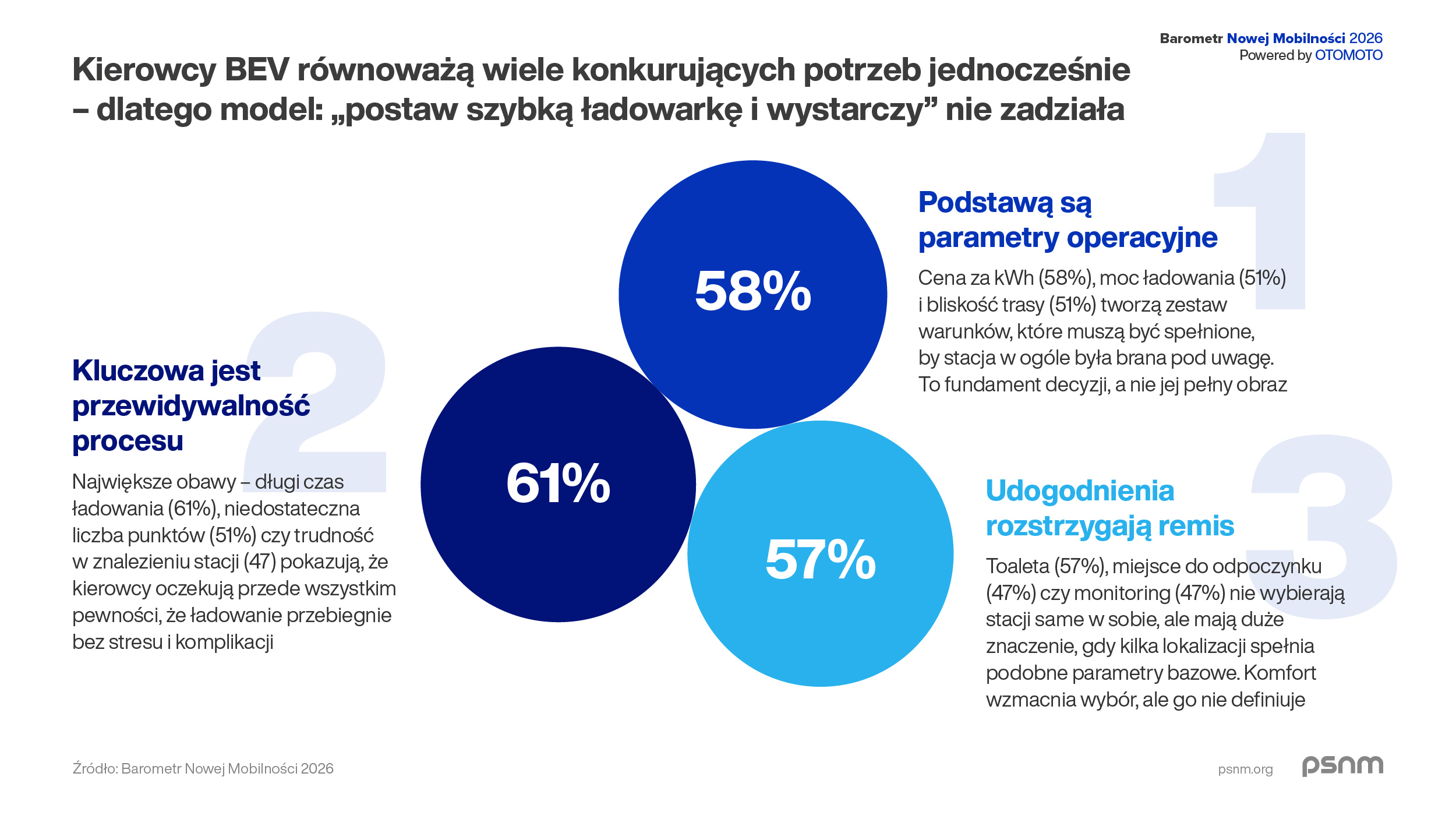
When choosing a vehicle charging location, BEV drivers balance many competing needs simultaneously. According to 58% of respondents, the primary criterion is the price per kilowatt-hour (kWh). Charging power (51%) and proximity to the chosen route (51%) are equally important. Drivers’ biggest concerns are: long charging time (61%), insufficient number of charging points (51%), and difficulty in finding a station (47%). Amenities (restroom, rest area, monitoring) matter when choosing between comparable locations.
The results of the study clearly show that electric vehicle drivers make decisions about choosing a charging location primarily based on practical needs: high charging power, convenient access to the station on the route, and price. At the same time, concerns related to charging time and infrastructure availability are still present. This is a very valuable tip for us – confirmation that network development should move towards ultra-fast, reliable, and intuitive solutions for users. That is why we are consistently investing in a new charging standard. Completing the Expand-E project and launching 35 ultra-fast hubs and 253 new DC points with power up to 400 kW, as well as another 26 fast points in new locations, is a milestone in increasing the comfort of traveling by electric car in Poland. Our goal is to provide drivers not only with the highest technical parameters but also with full convenience – from easy access and a transparent offer to amenities that really affect the quality of the stop.
– says Rafał Czyżewski, CEO of GreenWay.
About the New Mobility Barometer
The New Mobility Barometer, conducted since 2017, provides a comprehensive picture of public opinion on electric vehicle purchase preferences. Over the course of nine editions, a total of 10,518 surveys were collected, 1.34 million data points were analyzed, and more than 1,000 questions were asked. The partners of this year’s edition of the Barometer are: OTOMOTO (Title Partner), GreenWay (Thematic Partner), SW Research (Research Partner), and F5A New Mobility Research and Consulting (Substantive Partner). The full version of the report will be available on the PSNM website (psnm.org) from January 22, 2026.
Source: PSNM