








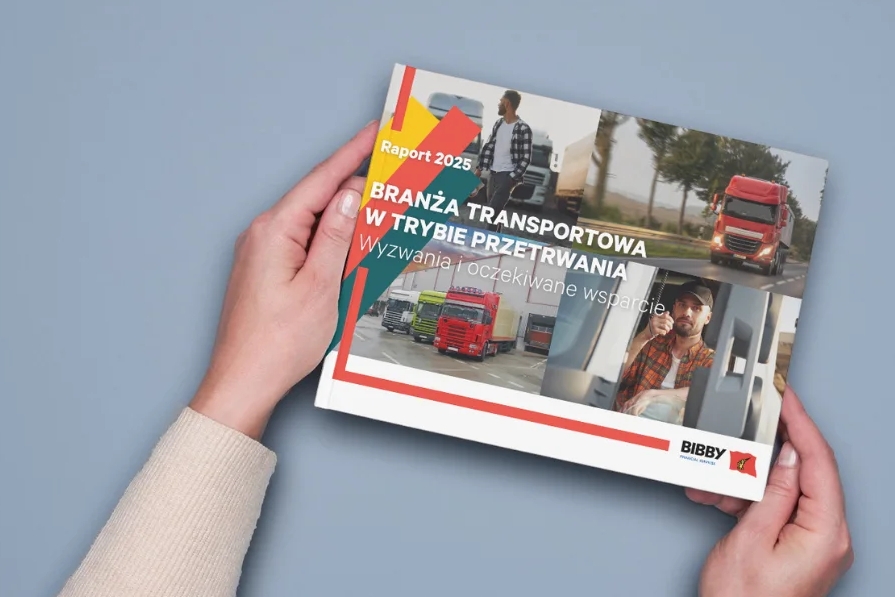
The transport industry is facing its deepest crisis in over two decades. Half of the companies have reported a decline in revenue, 90% of carriers do not receive payments on time, and the sector’s debt exceeds PLN 1.64 billion. The report “The transport industry in survival mode” presents a comprehensive analysis of the situation – based on a study of 100 transport companies and interviews with experts – it diagnoses the causes of the crisis and points to specific actions that can help the sector return to a path of growth.
Traditional operational management is not enough – the transport industry needs a change in its operating model. Instead of competing on price, it should compete on value, and instead of fragmenting, it should consolidate.
– says Ewa Gawrońska-Micuń, Country Manager at Bibby Financial Services Poland
From operating costs to competitive pressure
For carriers, the biggest challenge is high fuel prices, followed closely by rising road tolls across Europe. Additionally, the industry is struggling with a shortage of drivers – every fourth company surveyed points to this problem. Since the outbreak of the war in Ukraine, the number of Ukrainian employees has fallen by almost 40%, and there is a shortage of 120,000 to 230,000 drivers in Poland.
Every fifth entrepreneur also admits to struggling with insufficient financial liquidity, which makes it difficult to settle current liabilities. Competitive pressure is equally significant – some companies fear Ukrainian carriers, who may move around the EU without restrictions until 2027 and do not have to apply the Mobility Package regulations. However, experts emphasize that the greatest threat to Polish carriers often comes from… other Polish companies that accept rates below the profitability threshold in the fight for orders.
Frozen funds and a lack of business competence
As many as 9 out of 10 transport companies in Poland receive payments after the deadline. The delays are significant:
- Up to 14 days
- A month
- Two months or more
The average value of frozen funds is PLN 75.5 thousand, and almost every fourth company has unpaid invoices amounting to PLN 100,000–250,000. Moreover, 7% of companies declare amounts exceeding half a million zlotys.
Experts emphasize that this is just the tip of the iceberg. Many small and medium-sized companies cannot accurately calculate the full cost per kilometer. Additionally, managerial resources are consumed by the fight for current financial liquidity, which prevents:
- analyzing the causes of problems,
- developing a long-term growth strategy.
The consequence? Companies operate in survival mode instead of planning for growth and increasing efficiency – which in the long run blocks the transformation of the industry.
Declared growth vs. the real fight for survival
Most carriers declare a focus on growth: 42% want to acquire new customers, 36% are looking for financing. In practice, however, these actions often mean primarily an attempt to maintain their market position, not expansion. Almost half of the companies admit outright that their priority is to maintain operations and recover receivables.
Although some companies are implementing solutions based on artificial intelligence, these are mainly large firms. Smaller carriers usually do not have the time or financial resources to adapt new technologies. Paradoxically, AI will help those who have stable foundations, not those who are struggling for fuel and employee wages.
Ways out of the crisis – consolidation and a new operating model
Carriers do not clearly indicate a priority area for support – the answers are evenly distributed: preferential state regulations, easier access to financing, reduction of EU burdens, and lower credit costs.
Experts emphasize that the industry needs a fundamental change in thinking – a transition from survival-focused actions to strategic planning. Key actions that can help overcome the crisis include:
- Improving cost analysis
- Cooperation instead of competing on price
- Consolidation and resource sharing
- Strategic planning instead of crisis reactions
Such an approach can be a real way to stabilize operations and prepare for future challenges.
The report is available at the link.
About the study
The study “The situation in the transport industry 2025. Challenges, expected support, investments” covered a representative group of 100 companies from all over Poland – small, medium, and large enterprises processing plastics. It was carried out in September 2025 by the Keralla Research institute using the CATI method, on a representative group of people responsible for running the company (owner, manager) or responsible for purchasing, development, or management. The questions were answered by representatives of transport companies (carriers performing road transport). The study was commissioned by Bibby Financial Services.
Source: Bibby Financial Services Sp. z o.o.