








Transport and logistics companies have the highest ESG awareness, while trade and service companies have the lowest. The ESG Barometer prepared by EFL and Truck Care shows that the approach of Polish companies to sustainable development depends on their size and industry. 73% of medium-sized companies implement a comprehensive ESG strategy or legally required actions, while in micro and small companies, no one thinks about a strategy, and less than half limit themselves to basic formal requirements. Differences are also visible across industries. Transport and logistics have the highest ESG awareness, as only 15% of companies do not plan any steps in this area. In services and trade, this indicator is as high as 29%.
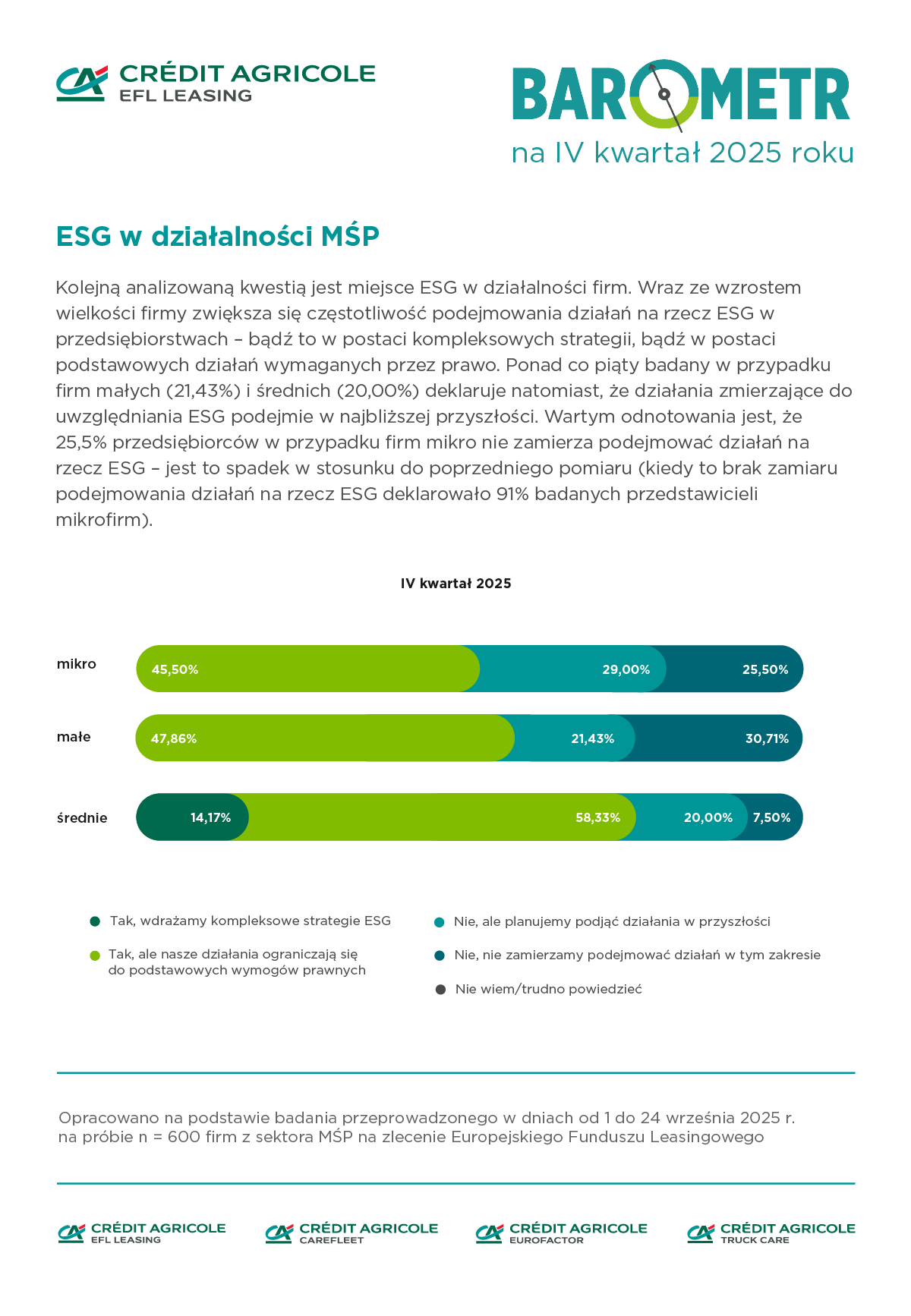
An analysis of the results of the EFL and Truck Care study indicates that there are large differences in the approach to ESG between micro, small, and medium-sized companies. As company size increases, the frequency of ESG-related actions in enterprises also increases. 46% of micro and 48% of small companies limit themselves to meeting basic legal requirements, while among medium-sized companies, 14% are preparing and implementing an ESG strategy, and 58% of them are taking basic actions. Every fifth respondent in the case of small (21%) and medium-sized (20%) companies, as well as 29% of micro-enterprises, intends to take ESG actions in the near future. The lack of any ESG activities is declared by 8% of medium-sized companies, 31% of small ones, and 26% of micro-enterprises.
Transport will deliver the most ESG
Significant differences are also visible in individual sectors. TSL is the sector where the most companies are planning ESG-related actions. 1% are creating a strategy, 58% are implementing actions required by law, and 26% have planned such a step for the future. Only 15% do not intend to do anything in this area. – ESG is no longer a choice, but a duty for every company. Our study shows that this is best understood by transport, logistics, and freight forwarding companies, which have been facing the pressure of increasing environmental requirements for years. Poland is a leader in international transport, which is why the decarbonization of heavy transport and the development of zero-emission fleets are of strategic importance for this sector. Regulatory announcements from the European Commission, even if not yet confirmed, reinforce the sense of urgency to include the aspect of environmental pressure in the strategy of transport companies. In such an environment, a government program to support the financing of zero-emission vehicles is not only necessary but can realistically accelerate the transformation, provided it is part of a broader system of incentives. – says Silvestr Ochrimović, CEO of Truck Care.
At the other end of the spectrum are trade and service companies, where twice as many companies as in the TSL sector (30%) do not intend to take any steps in the area of ESG. In manufacturing, on the other hand, the largest group (7%) is implementing a comprehensive ESG strategy.
Various ESG solutions
Entrepreneurs were also asked about what actions they are taking for ESG. The most popular answers, regardless of company size, were care for labor rights, energy and water savings, waste management and recycling, sustainable resource management, and involvement in local community activities. Broken down by industry, it should be noted that in the HoReCa industry, water and energy savings are the most important, which most likely results from the specifics of this industry. The same is true for services. In the case of care for labor rights, the trade industry stands out positively, although this aspect was important and relatively frequently indicated in all surveyed industries. For the construction, industrial, and transport industries, aspects such as waste management and recycling were important.
Research methodology: The study was prepared by Ecorys on behalf of the European Leasing Fund SA. Its participants are micro, small, and medium-sized companies from all over Poland. A representative group of 600 micro, small, and medium-sized companies took part in the study. The current edition of the study took place from June 1 to June 30, 2025.
Source: Truck Care / EFL S.A.