









Toll costs in transport per kilometer are starting to become comparable to, and sometimes even higher than, fuel expenses.[1] This is one of the consequences of linking their rates to the vehicle’s CO₂ emission level, which is being implemented in individual countries in accordance with the EU Eurovignette Directive. For transport entrepreneurs, these changes bring new financial challenges – up to 10,000 PLN per month just for tolls for a truck driving through Germany. How can one consciously calculate toll expenses, and how does technology support transport in determining alternative or free road sections? What should be done to make trips as cost-effective as possible? Tomasz Czyż, Chief Expert for Technological Solutions at Eurowag Group, estimates that the monthly cost of driving on toll roads in Germany alone can cost a company over 10,000 PLN.
Assuming that a truck covers 10,000 km in a month, of which 7,000 km are driven on German toll roads (the current so-called toll collect rate for Euro VI class vehicles is 0.349 EUR per km), a carrier can pay up to approximately 10,500 PLN based on today’s exchange rate of 4.24 PLN.[2] It must be noted, however, that this is an estimated expense for only one direction in transport, so the total cost for tolls will be even higher.
– comments Tomasz Czyż, Eurowag Group.
Toll calculation in TMS
Companies in the TSL industry need tools that allow them to plan routes not only in terms of travel time or distance but also in terms of toll costs. Not only do toll rates depend on many different factors, such as the vehicle configuration (GVW and number of axles), air and noise pollution, and CO2 emissions, but different settlement models also apply in individual European countries. It is therefore no surprise that it is difficult for transport companies to perform such simulations on their own.
Carriers are increasingly asking us about solutions for calculating tolls because they know that automation in this area is simply essential. They also want to increase the awareness of planners and equip them with tools that allow them to search for alternative, cheaper options. And TMS-class systems, such as fireTMS with HERE maps, can immediately indicate how much a given trip will cost the company when choosing the fastest or the cheapest and shortest route. Their integration with telematics is also important, because only then can business owners gain full control over the entire trip and check the execution of previously assigned tasks.
– notes Tomasz Czyż.
So, how much do you have to pay for a truck trip from Poland to Munich in Germany and Lyon in France? A simulation from the fireTMS system by Eurowag indicates that the cost on the Bydgoszcz-Munich route is 267 EUR (about 1,100 PLN) one way, while to France from the same starting point, toll expenses amount to 476 EUR, or over 2,000 PLN.[3] If a transport company decided on cabotage on the route from Lübeck to Munich, the tolls would amount to 288 EUR (about 1,200 PLN) one way.[4]
Are carriers looking for alternative routes?
Rising costs of motorways and expressways may encourage carriers to return to national roads. For example, calculations from the fireTMS system for the route from Bydgoszcz to the western German border show that instead of a motorway, one can choose a cheaper alternative (road 92) and save almost 30 EUR (approx. 125 PLN one way). With regular trips, these are real financial benefits for companies.
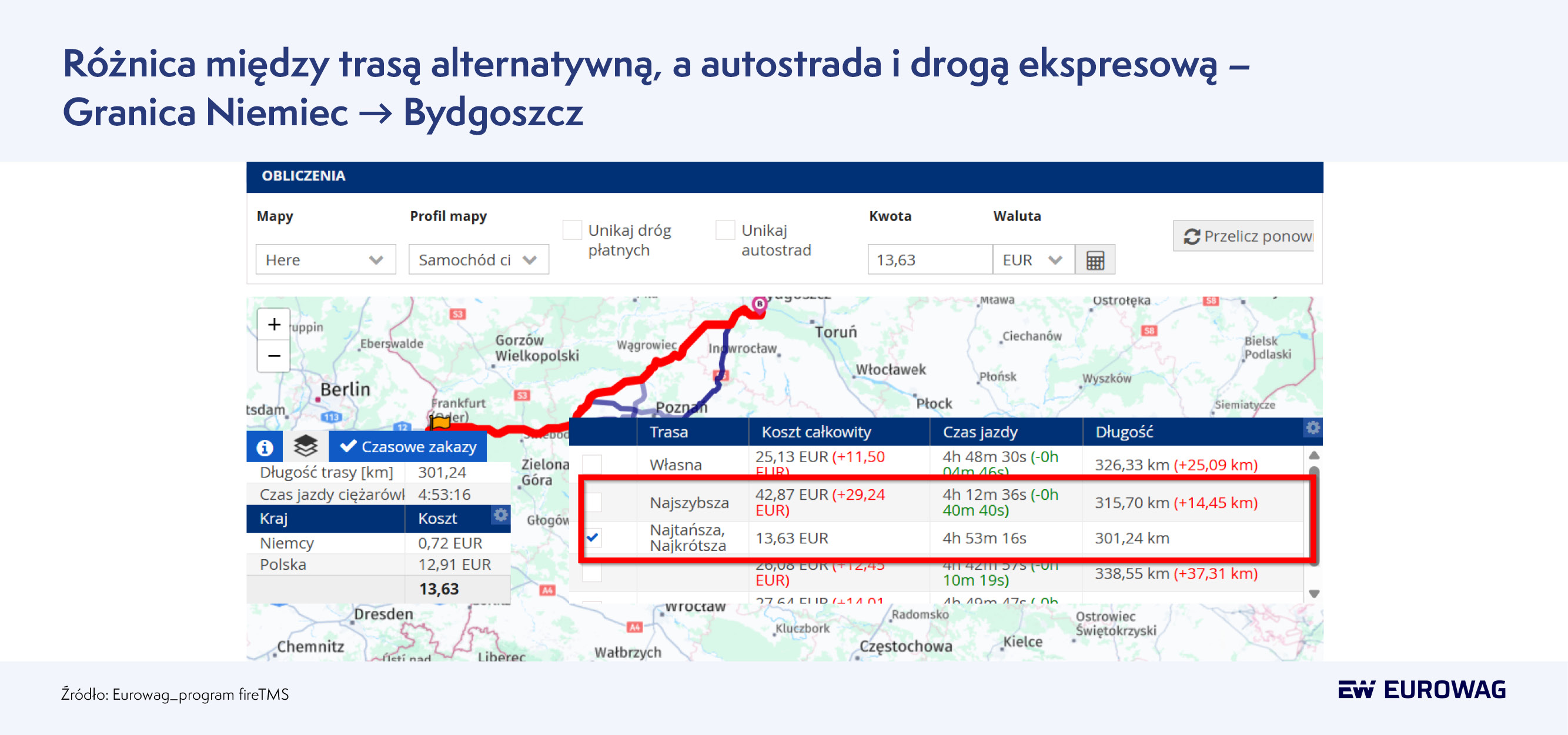
Source: Eurowag, fireTMS program
Such savings may seem like a small amount, but let’s remember that the scale effect works here. Companies with a large fleet, whose vehicles cover thousands of kilometers on toll routes monthly, can count on cost reductions of even several thousand. Every company, regardless of the scale of operations, benefits from rational route planning and the choice of alternative, cheaper sections. However, it is worth emphasizing that it is of great importance to stick to the previously established plan and for the driver to travel along the previously designated corridor, which is enabled by the integration of TMS tools with telematics.
– emphasizes Tomasz Czyż.
Before choosing a specific route, however, it is worth verifying the profitability of all roads and assessing whether, in a given case, we can afford to take a different connection, also taking into account other important factors such as delivery time or economical driving. Sometimes choosing a motorway or a toll section of the route may turn out to be a better option, despite higher travel costs, because the driver will reach the destination faster or the truck will consume less fuel due to the possibility of smoother driving.
Ignorance is costly – how to avoid mistakes in transport?
Knowing the travel costs allows for reducing the number of mistakes that may result from a lack of awareness among forwarders or dispatchers when planning routes. Such a situation could be directing a driver to the wrong road, and as a result, the necessity of adding extra kilometers, which may also turn out to be toll-bearing.
Knowledge about route optimization is the first step to searching for and designating alternative road sections and reducing expenses. Further steps can be taken when we integrate TMS tools with telematics systems, where one can designate part of the trip on toll sections and part on free ones, depending on the route and available options in a given country.
It is also worth mentioning another situation related to paying tolls that can generate unnecessary costs. Tomasz Czyż from the Eurowag Group emphasizes that readers for automatic toll collection can sometimes turn off automatically without the driver’s knowledge. This can cause a lot of problems for a transport company and requires the trucker to ensure that OBU devices are definitely active.
You have to be especially careful about the operation of the readers, because if the driver does not notice that any OBU device is not working properly or turns off, and as a result the trucker does not pay the toll while driving through the country, they may expose the company to financial penalties. Therefore, it is definitely easier to equip yourself with one device for toll collection, such as EVA from Eurowag, than to have several separate onboard units in the truck. EVA relieves the driver of the obligation to remember to connect or turn on each of the readers and allows for toll collection in the EETS standard in over a dozen European countries using only one tool. This simplifies the entire toll collection process, reduces the risk of sanctions for companies, and is a very convenient solution for drivers.
– emphasizes Tomasz Czyż.
In summary, cyclical increases in toll fees are a permanent element of operators’ pricing policy related to rising maintenance costs, the implementation of new projects, or route modernization. From December 1, 2025, the network of toll roads in Poland for vehicles over 3.5 tons will likely expand by another approx. 645 km, and these changes apply to newly built motorways, expressways, and selected national roads. As a result, the electronic toll will be collected on a total of approximately 5,870 km of sections in Poland. Additionally, a change in the rates for trips is also planned, which means that carriers must prepare for further increases.[5] In this situation, only constant monitoring of these changes using technology will allow for reacting on an ongoing basis and optimizing routes so that they are as cost-effective as possible.
[1] IRU, Driving profitability: Fuel, tolling and cost trends in the EU, 2025
[2] National Bank of Poland, Average foreign currency exchange rates, 24.10.2025: https://nbp.pl/statystyka-i-sprawozdawczosc/kursy/tabela-a/
[3] Eurowag data, fireTMS program simulations, September 2025
[4] As above.
[5] Gov.pl, Draft regulation of the Council of Ministers amending the regulation on national roads or their sections on which an electronic toll is collected, and the rates of the electronic toll, October 2025
Source: Eurowag