








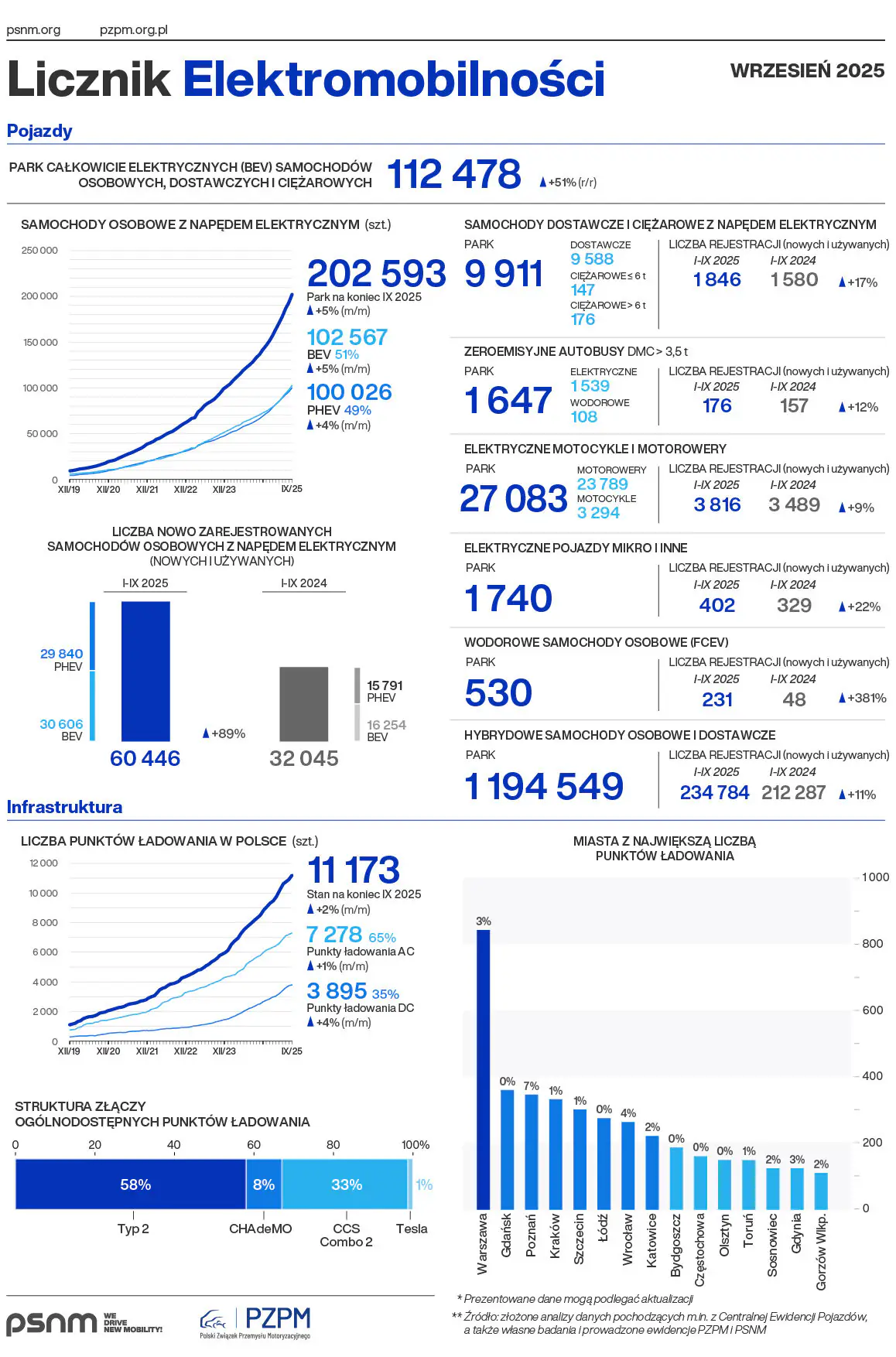
According to data from the end of September 2025, a total of 112,478 fully electric passenger and commercial vehicles (BEVs) were registered in Poland. Over the first three quarters of this year, their number increased by 32,452 units, which is 82% more than in the same period of 2024, according to the Electromobility Meter launched by PZPM and PSNM.
By the end of September 2025, there were 202,593 electric passenger cars on Polish roads. The fleet of fully electric passenger cars (BEVs) numbered 102,567 units, while the plug-in hybrid (PHEV) fleet totaled 100,026 units. The number of electric delivery and heavy-duty vehicles reached 9,911 units. The fleet of electric mopeds and motorcycles is also steadily growing, consisting of 27,083 units at the end of September, as is the number of hybrid passenger and delivery vehicles, which increased to 1,194,549 units. By the end of last month, the zero-emission bus fleet in Poland grew to 1,647 units (of which 1,539 were fully electric and 108 were hydrogen-powered).
Parallel to the fleet of electric vehicles, charging infrastructure is also developing. By the end of September 2025, there were 11,173 publicly accessible electric vehicle charging points in Poland. 35% of these were fast DC charging points, and 65% were slow AC charging points with a power of 22 kW or less.
The most important information this month is the announcement of a change in the formula of the “NaszEauto” program. Unfortunately, according to government announcements, this may be the last support program. One can only hope that funds will be found in the coming years to support the zero-emission vehicle market, because as the experience of other countries shows, this is an area where government subsidies or the introduction of regulations discouraging the purchase of internal combustion vehicles, e.g., by companies, are crucial for the development of the low-emission vehicle market. It is very good that the authors of the changes listened to the voice of the industry and that the amendments included most of the comments submitted by all market players – including PZPM. Now we need to consider how, after the end of the subsidies, this part of the market can be supported so that there is no sudden drop in registrations.
– says Jakub Faryś, President of PZPM.
Following an appeal from PSNM, the National Fund for Environmental Protection and Water Management (NFOŚiGW) decided to withdraw from the proposal to exclude vehicles for which customs duty was calculated from support under the “NaszEauto” program. In our opinion, such a provision would have limited the positive market effects of the subsidies. We generally assess the changes finally implemented in the “NaszEauto” program positively. However, covering additional vehicle categories with support and expanding the catalog of beneficiaries while simultaneously reducing the budget to approx. PLN 1.2 billion will mean that the funds allocated for subsidies will likely be exhausted long before the official deadline for submitting applications, i.e., April 30, 2026. Especially since at the current stage, almost 50% of the current allocation has already been used, and at the end of the year, we generally record increased demand for new vehicles.
– says Jan Wiśniewski, Director of the PSNM Research and Analysis Center.
Source: Polish Alternative Fuels Association (PSNM)