








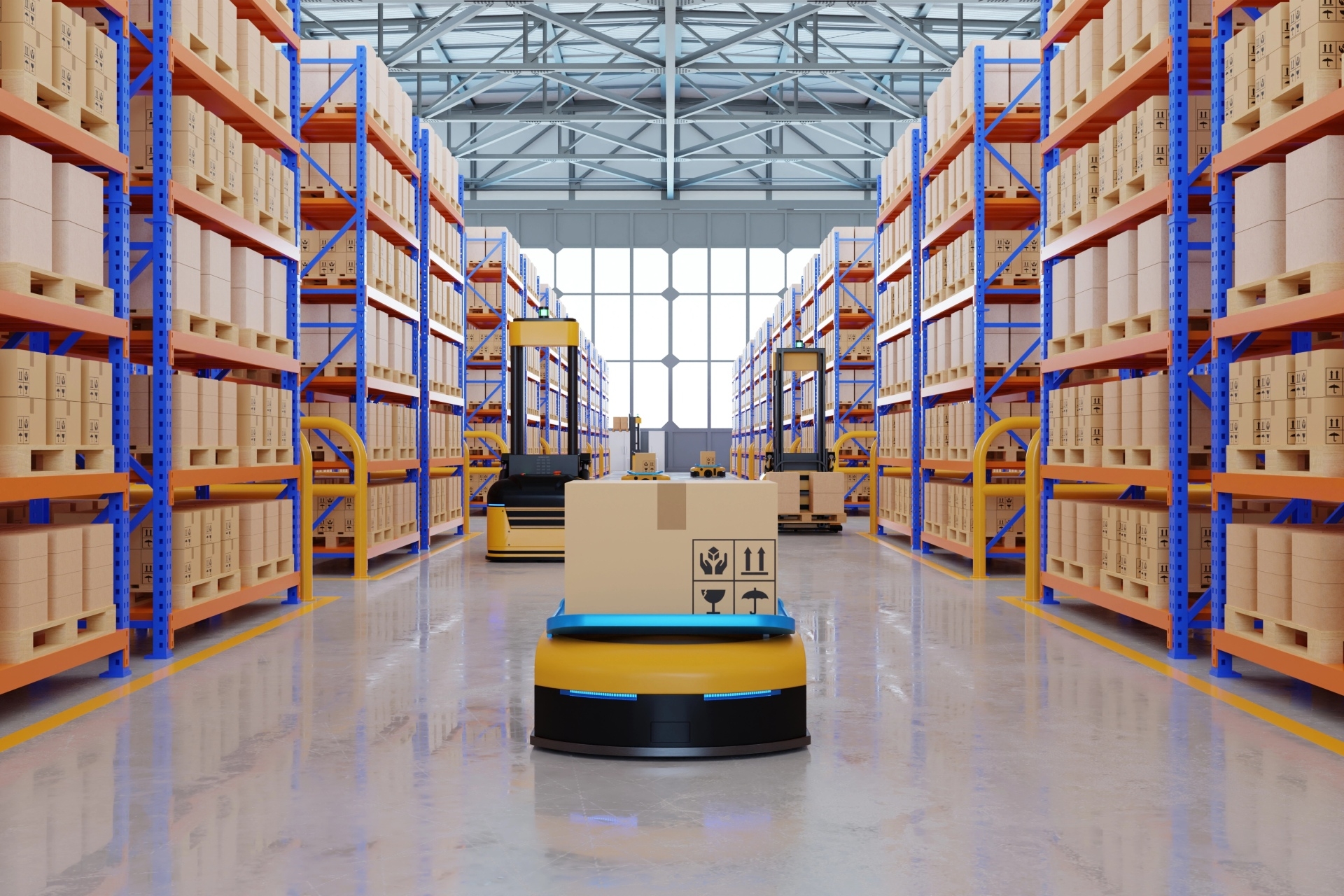
Robots and intelligent systems are changing the face of logistics and production processes. They are becoming a way to reduce labor costs and operate effectively in conditions of limited staff availability.
A few years ago, full warehouse automation seemed like a solution reserved for global e-commerce giants. Today, as Jakub Kurek, Director of the Industrial and Warehouse Department at Newmark Polska, points out, medium-sized enterprises are also increasingly reaching for modern technologies.
Our economy is struggling with rising labor costs and limited availability of workers. This makes companies look for alternatives in process automation – from simple solutions supporting operations to implementations in fully robotic facilities.
– says the expert.
The warehouse as an intelligent ecosystem
The approach to warehouse space itself is also changing. Tenants today expect it to support modernization and development, not just current operational handling.
The classic Class A warehouse standard is no longer enough. Technical parameters enabling the implementation of automation solutions, including power connection, energy availability, or IT infrastructure, are becoming key.
– points out Kurek.
Thanks to automation, warehouses can store a larger number of goods in the same area, which translates into better space utilization and higher revenue potential. At the same time, the importance of employees specialized in supervising robots and analyzing data is growing. Robert Kosicki, technical-commercial advisor for warehouse automation at Mecalux, emphasizes that – automated accumulation storage systems, which enable optimal use of the warehouse’s usable area by densifying loads in racks, are currently enjoying the greatest interest. Key elements of the installation are stacker cranes and Pallet Shuttle carts that store and retrieve pallets. Customers value this solution due to the possibility of building racks up to 40 meters high and the very high operational efficiency of the system.
A modern warehouse or production plant is today a complex ecosystem in which automation, robotics, and intelligent management systems interpenetrate at many levels.
Importantly, this process begins at the design stage. The developer, together with the tenant, analyzes not only the layout of workstations or transport routes but also elements such as floor reinforcement for racks with loads generating higher stresses, busbar routing, compressed air installations, as well as planning space reserves for additional production lines in the future.
– says Jakub Jankowiak, Development Director at Panattoni BTS.
According to the expert, intelligent, energy-efficient lighting, equipped with dynamic control systems that allow for motion detection and automatic adjustment of lighting relative to daylight, also plays an important role in saving resources.
Technical foundations of automation
The foundation for the efficient operation of automation systems is ensuring appropriate technical conditions, power connection, and IT infrastructure.
The priority is the availability and reliability of power supply, because automation means a strong dependence on the continuity of electricity supply. That is why in our investments we increasingly include additional energy sources, such as a power generator or even a second independent connection. Equally important is the preparation of properly designed server rooms and the possibility of integrating installations with client systems, which requires compatibility with BMS communication protocols. In the area of fire safety, we support tenants by designing sprinkler systems and fire passages for automation systems.
– emphasizes Adrian Winiarek, Partner, Development Director at MDC2.
Automation also allows for increased safety and quality control, minimizing human error and the risk of damage to goods. Solutions such as access control systems, real-time media monitoring, integration with digital twins of the warehouse, or reporting systems allow for predicting failures and planning maintenance in a way that minimizes downtime.
Technologies that save energy and money
The implementation of robots and intelligent warehouse management systems (WMS, IoT) allows for optimizing processes and reducing operating costs. Renewable energy sources, heat recovery, or systems controlling water consumption are also increasingly used.
A good example is the e-commerce distribution center in Świebodzin, completed by Panattoni. The facility was equipped with over 3,000 mobile robots transporting racks to employees, which significantly shortens picking time. A photovoltaic installation covering over 4,000 panels (1.7 MWp), a heat recovery system, and HVAC automation also operate at the center, thanks to which annual energy and water consumption fell by over 55 percent.
Another example is the warehouse in Piła, built for CEVA Logistics, which serves the company Signify. Thanks to the use of intelligent LED lighting, energy consumption there fell by 62 percent.
Savings are also generated by the low-emission factory in Grodzisk Mazowiecki built by Panattoni BTS for the Danfoss company. Heat recovered from various zones of the building is used for reheating, with the possibility of recovering up to 80 percent of the energy needed to heat the production hall in winter.
According to Panattoni’s estimates, the comprehensive implementation of automation, robotics, and green technologies allows for reducing operating costs by as much as 30 – 40 percent compared to traditional halls and simultaneously improving efficiency by several dozen percent. This shows that modern technologies are not just an addition, but are becoming the foundation of the competitiveness of production and logistics companies.
– emphasizes Jakub Jankowiak from Panattoni BTS.
Automation under pressure: implementation barriers and adaptation costs
Although the benefits of automation are obvious, implementing new technologies in warehouses is associated with numerous barriers. – When building new facilities, entrepreneurs do not always plan the implementation of automation immediately. In practice, this means that suppliers must adapt solutions to existing and partially already developed space. The most common challenge is the building’s height being too low. In Poland, warehouses with a usable height of 10 – 12 m are built, which is suitable for container warehouses, but in the case of pallet warehouses, a structure from 15 to even 32 m is much more economically advantageous – points out Robert Kosicki from Mecalux.
Adaptation costs are also a major challenge. Expenditures on robotics, automatic sorters, production lines, or energy installations often exceed the value of the building itself.
More and more often, at the investment stage, the tenant specifies requirements regarding automation, and the developer undertakes the initial adaptation of the facility to these needs. Detailed systems and installations are then implemented in cooperation with technology suppliers. In practice, part of the costs covered by the developer can be included in the rent, which limits the need for the tenant to incur high investment outlays at the start. Advisors play an important role in this process, coordinating all arrangements, engaging the technical department, and ensuring the compliance of solutions with OHS regulations and fire requirements.
– emphasizes Jakub Kurek from Newmark Polska.
Requirements also vary depending on the industry.
For example, the food industry needs specialized cooling and insulation systems, the automotive industry – high-precision robotic lines, and the chemical industry – advanced process safeguards. Integrating such requirements with the building’s structure can be difficult, especially in multi-tenant warehouses, where excessive adjustments for one tenant limit the flexibility of the entire building. Therefore, in some cases, a dedicated BTS (build-to-suit) becomes the optimal solution, where the entire space is designed from the beginning for specific processes.
– adds Jakub Jankowiak.
The rapid pace of technological development is also not without significance.
Systems that are state-of-the-art today may require modernization in a few years. Therefore, it is crucial to design facilities with appropriate power reserves, space for expansion, and modular infrastructure that can be easily adapted to new solutions. Only such an approach guarantees that investments in automation will remain profitable in the long term.
– summarizes the expert from Panattoni BTS.
Competitive advantage for years
Automation and robotics are conquering the warehouse market, setting new standards for efficiency and process scalability.
The key to success is the cooperation of tenants, advisors, developers, and technology suppliers at the design stage. The market is moving towards fully intelligent warehouses, where robotics, IoT, and digital twins are becoming the basis of operational advantage. – In the coming years, we will see even more autonomous warehouses, capable of independently monitoring and optimizing processes, which will translate into a real competitive advantage for logistics and production companies – predicts the director at Newmark Polska.
Source: Newmark Polska