










The logistics industry is facing enormous HR challenges today. Proper management of the payroll budget is becoming crucial not only in the context of employee retention but also for cost optimization under conditions of increasing wage pressure. Meanwhile, many companies still make fundamental mistakes in analyzing and planning salaries – relying on overly general data and incorrect assumptions. How to avoid this?
Regionalization of the labor market – the key to understanding wage dynamics
One of the most common mistakes when planning payroll budgets is relying on the “industry average.” Such data, while temptingly simple, rarely reflects the complexity of local labor markets.
Let’s take the example of a warehouse worker. Data from manaHR Salary Reports (July 2025 edition) shows that the average salary of a warehouse worker in logistics is 5,843 PLN, while in manufacturing it is 6,517 PLN.
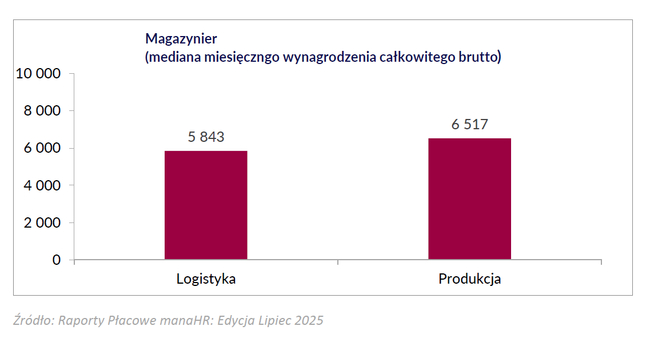
That is a difference of almost 700 PLN. However, by comparing only industries, it is easy to overlook other, often more important factors.
The average salary of a warehouse worker in logistics in the Silesian Voivodeship is 6,498 PLN, while in Grodzisk Mazowiecki it is 6,500 PLN. Meanwhile, in the Warmian-Masurian Voivodeship, it is only 5,751 PLN. The difference reaches as much as 750 PLN depending on the micro-region. Therefore, the competitiveness of an offer does not depend solely on the industry – location can be of decisive importance.
For an employee who travels several kilometers to work every day, a better-paying offer 20 km away can be a real alternative. This means that payroll budget analysis should take into account not only industry data but also local labor market conditions.
Job titles are not enough – the importance of role evaluation
An equally common mistake in salary management is mechanically comparing positions with the same name without analyzing the scope of responsibility and competencies.
An example? The position of a freight forwarder. According to data from the manaHR report, a domestic road freight forwarder earns an average of 7,506 PLN, a rail freight forwarder – 9,286 PLN, and an air freight forwarder as much as 10,460 PLN.
The difference between the lowest and highest-paid freight forwarder reaches nearly 3,000 PLN. The job title alone is not enough to correctly compare salaries. Without precise role evaluation and assigning them the appropriate level of responsibility, it is easy to draw incorrect conclusions and make costly HR decisions.
Market analysis – essential background for budgeting pay raises
According to manaHR’s analysis of pay raises, salary increases in logistics this year are hovering at the level of 5.9%. We are still waiting for the October edition of the Salary Report to see if this indicator will change.
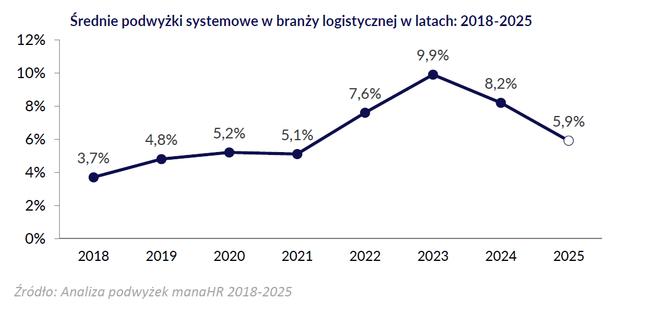
Relying on reliable market data helps to set pay raise thresholds that will be both competitive and sustainable for the organization. Such an approach allows for the creation of predictable and clear compensation mechanisms that build employee trust and strengthen the company’s transparency.
– In the face of increasing competition for employees, rising costs, and limited budgets, logistics organizations cannot afford decisions based on intuition. Market salary data, such as those contained in reliable salary reports, allow not only for better salary planning but also for building retention and competitiveness strategies in the labor market. Companies that regularly analyze salary data, compare positions based on evaluation, and take into account the local specificity of the labor market win the race to retain key employees and optimize personnel costs – summarizes Dorota Bodek, member of the manaHR board.
How to avoid overpaying and losing employees?
Effective management of the payroll budget in logistics requires paying attention to four key aspects.
- Region matters.
When analyzing salary data, it is worth going down from the voivodeship level to the micro-region level. Employees rarely consider changing jobs in another voivodeship, but they are open to a better-paying offer 20-30 km away. Taking the local geographical context into account is essential. - Real competition for employees.
For a logistics company, competition for an employee can often be a local manufacturing company or an e-commerce warehouse. Employees are not guided by the employer’s industry affiliation, but by the level of salary and working conditions. - Proper comparison of positions.
Using general job titles without evaluation can lead to misinterpretation of salary data. Not all freight forwarders are the same – they differ in both the scope of responsibility and the required competencies. Only precisely described roles allow for accurate market analysis. - Managing pay raises based on market data.
Decisions on the amount of pay raises should be preceded by an analysis not only of the company’s financial condition but, above all, by reference to current, local salary indicators. These indicators allow for adjusting the salary offer to the realities of the labor market, which is especially important in logistics, where competition for qualified operational and specialist employees is growing day by day.