









The transport, forwarding, and logistics industry in Poland in the second half of 2025 is far from stable. Although there are signs of recovery, financial data and insolvency statistics show that the sector has entered one of its most difficult periods in recent years. Entrepreneurs must cope not only with growing payment arrears, which according to the National Debt Register (KRD) already amount to PLN 16.4 billion, but also with high operating costs, a wave of restructuring, and a decline in actual freight volumes.
The second quarter of 2025 brought a recovery in the domestic freight market – the number of freight offers increased by as much as 63 percent year-on-year. There is also a clear increase in the number of import orders from Germany and France. However, data from Statistics Poland (GUS), analyzed by the Polish Institute of Road Transport (PITD), show that the transport reality is much more difficult.
In the first half of 2025, 115.99 million tons of cargo were transported by road, which is 13.4 percent less than a year earlier. June turned out to be the weakest month of the half-year – 18.25 million tons of goods represents a decrease of 15.5 percent compared to June 2024. Transport performance also decreased, which means that the declines concern not only the number of tons transported but also the distance over which the cargo is transported.
Moreover, GUS statistics do not include the smallest entities employing fewer than nine people. This is significant because it is in this group – micro-enterprises that dominate road transport – that the financial situation is usually the worst. PITD data confirm that although the revenues of the entire TSL sector increased by 4.9 percent in the first quarter, land transport alone recorded a revenue decline of about 2 percent, and profitability deteriorated significantly. In practice, this means that official statistics may not reflect the scale of the problems faced by the smallest companies.
Debt – a record in the KRD and falling payment credibility
The scale of the difficulties is well illustrated by data from the National Debt Register. At the end of August 2025, the debt of TSL companies reached PLN 1.64 billion, which means an increase of PLN 209 million compared to the previous year and PLN 104 million since the beginning of the year. The number of debtors amounted to 32.1 thousand, which was 1.2 thousand more than a year earlier. The average debt increased during this time from PLN 46.6 thousand to PLN 50.9 thousand. The largest part of this debt – PLN 1.3 billion – is attributed to road freight transport.
Sole proprietorships have the largest arrears – PLN 932.6 million, while commercial law companies account for PLN 703.9 million of debt. This confirms the thesis that the situation of the smallest companies, absent from GUS statistics, is much more difficult than that of larger carriers.
Regional KRD data show that the most arrears are in the Masovian Voivodeship (PLN 333.4 million and 6.3 thousand debtors), Silesia (PLN 215.4 million and 3.9 thousand debtors), and Greater Poland (PLN 214.6 million and 3.5 thousand debtors). Next in the ranking are Lower Silesia (PLN 133.2 million) and Lesser Poland (PLN 109.9 million), while the least indebted remain the Opole (PLN 28 million), Świętokrzyskie (PLN 28.7 million), and Warmian-Masurian (PLN 33.8 million) voivodeships.
The largest creditors are leasing and factoring companies and banks (PLN 478.5 million), secondary creditors (PLN 458.7 million), fuel suppliers (PLN 266.5 million), insurance companies (PLN 181.5 million), and telecommunications (PLN 48.3 million).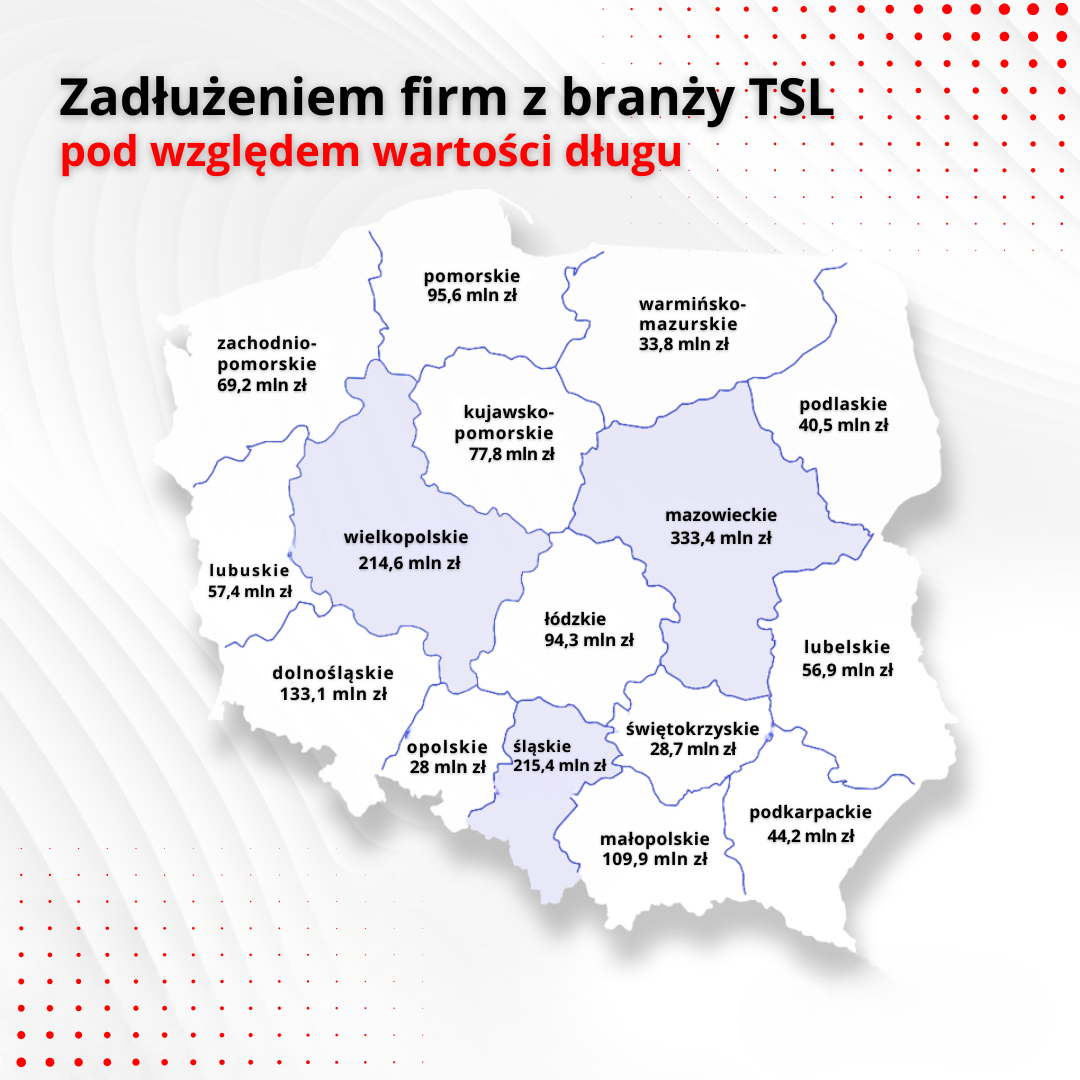
Credibility in question
An analysis of payment credibility, conducted by the KRD, shows that only 65.8 percent of transport companies have high credibility, 21.5 percent have medium, and 12.7 percent have low. This means that every eighth company in the industry is in a high-risk zone for insolvency.
It is worth noting the phenomenon of payment bottlenecks. Carriers declare that they are the second most burdensome barrier to doing business (54 percent). Meanwhile, in the National Debt Register, transporters have placed only 11.7 thousand debtors with total arrears of PLN 197.7 million. This is relatively little compared to the industry’s own liabilities of PLN 1.64 billion. Some entrepreneurs cope differently – they use factoring or other forms of financing. However, a large group passively accepts the situation and takes no action, thereby giving up a real chance of recovering their money.
The transport industry has been struggling for years with chronic payment bottlenecks, which are one of the main barriers to its development. Clients often force 60- or even 90-day payment terms, yet carriers incur high operating costs every day: fuel purchases, leasing, driver salaries, or road tolls. This is felt most strongly by sole proprietorships, where the owner is also the driver and pays their own salary. In practice, this means that they often work for free while waiting for a transfer from a client for a completed service. In the domestic transport industry, these are the most common types of companies, and based on our experience in debt recovery, we see that many carriers avoid confrontation with the debtor. They hope for an automatic improvement in business relations and accept the prolonged waiting for transfers. And this may never happen, because already 12 percent of transport companies are on the verge of high insolvency risk. – notes Jakub Kostecki, President of the Management Board of the debt collection company Kaczmarski Inkasso.
Bankruptcies and restructurings – transport in fourth place
According to data from the Central Economic Information Center, 207 company bankruptcies were announced in the first half of 2025, and transport and warehousing took fourth place in this ranking. Restructurings are an even bigger problem – there were 2,610 of them by July, of which 358 concerned the TSL industry, which also places it in fourth position.
Of the companies that declared bankruptcy, 17 were listed in the KRD as debtors three years earlier. In the case of restructurings, 195 companies had a similar history. The total debt of these companies on the day the court decision was announced amounted to PLN 36.7 million. These data prove that the industry’s financial problems are chronic and have been growing for years.
Costs, regulations, and barriers for small carriers
The industry’s troubles are deepened by regulatory and cost factors. The Mobility Package, growing ESG requirements, and the need to replace second-generation tachographs increase the costs of doing business. Added to this are rising salaries for drivers and support staff, as well as increasingly higher financing costs. Large companies have greater capacity to absorb these expenses, while for micro-entrepreneurs, they often represent an unbearable burden.
Sentiment – between optimism and uncertainty
In August, the GUS general business climate indicator for transport and warehousing was -0.4, while 1.1 points were recorded in July. In turn, the Monthly Business Climate Index developed by the Polish Economic Institute for TSL fell to 89.7 points from 100.8 points in July.
The main reason for such a significant decrease in this value was, on the one hand, a decrease in the percentage of companies declaring that they have funds allowing them to operate for more than 3 months, and on the other hand, an increase in the share of companies declaring a decrease in sales value and the number of orders.
Outlook for the end of the year
The last months of the year will be a test of resilience for the industry. The traditional peak in transport in the fourth quarter may improve liquidity, but with strong competition for rates, this effect may be limited. Hope is provided by growing imports from European Union countries, which partially compensates for the declines in exports to the United Kingdom.
In the longer term, companies that can effectively manage liquidity, diversify their operations, and invest in the digitalization of processes will gain an advantage. Those that stick to the traditional model may have increasing difficulty staying in the market.
Source: KRD