








Although paper and wood are considered natural, their transport cannot always be described as such. What logistics solutions should be considered to move towards sustainable transport?
Eco-friendly transport starts with eco-friendly sourcing
The wood and paper industry worldwide can be subject to FSC (Forest Stewardship Council) chain of custody certification. A certificate granted by this organization confirms that the product comes from a certified forest and meets rigorous environmental requirements. Although holding this document is not necessary to operate in these industries, it can bring many business benefits, especially considering the increased environmental awareness of today’s society.
The assessment of products before being awarded the FSC certificate covers various areas, including the transport of raw materials. By offering sustainable paper transport and wood transport, it is possible to establish business partnerships with investors who care about confirming that this process takes place with minimal impact on the natural environment.
Challenges in the transport of paper and wood
It is worth keeping in mind that cargo consisting of paper, wood, and their derivatives belongs to a group particularly sensitive to damage. The greatest threat here is water, as products from these categories exhibit high hygroscopicity. Contact of wood with water threatens it with dampness and increased pest activity. In the context of paper and cellulose, this primarily means swelling or molding.
From the carrier’s point of view, this boils down to the need to create appropriate transport conditions. For the cargo to arrive in an unimpaired state, it must be enclosed in packaging resistant to temperature fluctuations and moisture. It is also necessary to implement solutions aimed at controlling conditions inside the trailer or container where the paper or cellulose is located. This is served by a so-called active shipping system, which allows for monitoring conditions in the transport space in real time.
Contrary to appearances, paper wound on a spool is characterized by much greater weight than one might assume. For this reason, the carrier is under an obligation to properly secure it for the duration of transport. Strong cargo straps and paperliner systems with longitudinal rails and wedges locking the rolls in one position often prove to be the choice here.
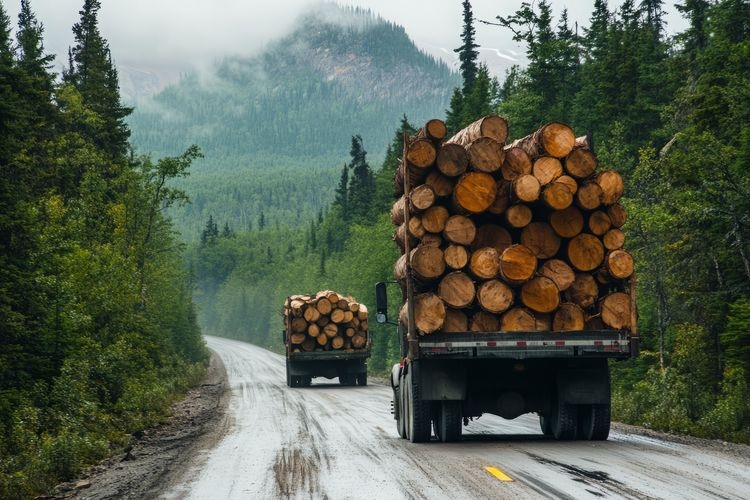
When it comes to wood transport, the biggest challenge turns out to be so-called long timber, i.e., lumber of non-standard length. Its road transport must take place using specialized equipment, including, for example, a trailer with an extended profile with an extended load or a telescopic trailer. Particular attention should also be paid to the safe packing of bundles and even loading of the cargo space. If the cargo qualifies as oversized, it is also necessary to obtain the required permits.
Logistics solutions in the service of sustainable paper and wood transport
Taking into account the need to maintain controlled conditions during the transport and storage of paper, cellulose, and wood, planning transport in an appropriate way favors environmental goals. Any changes in the means of transport or temporary storage in a warehouse involve the need to involve additional human factors and power systems used to maintain moisture and temperature at a specific level.
Therefore, the route should be optimized in such a way that the cargo reaches point A to B in the shortest possible time, excluding stops that are not absolutely necessary. For this reason, door-to-door transport carried out by an experienced logistics partner will prove to be the most ecological.
It is also worth ensuring that eco-friendly solutions are used for packing and securing cargo. Where stretch film can be dispensed with without harm to the transported products, it should be excluded. In other cases, it is recommended to limit it to a minimum. Modern cargo securing solutions will also prove helpful, e.g., dunnage bags (useful for filling the space between paper rolls) or shoring bars and beams.
In the context of sustainable transport, it must also be remembered that vehicles used for transporting wood and paper are exposed to difficult working conditions. Therefore, their technical condition should be checked more often than in the case of vehicles handling lighter loads. The more efficiently the fleet operates, the lower the carbon footprint it generates.