








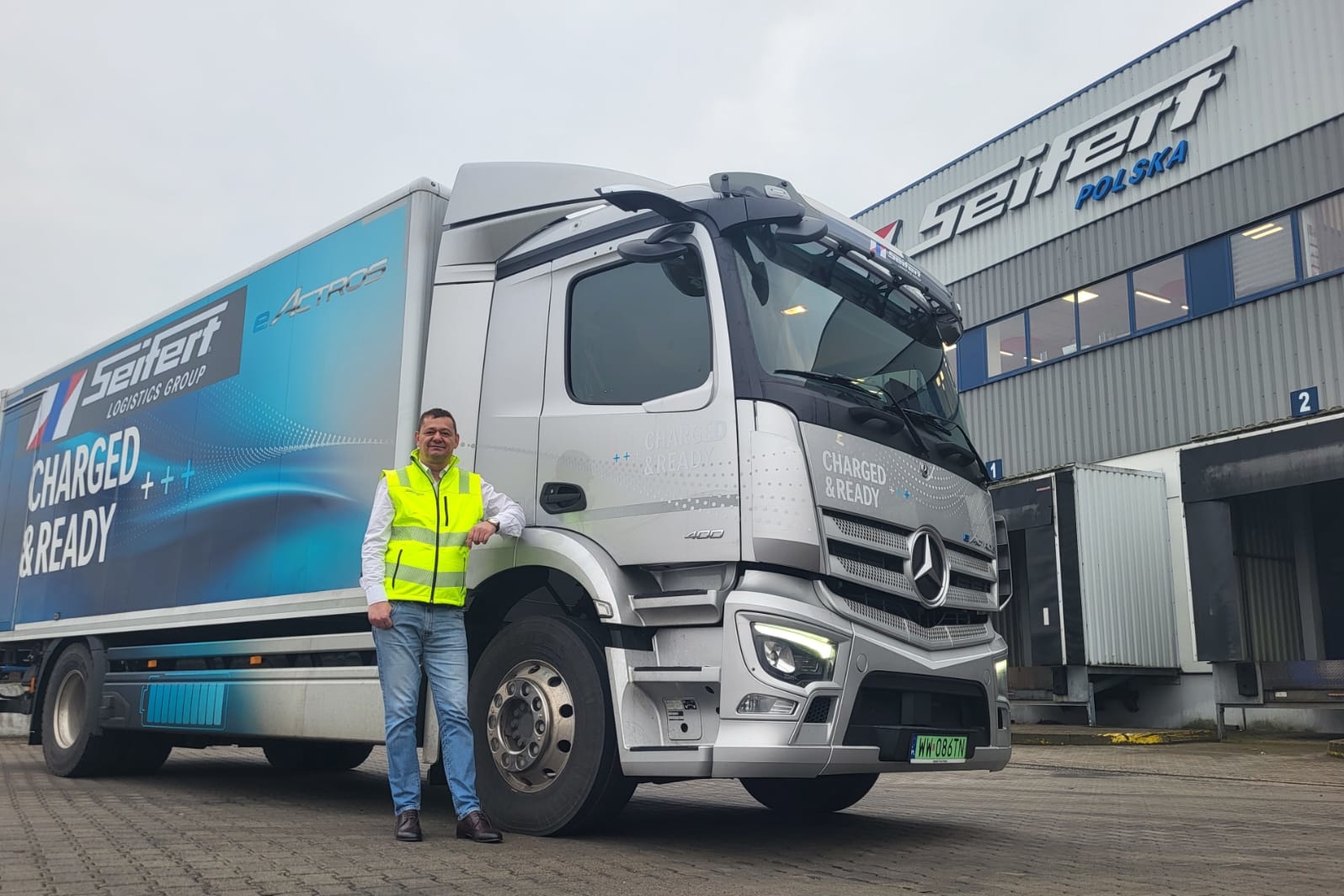
This has probably never been done before in Poland. The company Seifert Polska from Mysłowice has tested the performance of a fully electric truck in winter and summer. On the same route, with the same load, at the same times. What was the result of this trial? From Stryków to Ruda Śląska. And back. This was the test route covered by the eActros 400. A total of approx. 720 kilometers. How will the electric vehicle handle it? How much time will it spend plugged into a charger? What emotions will the driver experience?
There were many questions and doubts, and we wanted to get reliable answers. That is why we decided to conduct tests in real-world conditions. We were carrying out a real order for an important client.
– emphasize representatives of the transport and logistics company Seifert Polska.
Test from the driver’s perspective: Impressive acceleration
The first test took place in December of last year. The second one half a year later, at the turn of May and June. The eActros 400 covered the same route each time, loaded with automotive parts that, according to the order, were delivered to Mercedes-Benz workshops in Silesia.
The test drives in both cases lasted for a week and took place at the same times, ensuring – for the purposes of the tests – the most similar road conditions possible. What was the result?
Driving an electric truck pleasantly surprised me. Although I had undergone appropriate training, when getting into such a vehicle for the first time, I had significant concerns. Now I know they were completely unnecessary. The ride is quiet and smooth, and the acceleration is truly impressive. Initially, during the first winter test, I tried to drive gently, but later I drove normally, without constantly looking at the battery gauge and its range. I gained more confidence – says Mr. Krzysztof.
Battery consumption: a special system tracked the test
How much did the 19-ton electric truck “burn” on the route from Stryków to Ruda Śląska and back? Did the season of the year have an impact on battery consumption, and if so, to what extent? – These were some of the key questions we asked ourselves – admits Jarosław Brachmański, Director of Strategy and Development at Seifert Polska.
All doubts were quickly dispelled. The reason? All test drives were tracked by a special simulation system from Daimler Truck Polska, which provided the vehicle and monitored the progress of the tests.
Thanks to the Fleetboard application, we monitored the status of the lithium-ion battery with a total capacity of approximately 388 kWh from the eActros 400 model on an ongoing basis.
– says Damian Rendzikowski, eConsultant Zero Emission Vehicles at Daimler Truck Polska.
Battery in winter versus battery in summer
It turned out that the average energy consumption during winter driving was 82 kWh/100km, and in summer – 76.11 kWh/100 km. The difference, as is easy to calculate, is exactly 5.89 kWh. In favor of the warmer season, of course.
Costs depend, of course, on which charger we use, and to put it bluntly – on the electricity supplier’s price list. For a large transport and logistics company that regularly services specific routes, the difference between “fuel consumption” in winter and summer is significant.
– admits Jarosław Brachmański, Director of Strategy and Development at Seifert Polska.
The eActros 400 charged twice on the test routes. It started from the warehouse in Stryków at approx. 8:00 PM with a 100% charged battery. It charged at Daimler Truck Polska in Ruda Śląska – depending on the needs of the order – from 35% to 100% (correspondingly from 01:20h to 03:20h) and returned to Stryków. It finished the route at approx. 8:20 AM with at least 1/3 of a “tank” left.
Savings for the planet
Transport and logistics specialists predict that as the infrastructure for charging heavy-duty vehicles develops, costs will fall. They state clearly:
There is no doubt that electric trucks are the future of transport, and soon – simply a necessity resulting from European Union regulations.
– notes Prof. Wojciech Paprocki from the Department of Transport at the Warsaw School of Economics.
Let us recall; in March 2023, the Council of the European Union made a key decision, approving a regulation that sets new paths for the automotive industry. The regulations mandate a reduction in CO2 emissions, and consequently, a systematic withdrawal from the production of cars with internal combustion engines.
Interestingly, we managed to analyze the test route in terms of CO2. It turned out that we saved just over 417 kg of CO2. After all, electric transport is zero-emission – emphasizes Seifert Polska.
Source: Seifert Polska Sp. z o. o.