










E-commerce deliveries in Central and Eastern Europe: the second quarter of 2025 brings fewer refusals and more on-time deliveries.
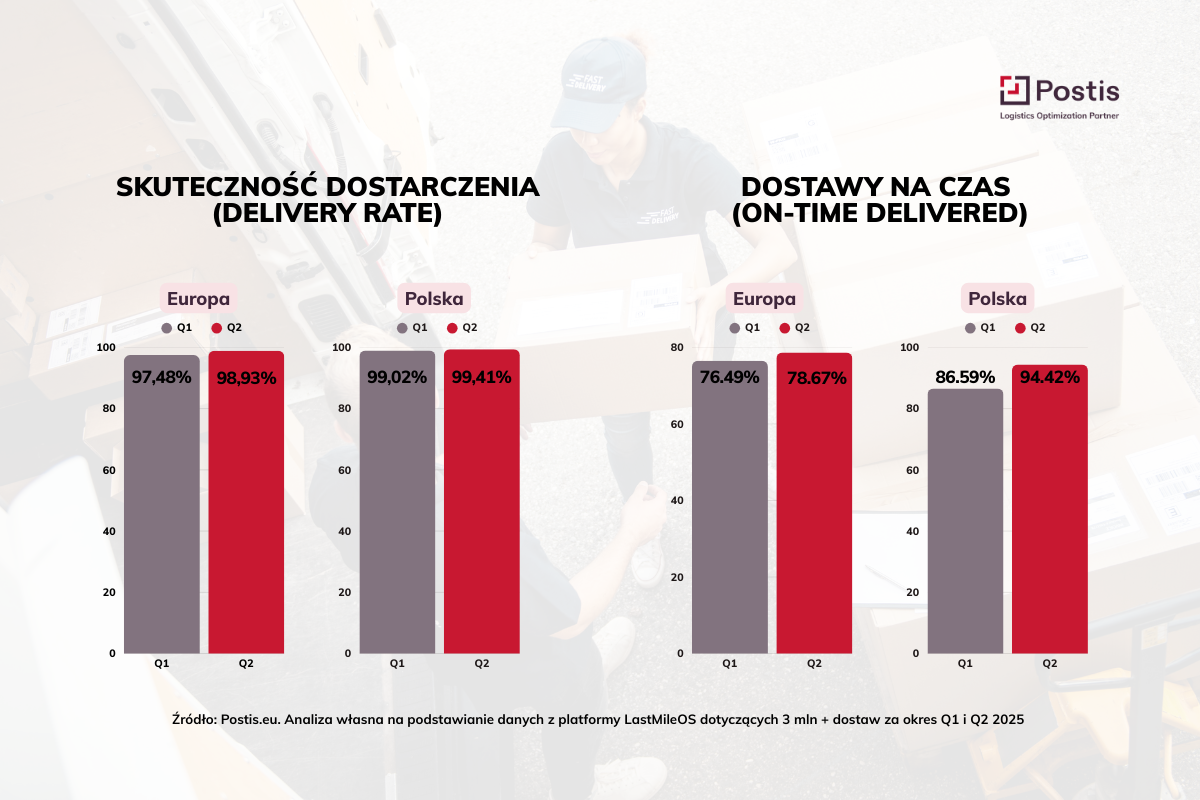
The average delivery success rate increased from 97.48 percent in the first quarter to 98.93 percent in the second (data covers over 3 million shipments). Even more telling is the change in the refusal rate: a drop from 2.52 to just 1.07 percent. Punctuality is improving slightly more slowly, but here too there is movement in the right direction – the percentage of parcels delivered on time increased from 76.49 to 78.67 percent. Although this means that one in five shipments still does not arrive on time, the trend remains positive.
- Following Q1 results, which showed issues with timeliness and a relatively high level of refusals in last-mile delivery results in Central and Eastern Europe, Q2 shows a positive trend shift.
- Data for the second quarter of the year provided by Postis, a provider of a last-mile delivery management platform, shows an improvement in key indicators: delivery success has increased, the refusal rate has decreased, and—albeit to a lesser extent—punctuality has improved.
- However, although parcels reach recipients more often and customers refuse them less frequently, statistics vary significantly between countries, which particularly affects order fulfillment for companies selling their goods on multiple European markets simultaneously.
Poland definitely stands out in the region, achieving the best results in Central and Eastern Europe in the second quarter. The delivery success rate was 99.41 percent, and refusals fell to a record low of 0.59 percent. Even more impressive is the improvement in punctuality – from 86.59 percent in the first quarter to as much as 94.42 percent in the second.
The Czech Republic maintains its position as a model market in terms of timeliness. In both quarters, the on-time delivery rate exceeded 91 percent, confirming the stability of the local delivery system. The situation in Romania and Greece looks slightly less optimistic. Romania still struggles with the highest refusal rates in the region. In the first quarter, the percentage of unaccepted shipments was 3.14 percent, and in the second it was 2.97 percent, which clearly indicates a need to improve service quality or align the offer with customer expectations. Greece, on the other hand, recorded a significant drop in timeliness – from 80.49 percent in the first quarter to 68.15 percent in the second. Interestingly, Greek customers showed great understanding regarding delays, as only 0.71 percent of parcels delivered late were ultimately rejected.
The most important observation from the data covering both quarters is clear: delays increase the risk of shipment refusal. In the second quarter, an average of 1.92 percent of parcels delivered late were returned, while for shipments delivered on time, this rate was only 0.97 percent.
As summarized by Damian Siusta, Business Development Manager at Postis in Poland, the first quarter of 2025 brought warning signs, while in the second we see improvement, although there are still a few steps to perfection. – In today’s highly competitive e-commerce environment, it is delivery effectiveness and punctuality that generate competitive advantages. While Poland and the Czech Republic show that high efficiency and timeliness are possible, and their successes can be an inspiration for neighboring markets, for everyone selling on multiple markets, differences in delivery timeliness can affect efficiency and the final bottom line – comments Damian Siusta.
Source: Postis