









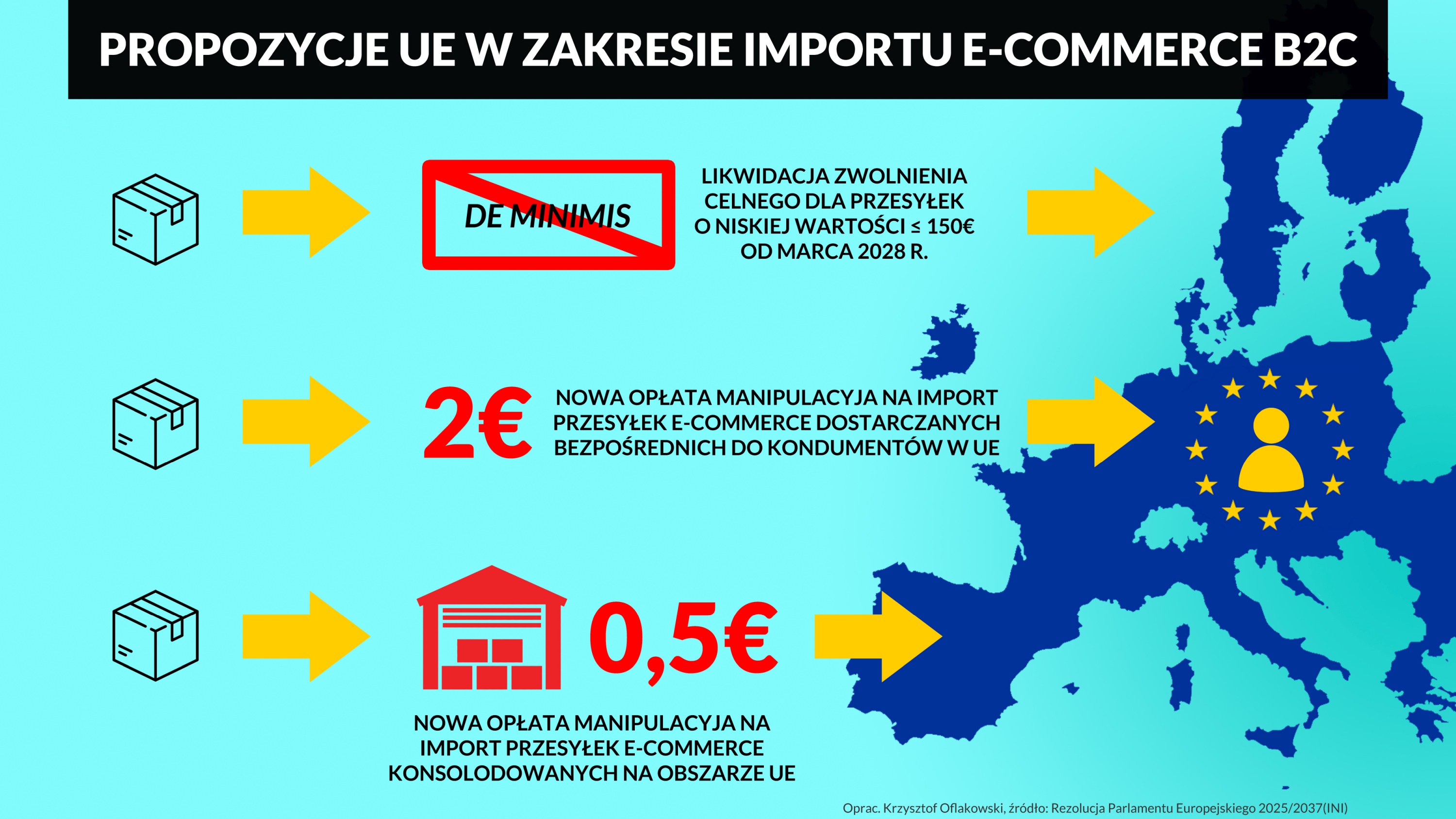
The European Parliament wants every e-commerce parcel imported from outside the Union to be subject to a handling fee of 0.5 euros, but only in a scenario where it first reaches a consolidation center and is then shipped to the consumer from there. Otherwise, the levy will amount to 2 euros. This is a unique opportunity for the contract logistics sector, which could manage such consolidation and deliveries on behalf of sales platforms originating mainly from China. These certainly need access to European consumers, even though the Union itself aims to limit the influx of online purchases from the Middle Kingdom, despite the fact that they generate growth, including in e-commerce logistics.
Events of recent weeks confirm that the European Union is consistently striving to limit the influx of foreign e-commerce, especially low-value goods exempt from customs duties, the import of which reached a volume of 4.6 billion parcels in 2024. This is about 12 million parcels per day or 145 individual packages cleared at the Community’s borders every second. Last year, as many as 91% of all such orders came from China, and estimates for this year assume a further increase in volume, which is favored by US policy. It is Chinese e-commerce that raises the most concerns and opposition and focuses the attention of EU officials, especially as the wave of incoming imports is gaining momentum. This is well illustrated by data from 2022 and 2023, when 1.4 billion and 2.3 billion cheap parcels worth up to 150 euros were imported, respectively.
The controversial topic of Chinese e-commerce has been discussed many times at various levels of the EU administration, but at the beginning of July this year, things accelerated slightly because the European Parliament adopted a report containing a number of interesting solutions proposed by the European Commission. Among many ideas aimed at, among other things, increasing the accuracy of inspections, ensuring product safety, speeding up customs clearance and relieving customs services, as well as increasing revenues for national budgets and the EU treasury, there were also three very interesting elements, including one with potentially huge significance for the European logistics sector serving online trade.
To start with, the elimination of exemptions and taxation
Certainly worth noting is the long-announced postulate of eliminating the customs exemption for shipments worth up to 150 euros, which according to the current calendar is to take effect from March 2028 and be part of a major EU customs reform. MEPs also conditionally supported the EC’s idea to impose a non-discriminatory handling fee of 2 euros on every e-commerce parcel originating from outside the Community. Conditional consent means that the EP wants the Commission to first check whether the fee will be proportionate, compliant with World Trade Organization rules, and whether it will not be passed on to buyers. The Union hopes that the levy will be covered by online platforms, even though the described changes will shake the foundations of the pricing policy and delivery model of Asian sellers.
The new tax imposed on imported e-commerce is to be fixed and apply to every shipment, regardless of its value. In practice, alongside financial, security, and control elements, the levy is also intended to act as a deterrent and reduce the volume of individual parcels flowing from China by directly increasing import costs. At the same time, there are declarations that further work aimed at Chinese e-commerce platforms is already underway in EU offices, although Brussels, through the words of the Commissioner for Consumer Protection, declares that it does not want to cut itself off from the Middle Kingdom, but will strive to reduce risks in trade relations.
Civilizing e-commerce imports through order consolidation in warehouses
The most important proposal from the point of view of logistics, however, seems to be the postulate that, in addition to the 2-euro tax, platforms should be offered an alternative in the form of a levy of only 0.5 euros, provided, however, that the imported goods are consolidated and sent to consumers from warehouses located within the Community. This is intended to strengthen the effectiveness of customs and market surveillance authorities and increase the effectiveness of inspections. The EP report even calls on Member States and the Commission to consider all possible ways to encourage such practices, including a simplified procedure for granting the status of an authorized economic operator. The practical justification for such a mode of processing Chinese e-commerce imports seems almost obvious. Inspecting and clearing shipments arriving at warehouses would be much simpler than checking every parcel sent from third countries.
Not only sales platforms paying a lower handling fee would benefit from such a model, but also contract logistics operators for the e-commerce sector, who would manage operations on behalf of the platform. The scope of their responsibility could be freely expanded, e.g., to include fulfillment or returns handling. The warehouse sector would also be a natural beneficiary of the proposed solution.
Chinese sellers are migrating to Europe anyway
The strategy of anchoring resources within target markets is not new, as Chinese platforms have been developing logistics capabilities in Europe for years, including in Poland. This applies not only to services originating from Asia but also to e-commerce giants from other continents. Each of the world’s largest sales platforms operating in Europe has either a local warehouse in our country, which very often also serves the regional market, or works closely with one of the last-mile operators. However, the existing strategies for expanding logistics capabilities were not motivated by imposed tax policy, but by the natural need to be present in the absorbent European Union market, where 77% of internet users shop online, of which as many as 46% order clothing, footwear, and accessories. Now the motivation is to have a different character and in practice will leave the services with no choice, because it is very unlikely that the platforms will maintain their current business model by paying an extra 2 euros for every order sent, especially in the scenario of the elimination of the de minimis exemption.
– explains Marcin Smoła, Chief Operating Officer at ID Logistics Polska, which provides comprehensive logistics and transport solutions, e-commerce handling, and supply chain management in 18 countries.
In practice, this process is already happening and is one of the reasons for the acceleration of the EU debate. The key issue, therefore, remains to utilize the huge potential that the presented proposals regarding the consolidation of orders within the Community create for the logistics sector. Undoubtedly, contract logistics will benefit from this, because even if we assume last year’s parcel volume of 4.6 billion units, each of them will need individual handling. Revenues from handling fees will also not be without significance, which theoretically in 2024 could have amounted to 2.3 billion euros, and for such an amount one could build 5 container terminals, exactly like the one opened in June at the Baltic Hub in Gdańsk. Certainly, the Community countries will compete to have the warehouses where parcels from China are consolidated built and operated in their territory. This would be a very positive stimulus for the development of the contract market and e-commerce logistics in Europe and an important impulse for countries such as Poland, which could strengthen its position as an important logistics hub in the region. We believe, however, that one should be very well prepared for such competition, both at the national and industry level.
– summarizes Marcin Smoła from ID Logistics.
Why would Chinese sellers pay extra for Europeans’ purchases?
Primarily because China does not have many alternatives, as the US customs salvo aimed at their platforms has already proven. It showed, by the way, how important the European market is for Asian e-commerce giants and what an important role the Union plays for their air transport.
Since mid-May this year, the customs exemption for low-value shipments imported from China and Hong Kong, for which the price limit was recently 800 dollars, no longer applies across the ocean. Instead, parcels handled by the US Postal Service (USPS) are subject to customs duties at a level of 54% or alternatively subject to a fixed fee of 100 dollars. Deliveries handled by commercial operators are in turn subject to customs duties of 30%. This is a strategy that the Union intends to partially follow, i.e., it wants to eliminate the exemption and impose new levies.
The effects of such practices were immediately felt by air transport
According to IATA, when the de minimis exemption was eliminated in the US in May and import duties were raised, air cargo transport work on the Asia-North America route recorded a decline of 10.7% yoy, and 12.3% compared to April. This was an exceptionally strong slump, especially since other important transport routes recorded growth. The Asia-Europe transport corridor, where some exports were redirected, gained 13.4% yoy and 2.3% mom. Transport work on the route connecting Asia and the Middle East also increased by 10.8% yoy and 3.9% mom, and a decline was recorded only on connections between Asia and Africa.
Analysts at Aevean had similar observations to IATA, according to whom the import of low-value e-commerce shipments from China to the US fell in May compared to April by as much as 43%, and Europe became the main market for cheap shipments. It was the European market and Southeast Asia that made the air export result in Chinese e-commerce at the level of about 400 thousand tons only 3% lower than in April. Data from subsequent months will show whether Chinese sellers will turn again to American consumers or intensify their activities in the European, Asian, or Latin American direction.
The EU fears exactly this scenario, i.e., the redirection of increased volumes of parcels to Europe, because the Middle Kingdom will likely not be satisfied with the loss or limitation of operations in both markets. This would negatively affect not only the sellers themselves but also the condition of their local aviation sector. As indicated by Rotate analysts monitoring air e-commerce flows, cheap shipments from China sent to both Europe and the US have a significant share in the structure of air transport. In 2024 alone, they reached a level of 1.2 million tons and accounted for 55% of total Chinese air exports.
Does the European logistics sector serving e-commerce even need cheap parcels from China?
If we take into account the official EU data regarding 4.6 billion low-value shipments, of which 91% came from the Middle Kingdom, this means that European logistics operators were involved to a greater or lesser extent in handling over 4.18 billion individual deliveries from China in 2024. The very scale of the operations conducted shows the potential that the largest platforms with Far Eastern roots have. The other side of the coin is that European logistics working for e-commerce needs every possible stimulus, because although it cannot complain about a lack of work, its growth rate significantly deviates from the other two competitors on the global podium.
According to data from the British analytical center Transport Intelligence (Ti), last year’s revenues of the European sector working for online trade reached a value of 94.6 billion euros, which means an increase of 9.4%. In the same period, the global market leader, i.e., North America, with revenues of 200.4 billion euros, recorded an increase of 14.6%, while Asia, with a value reaching 198.6 billion euros, grew by 14.9%.
The entire global e-commerce logistics market grew by 13.6% yoy in 2024, reaching a value of 521.9 billion euros, which is also a doubling of the result just before the pandemic, however, after subtracting inflationary factors, last year’s market grew in real terms by 9% yoy.
In 2025, the global e-commerce logistics and fulfillment market is expected to grow by another 15.5%, reaching a nominal value of about 602.8 billion euros. It is clearly visible that Europe is lagging behind, and it is not just about the result against the leaders of the 2024 ranking, but also about a longer perspective. The growth rate of the Asia-Pacific region in 2020-2024 was 11% and was slightly higher than in North America, which reached 10%. Europe can boast a result of 8%.
Europe could use a larger volume of e-commerce for at least a few other reasons
The first of these is the argument of the professionals themselves managing supply chains within electronic commerce, saying that the share of e-commerce in the total volume of goods handled within contract logistics will grow, and significantly so. Last year, as many as 30% of operators surveyed by Ti declared that online orders account for 41-50% of the total volumes handled. This is a much better result than the previous edition of the study, where products ordered online accounted for 11-20% of the total volume handled.
Last year, an additional 20% of respondents declared in the survey that e-commerce accounts for as much as 51-60% of all goods, but the situation is expected to look completely different in 5 years. More than 23% of contract logistics managers estimate that as much as 61-70% of traffic in the business will be generated by products sold online. Another 20% of respondents believe it will be 41-50%, and about 16% assume an e-commerce share of 51-60%. Less than 15% of respondents also believe that e-commerce will amount to 71-80%, and about 6% of respondents that it will be 81-90%. There are even those who assume that in 5 years the share of e-commerce in their business will be 91-100%, but they are only a few percent.
A clear evolution of the trend in the e-commerce logistics market can also be seen in the geographical reach of the goods handled. While in 2024, on average, 65% of e-commerce volume consisted of domestic flows and 35% of international ones, in 5 years the proportion is expected to change to 55% to 45%, respectively. Such a large increase is primarily expected to be the merit of the largest Chinese players, who are strengthening their popularity in Western markets and gaining ever-larger groups of customers.
So what does the global balance of power look like when it comes to online sales?
Data from ECDB shows that global B2C e-commerce sales of goods could reach just over 5 trillion dollars this year, which will mean a nominal increase of 9.7% compared to 2024, and in real terms by 5.1% to 4.562 trillion dollars. It is not yet known how the ongoing trade war and the imposition of mutual restrictions by countries will affect the estimates. It is known, however, that since 2017, the global B2C e-commerce sector has been developing at a very good pace of 14% on average.
This is mainly due to China and the US, which accounted for almost 70% of global e-commerce revenues last year. However, China had a decidedly dominant position, where the market value reached over 1.9 trillion dollars, which means that it generated 43% of the total value of the sector. In second place was the US with revenues reaching just over 1 trillion dollars, which corresponded to a 23% share in sales. In third place was Europe, where 694 billion dollars were spent on online purchases, which guaranteed 15% of the global e-commerce pie.
Forecasts for the coming years do not predict an e-commerce revolution in Europe, which is a pity
ECDB estimates show that in 2024-2028, the fastest-growing continent will be Asia, whose revenues will increase by 42.7% to almost 3.8 trillion dollars. Both Americas will grow by 36.1% to almost 1.67 trillion dollars. On the other hand, the third-largest continent in terms of market value, Europe, will grow the slowest, by only 27.1% to a value of 901 billion dollars. This is slower than Australia and Oceania (37%) and Africa, which is expected to develop the fastest in terms of growth rate, reaching 52.6% in 2028. However, the value of this market will be small and will amount to only 29 billion dollars.
It is also worth paying attention to one more fact that may help Europe achieve better results in the field of e-commerce. Currently, 72% of global B2C e-commerce revenues are generated on platforms operating in the marketplace model, and 6 out of the 10 largest services of this type have Chinese roots. In Asia, marketplace sites account for 97% of the revenues of the entire e-commerce sector. It is similar in South and Central America, where the share in revenues is 96%. It is completely different in North America and Europe, where the share of marketplace websites is 46% and 47%, respectively.