








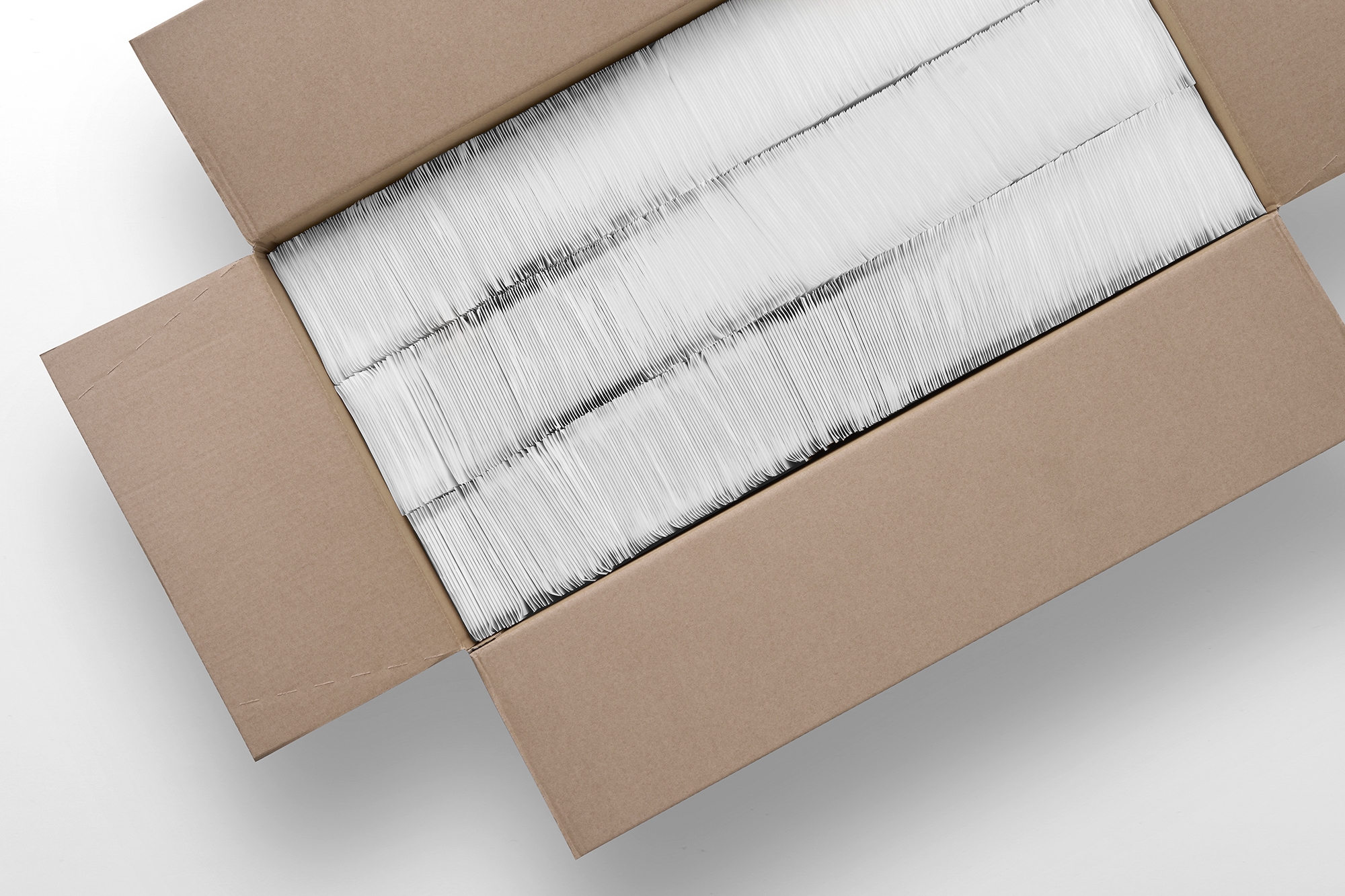
The inconspicuous pad hidden under meat, fish, or fruit is today much more than just a packaging element. It is a technology that protects food, extends its freshness, and in its modern form, is environmentally friendly. Although associated with controversy for years, it is now becoming a symbol of a shift in thinking about food packaging. How to distinguish a safe pad from a risky one? Can it be composted? And why could cellulose revolutionize the packaging market? Enverde shares its expert knowledge.
Media storm
In 2013, alarming reports circulated in the media: could the pads in meat packaging be harmful to health? This sparked a wave of questions and suspicions regarding the materials used. Although some headlines were exaggerated, this moment became a catalyst for important changes.
Today, more than a decade later, packaging technology has changed beyond recognition. The packaging industry, together with the food industry, has focused on safety, quality, and sustainable development. Absorbent pads – those inconspicuous “pads” under meat, fish, or fruit – have become an inseparable and very important element of food protection.
Their task? Absorbing excess moisture and liquids, such as blood, plasma, and fruit juices, which limits bacterial growth, improves hygiene, and thus allows the product to stay fresh for longer. It must be emphasized that a well-chosen pad can significantly reduce food waste – both in the store and in our refrigerator.
What are absorbent pads actually made of?
Not every absorbent pad works the same way – they differ not only in material but also in construction. In terms of structure, we distinguish open pads, which lack edge sealing and are more prone to structural delamination. As a result, cellulose fibers, for example, may enter the food. Closed pads, on the other hand, have sealed edges – a solution that eliminates the risk of product contamination.
From the perspective of the materials they are made of, absorbent pads are most often classified as monomaterial or multimaterial. Multimaterial absorbers are structures composed of several components, often including synthetic polymers with superabsorbent properties, such as SAP (superabsorbent polymer) or SAF (superabsorbent fibre). Although they provide high absorption efficiency, their construction and the presence of plastics exclude biodegradability, and disposal is possible only in the mixed waste stream. In contrast, monomaterial pads are produced entirely from one raw material, usually plant-based cellulose fibers. Such a structure not only enables material recovery but also promotes recycling – cellulose leaves behind long fibers that exhibit high durability and can be processed multiple times. Importantly, these pads are also biodegradable and compostable.
The solutions we are working on in the industry today are advanced technologies and real innovations in the area of auxiliary materials. Research conducted by the independent French research institute Centre Technique du Papier (CTP) has shown that pure cellulose pads can be recycled in the paper stream with a material recovery rate of 79.4%. For comparison, the average recycling rate for non-durable paper products is 43%, and for newsprint 65%. Just as importantly, this type of absorber – regardless of where it ends up – decomposes within 6 months without leaving any harmful traces in the environment. This is just one small element, but when we realize how many products it is in, it becomes clear that it too must be part of sustainable packaging design.
– says Przemysław Słomiński, CEO of Enverde.
Information responsibility – it is important today
Although an absorbent pad is just one element of packaging, its composition has a real impact on both food safety and the environment. Nevertheless, today we will not find information on most packaging about what it is made of. And yet, the market for auxiliary materials is changing dynamically.
Absorbers based on SAP and SAF are still widely used. At the same time, pads with a cellulose core combined with other synthetic components are increasingly being used, and in the most advanced cases, fully monomaterial solutions made of pure cellulose.
Why is this important? Because if a consumer encounters a pad containing SAP and it gets damaged, gel or absorbent powder may be released. Although these substances are approved for use in the food industry, they are not intended for direct contact with food. Such contact means that the product is no longer safe for consumption and may cause irritation.
Open absorbent pads are cut to the appropriate format before application to MAP-type packaging. In the case of these pads, two significant problems arise. First, production downtime resulting from the need to clean machines. Second, the risk that despite cleaning, dust remains on the line elements that cannot be completely removed. In practice, this means that food may come into contact with microplastics.
– emphasizes Przemysław Słomiński, CEO of Enverde.
Sustainable development is not just a matter of raw materials, but also of how honestly we communicate their presence. In times of growing consumer awareness, full transparency can become one of the most lasting competitive advantages.
Throw away, compost – what to do with the pad after use?
Pads that contain plastic elements, i.e., are a multimaterial solution, should by necessity be incinerated or remain forever in the mixed waste stream, i.e., in a landfill.
However, in the case of monomaterial pads made entirely of cellulose – both in the paper pocket and the core, e.g., made of cellulose – we are dealing with a solution fully compliant with the principles of a circular economy. Such a construction allows them to be classified into up to three different waste streams: bio (as biodegradable waste), paper (material recycling), and mixed waste. It is worth adding that these pads are also compostable in home and garden conditions. Furthermore, if they are not properly sorted, they will decompose on their own within 6 months, leaving no trace behind.
What is worth paying attention to when buying?
Although an absorbent pad may look inconspicuous, its construction and composition determine the safety of food – and our own. During daily shopping, it is worth taking a moment to assess the quality of this invisible but important packaging element.
Here is what to look for:
- Sealed edges – choose pads that have all edges evenly sealed. This prevents absorbent material or cellulose fibers from escaping.
- Odor – a good pad should not have an intense smell. The lack of a plastic or chemical scent often indicates the natural, non-synthetic origin of the material.
- Material structure – if the pad resembles thicker tissue paper, non-woven mat, or soft cardboard, it may be a cellulose-based product.
- Material markings and certificates – it is worth looking for symbols such as FSC®, compostability certification (e.g., EN 13432), or declarations of conformity with HACCP. This is additional confirmation of quality and a responsible approach.
- Manufacturer transparency – reach for products from companies that openly inform about the composition of the absorber and the type of absorbent material used. This is not only an expression of responsibility but also a market standard that should gain strength.
Of course, we know that there is no absolutely perfect solution yet, but today, it is precisely around cellulose pads that the most innovative work is concentrated. Their construction and the nature of the raw material allow for combining functionality with responsibility – and this currently makes them one of the most sustainable choices in the entire fresh food packaging system. The more we know, the better we choose – and it is conscious decisions that build a market that serves both people and the environment.
– concludes Przemysław Słomiński, CEO of Enverde.
Source: Enverde Sp.z.o.o.