









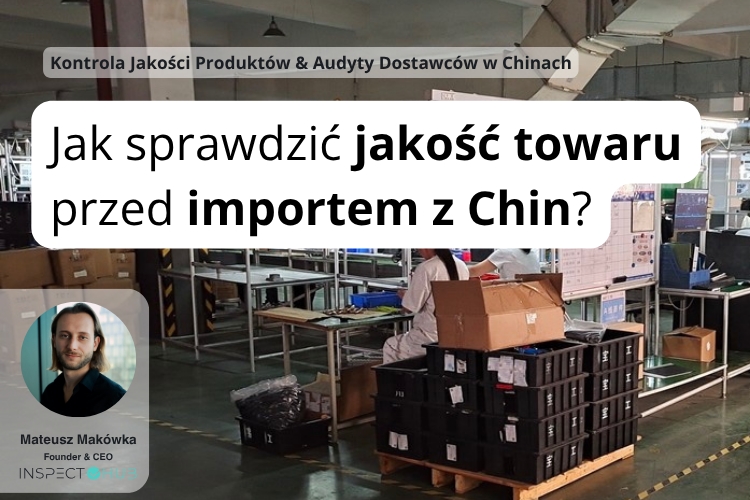
Importing from China is a huge opportunity – lower production costs, a wide selection of suppliers, and the ability to scale your business. But like any opportunity, it also carries risks. One of the biggest threats for importers is receiving defective or non-compliant goods. Worse still, they often find out about this only after opening the container, when it is already too late. In this article, we present concrete and proven methods for quality control in China that will allow you to conduct safe imports – without stress or unpleasant surprises.
1. Why is quality control in China necessary?
Let’s start with the basics: why is it worth checking the quality of goods before they are shipped from China? Unlike shopping in Europe, in China, the rule is often: “Deliver what the customer ordered – not necessarily what they expected.” What does this mean? If you do not specify your requirements in detail and verify that they have been met, the goods may be manufactured using the cheapest available materials. For many Chinese manufacturers, “quality” is a relative term – unless you clearly define it and verify it before shipment.
2. When is it worth conducting quality control?
It is best to plan inspections at various stages of production. Here are the three most important moments:
a) Initial Production Check (IPC)
When production is at the 0-20% completion stage, inspection companies check:
- Whether production has started on schedule,
- Whether production complies with the order,
- Whether the correct materials are being used,
- Whether the production method is appropriate.
b) During Production Inspection (DPI)
When about 20–80% of the order is ready, you can check:
- Whether production is proceeding according to the arrangements,
- Whether the correct components are being used,
- Whether recurring defects are appearing.
This is the perfect moment to identify problems and avoid them being repeated throughout the entire batch.
c) Pre-Shipment Inspection (PSI)
The most frequently chosen form of inspection – carried out when at least 80% of products are ready and packed. During this process, the following are checked, among others:
- compliance with specifications (dimensions, appearance, colors, functions),
- quality of workmanship and finishing,
- packaging and labels,
- completeness of the order.
d) Container Loading Check (CLC)
At this stage, the inspector supervises the physical loading:
- ensures that the correct goods are going into the container,
- checks the quantity and markings,
- checks how the cargo is secured.
This is the last chance for intervention before the products leave China.
More information on inspections at various stages of production can be found at https://inspectohub.pl/uslugi/inspekcje-produktow
3. The golden sample? Don’t be fooled
Many importers rely solely on the so-called golden sample, i.e., an approved product sample. This is a mistake that can cost dearly. Why? In China, samples are often created in special “sample rooms” using better materials and greater care. Mass production is a completely different story. The result? The order differs significantly from the sample. Conclusion: the sample is a point of reference, but the quality of mass production must be confirmed independently.
4. What does a professional inspection look like?
A professional inspection of goods in China – carried out, for example, by a company like InspectoHub – consists of several key stages:
- Random selection of samples according to the international AQL (Acceptable Quality Limit) standard,
- Detailed check of compliance with documentation: dimensions, functions, materials, aesthetics,
- Mechanical and functional tests (e.g., button operation, tightness, durability),
- Evaluation of packaging and labels,
- Full photo documentation and report,
- Clear recommendation: accept or hold the shipment.
Everything takes place on-site at the factory – by an independent inspector who is not affiliated with the supplier.
5. What if you don’t have a specification?
This is a common problem – importers have a general idea of the product but do not have a ready technical specification. Example: “cotton t-shirt with a print.” For the manufacturer, this is too vague.
What should be included in the specification for the inspection to be effective:
- exact material composition (e.g., 100% cotton, 180 g/m²),
- allowable dimensional tolerances,
- print description (technique, size, location),
- guidelines regarding packaging and markings (e.g., tags, barcode, instructions in Polish),
- quality standards (e.g., no abrasions, minimum 95% color match to the sample).
The good news is that you don’t have to prepare this yourself. Professional QC companies will help you develop a so-called checklist for a specific product.
6. What does an inspection most often detect?
Experience shows that even with proven suppliers, problems can occur. The most common include:
- scratches, scuffs, paint defects,
- incorrect dimensions and lack of compliance with the design,
- missing parts (e.g., cables, screws, instructions),
- different materials than declared,
- malfunctions (e.g., non-working buttons, short circuits in electronics),
- lack of CE markings, instructions in Polish, or non-compliant labels,
- poorly secured packaging prone to damage during transport.
All of this can be detected before the goods leave the factory – and that is when it can still be fixed.
7. Do you have to fly to China to check the goods?
Absolutely not. Modern inspections are carried out by local teams – experienced inspectors who know the specifics of how Chinese factories operate.
How it works in practice:
- You send the supplier’s details, factory address, and product specification.
- The inspection company organizes a visit to the factory (even within 48 hours).
- The inspector conducts the inspection on-site and documents the results.
- You receive a full report with photos, descriptions, and a recommendation.
You don’t have to fly anywhere or know Chinese – everything happens remotely, with your full insight into the situation.
8. What to do if the inspection detects problems?
The most important thing is that you find out about the problems before shipment.
Thanks to this, you can:
- demand corrections or replacement of defective products,
- hold the shipment until the defects are removed,
- renegotiate terms (e.g., a discount),
- order a re-inspection after corrections.
This is a huge advantage. After shipment and customs clearance, your options are very limited, and the risk is on your side.
9. Summary – quality control is your protective shield
Importing from China offers many opportunities but also requires caution. Professional quality control is one of the best tools to avoid losses, stress, and complaints.
Remember:
- Always check the goods before shipment,
- Do not rely solely on a sample,
- Use the help of companies that know the local market and standards,
- The earlier you detect problems, the easier and cheaper they are to fix.
Need help?
At InspectoHub, we specialize in quality control of goods and supplier verification in China. We support importers from Poland and Europe in safe importing – quickly, concretely, and directly at the place of production.
Check out inspectohub.pl or write to us at contact@inspectohub.com. We will be happy to help you prepare a checklist, organize an inspection, or simply advise you on what to do in your situation.