








Vehicle fleets are a significant source of carbon dioxide emissions, especially in shipping and transport companies. The use of renewable synthetic fuels can significantly reduce their carbon footprint – however, the challenge remains in properly documenting this fact, for example in sustainability reports.
It is precisely for this purpose that Bosch has created the Digital Fuel Twin solution: it is software integrated into the vehicle that records the use of climate-friendly fuels and documents the reduced CO₂ emissions. Thanks to this solution, companies not only meet increasingly stringent reporting requirements but can also actively demonstrate their pro-ecological actions. The Digital Fuel Twin was used during the Tour d’Europe rally, the first stop of which was the Fuel Congress in Warsaw. During the rally across Europe to Brussels, passenger cars and trucks with internal combustion engines are refueling exclusively with renewable synthetic fuels at public gas stations.
Online documentation and verification
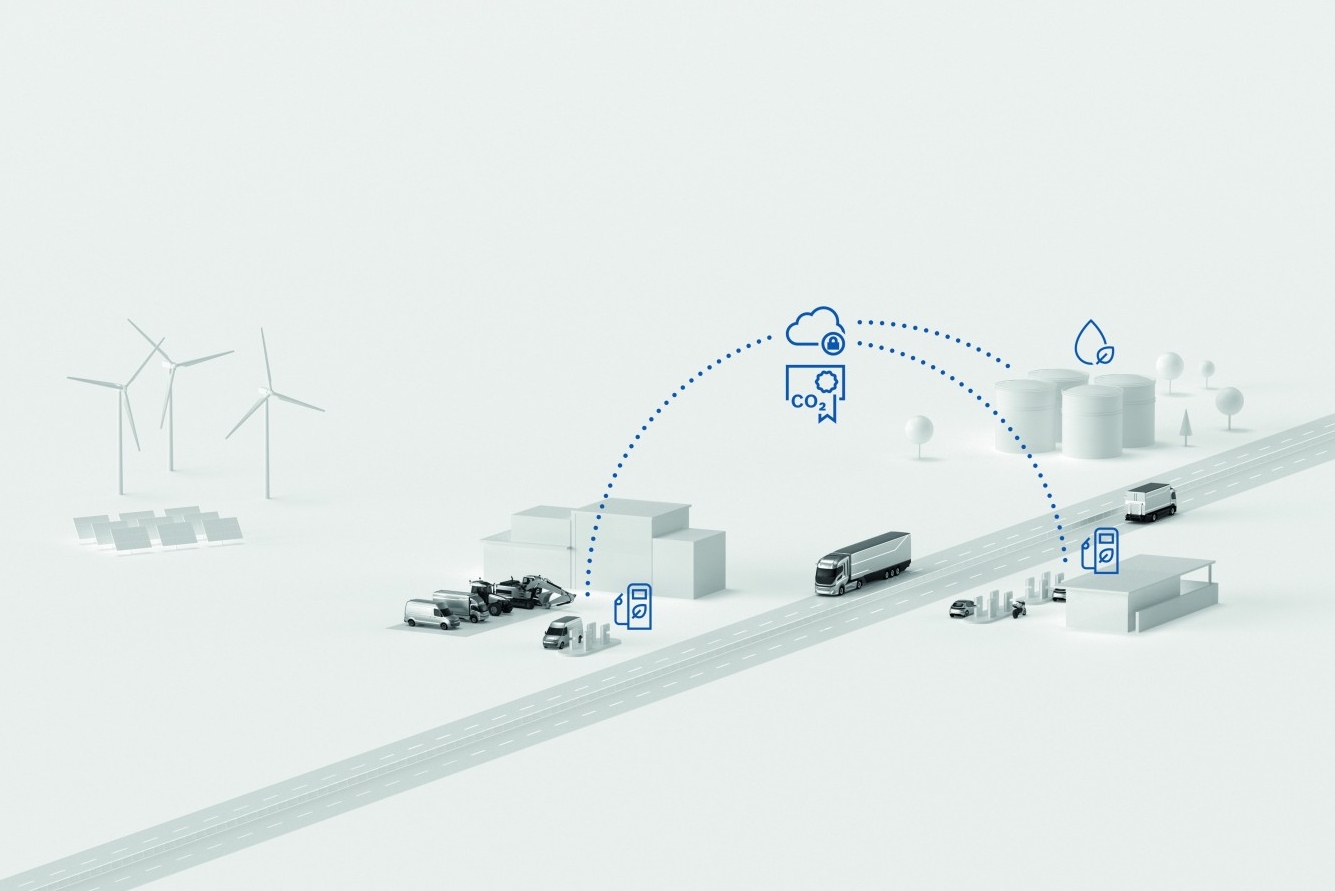
The new Bosch software enables reliable tracking of all fuel properties relevant from the perspective of climate protection – from production, through all stages of the supply chain, to the gas station and the final refueling of the vehicle. At the beginning, producers of renewable synthetic fuels provide Bosch with information about the quantity of fuel sold, the recipients, and the carbon footprint. In turn, transport companies report how much they purchased and when. The Digital Fuel Twin compares this data. If the time and quantity match both in the company’s records and with the data recorded by pumps and sensors, the fuel properties – such as its type, CO₂ content, and emission reduction potential – are passed on in the supply chain. Any carbon dioxide emissions generated during further transport are attributed to the fuel – which means that the shorter the distances, the lower the impact on the climate. Ultimately, at the gas station, a so-called digital handshake occurs – an exchange of data from the gas station, the vehicle, and the cloud, where it is documented exactly how much fuel and of what type was refueled. Identification takes place, among other things, via the fleet management system. Such a database provides Digital Fuel Twin users with reliable information about CO₂ emission values regarding the fuel used, as well as proof of its consumption for presentation during an audit. Data is always digitally mapped as a virtual twin in a secure data space in the cloud. The Bosch solution can be used not only in passenger cars, trucks, and buses, but also in construction machinery and even on ships.
The Digital Fuel Twin is currently being tested in cooperation with numerous partners at all stages of the fuel supply chain. The reliability and security of the system are being verified together with vehicle manufacturers. So far, the Digital Fuel Twin has been installed as a retrofit in existing vehicles, but in the future, it will be fully integrated into the vehicle’s electronics. Such a solution will ensure protection against tampering and enable unambiguous identification of the use of renewable synthetic fuels in a given vehicle.
Bosch’s Digital Fuel Twin makes it easier for companies to demonstrate that they are using renewable synthetic fuels. It provides auditable data regarding the quantity and carbon footprint of the fuel consumed for each vehicle, which can then be used in reporting. We expect the solution to be available in mass-produced vehicles as early as 2026.
– announced Thomas Pauer, President of the Power Solutions division at Bosch.
Renewable synthetic fuels available for many years
Renewable synthetic fuels are produced from plant raw materials or using renewable energy. Unlike petroleum-based fuels, they do not cause additional carbon dioxide emissions into the atmosphere. Some of these fuels have been available for many years. The most widely used is HVO100 fuel derived from waste oils and plants. Taking into account CO₂ emissions from both the fuel itself and its production process (the so-called well-to-wheel analysis), this type of diesel provides up to 90% reduction in CO₂ emissions compared to its traditional petroleum-based counterpart. For gasoline engines, the E85 ethanol fuel, based on bioethanol, is also an alternative. Both fuels – both HVO100 and E85 – are already available at over 5,000 gas stations across Europe, including in Poland. Since April 17, 2025, quality requirements for HVO have been introduced in Poland, making its domestic production possible. Previously, the distribution and sale of this fuel took place via a mutual recognition clause, but now these operations can also be carried out on the basis of national regulation.
Another application of the Digital Fuel Twin will be possible when vehicles with internal combustion engines are reclassified as zero-emission vehicles. The condition is to use only renewable synthetic fuels in them. The EU intends to look into this issue this year. The current plan, starting from 2035, assumes imposing fines on all manufacturers of internal combustion vehicles at such a high level that their sale would cease to be profitable.
Renewable synthetic fuels should be part of the solution. This is the only way to achieve climate goals in the transport sector. If the EU decides to change the classification, the Digital Fuel Twin could be an important tool in its implementation.
– noted Pauer.
Source: Bosch Group