








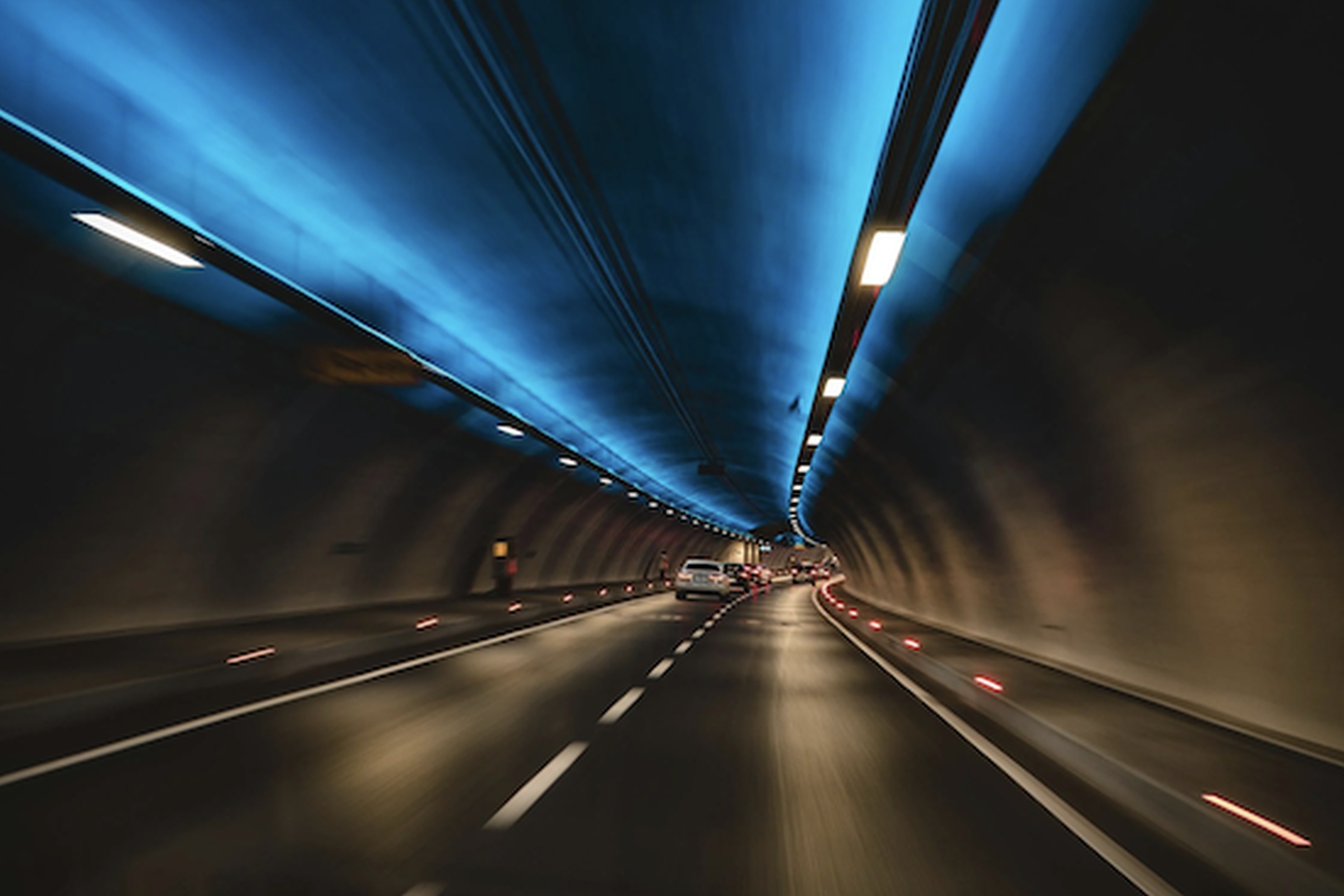
The total length of all road tunnels in Poland will soon exceed 25 kilometers. Are they adequately protected against fire? Regulations do not require the latest extinguishing solutions. Developed by specialists, the “Description of needs and requirements for road tunnels” indicates principles and best practices. From spring to autumn, tunnel traffic is at its peak. During the holidays, up to 1.5 million vehicles pass through the “Zakopianka” tunnel, with over 44,000 cars on record days. When is a driver not allowed to enter a tunnel?
Poland is not among the leading European countries with the greatest length of road tunnels, yet more are being built every year. New, even longer underground arteries shorten travel time and increase travel comfort. They also raise questions about safety, especially in the context of fires. A significantly greater emphasis on improving safety in this area occurred in Europe after two tragic fires at the turn of 1999-2000 in the Mont Blanc tunnel and the Tauern tunnel in Austria. Currently, a number of factors are taken into account at the design stage to exclude or at least minimize the probability of such events.
Fortunately, in recent years, there have been no incidents as serious in their consequences as those at the beginning of the current century.
The number of road tunnels in Poland is constantly growing
As of the beginning of 2025, seven road tunnels were in operation in Poland. The plans of the General Directorate for National Roads and Motorways (GDDKiA) assume that their number will soon increase to 18. Eight underground crossings are under construction, and three are in preparation, including a record-breaking tunnel under the Oder, which is expected to be over 5 kilometers long. The total length of all tunnels in Poland, after the completion of planned investments, will increase to 25 km.
Today, the longest existing tunnel in our country is located in Ursynów, Warsaw, and is 2,335 m long. Next on the list is the one on the Bolków-Kamienna Góra route (2,300 m), built together with a shorter one located a few kilometers away, measuring 320 m. On the S7 Lubień-Rabka Zdrój route, we will pass through a 2,058 m tunnel, and when driving to Świnoujście, a 1,485 m one. Relatively long are also the tunnels on the S1 between Szare and Laliki (678 m) and the two newest ones on the Krakow bypass (653 m and 496 m). This year, the opening of another facility on the S1 expressway in the Żywiec Beskids is planned.
New needs and requirements for tunnels
The result of the constantly growing number of tunnels in Poland is the development in July 2023 by GDDKiA specialists of a document titled “Description of needs and requirements for road tunnels.” This document defines requirements regarding, among other things, ventilation systems, excavation, traffic control systems, pavement, and fire protection systems. Its authors argue that adopting uniform requirements will allow for the development of optimal tunnel designs based on gained experience and current technical knowledge.
The guidelines contained in this document may be a valuable contribution to applicable regulations in the future. Current law in this area is based on Directive 2004/54/EC of April 29, 2004, the Regulation of the Minister of Infrastructure of June 24, 2022, and the Regulation of the Minister of Transport and Maritime Economy of May 30, 2000. Although these regulations define technical conditions for road engineering structures, as experts point out, they do not take into account all modern extinguishing solutions that could significantly increase the level of safety.
One such solution is, for example, the use of high-pressure water mist. The Montreal Protocol, which led to the withdrawal of halon from use, contributed to its popularization. Currently designed and implemented high-pressure water mist extinguishing systems are an effective and proven technology, confirmed by full-scale fire tests performed in cooperation with accredited laboratories such as IBS, VdS, SINTEF, and PAVUS. Water mist is effective even under extremely high fire loads (up to 200 MW) and at fire temperatures exceeding 1000°C.
– says Krzysztof Majcher, an expert in fire protection systems at SPIE BTS.
Growing requirements demand the most effective systems
Current requirements for Polish road tunnels include a number of safeguards such as: early fire detection systems, alarm points with fire extinguishers (placed every 125 m) and hydrant niches, or rescue niches and cross-passages between tunnels (every 250 m). They also speak of the need to place emergency and evacuation lighting, advanced reversible ventilation systems directing smoke in the direction of traffic, or the need to install voice and text information transmission systems and radio communication.
The aforementioned tunnel on the S3 route – Bolków-Kamienna Góra was built according to these guidelines. It is not only the newest but also the longest currently existing non-urban tunnel in our country.
In the face of growing safety requirements, it is necessary to use technologically advanced extinguishing systems based on the excellent physical properties of the extinguishing agent, and such is water mist. Systems incorporating it are used to protect spaces where the priority is the safety of people, equipment, or protection against losses. The high durability and effectiveness of a system using water mist is another advantage.
– says Krzysztof Majcher.
During a fire, water mist absorbs a huge amount of heat from the fire source during water evaporation (1 liter absorbs approx. 2.26 MJ of heat), locally lowers the oxygen level as a result of turning into water vapor, and reduces radiation, effectively reducing the risk of fire spread and re-ignition.
– adds the SPIE BTS expert.
High-quality stainless steel nozzles are used in tunnels, which ensure reliable operation and long service life in environments burdened with dirt and exhaust fumes. The special design allows for minimal installation height and easy integration with other tunnel elements. The variable configuration of the nozzles makes it easy to adapt water mist nozzles to different fire capacities.
Solutions successfully used throughout Europe
All these factors mean that many European countries have decided to install water mist extinguishing systems in tunnels on their territory.
Such solutions can be found, among others, in the Austrian Mona Lisa tunnels in Linz (length 850 m), the facility connecting Salzburg with East Tyrol, the Felbertauern Tunnel with a length of 5,300 m, but also in the Lieferinger Tunnel (500 m) and the Arlbergtunnel (13 km 970 m). The Netherlands also uses this technology, e.g., in the Roertunnel (2,450 m), and Great Britain in the Heathrow Main Tunnel (2,500 m).
When can we be asked to leave a tunnel?
During the upcoming holiday season, tunnel traffic will increase, and many road users will use this type of crossing. In the “Zakopianka” tunnel, i.e., under Luboń Mały on the S7 route, traffic intensity increases significantly during the holidays. For example, in the first week of the 2024 holidays (June 24-30), the average daily number of vehicles was 26.4 thousand, and the highest recorded daily traffic occurred on August 11, 2024, when 44,217 vehicles passed through the tunnel. Over the seven weeks of the holidays, almost 1.5 million cars traveled the route.
The safeguards used in the tunnels are safe, but one must remember to follow a few rules.
A driver may be asked to leave the tunnel immediately in the event of a fire, accident, hazardous substance leak, tunnel system failure, emergency services operation, or terrorist threat. After noticing warnings in the tunnel, the driver should immediately follow instructions, leave the tunnel via the nearest exit, not stop unnecessarily, not turn around, and – if necessary – proceed on foot to the designated emergency exit.
If warnings are noticed before entering the tunnel, the driver has an absolute obligation to refrain from entering. Warning systems are integrated with the tunnel infrastructure and activated automatically in emergency situations. Ignoring them not only constitutes a serious violation of regulations but can also result in creating a real threat to the life of the driver and emergency services.
* data from https://www.gddkia.gov.pl
Source: Brandscope