








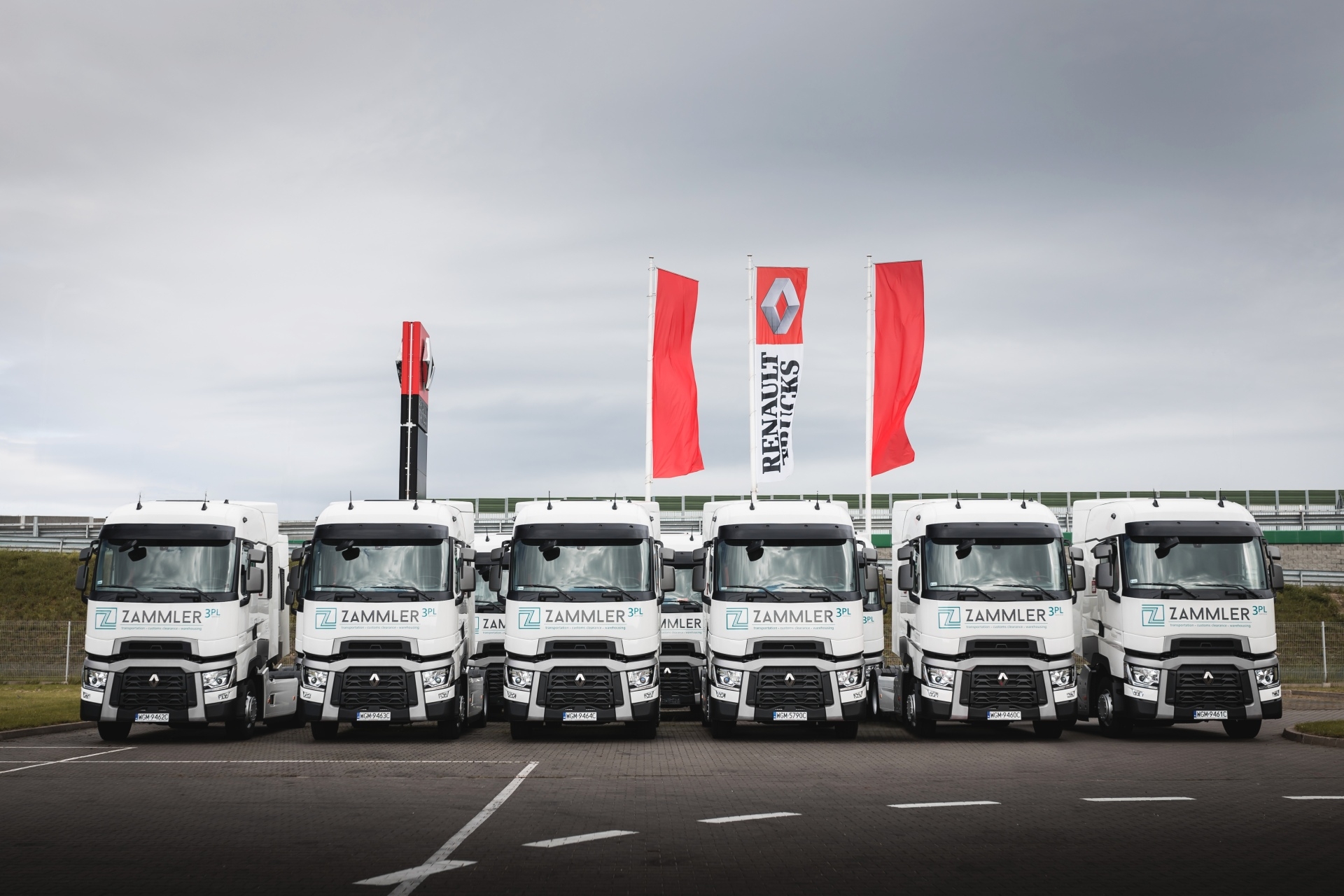
Every entrepreneur asks themselves how to win the race for the customer and grow in a demanding transport market during times of fierce competition? In the latest Eurowag report titled ‘Transforming Transportation ’24’, Artur Chojnacki from the Zammler Group, recognized in the Market Leader category, points out that the key to success in transport is a thoughtful and flexible approach, and that all changes should be made with caution, carefully observing market developments and reacting appropriately to the situation. In business, they rely on automation through technology, without which they would not be able to cope with the sheer volume of work. Artur Chojnacki talks about how to build a stable company in the TSL industry and face challenges.
10 years on the Polish market
The Zammler Group consists of 5 companies and 17 offices located in both Europe and Asia. The company specializes in road, sea, and air transport, and also offers customs brokerage and warehousing services. The company was founded in 2007 in Ukraine. Since 2014, it has been dynamically developing in Poland in Pruszków and has 51,000 m2 of warehouse space at its disposal. The company has been operating on the Polish market for a decade, employing approximately 130 people, and its fleet includes about 70 active vehicles and 85 trailers.
Two years ago, the company was included in the ‘Next250’ list of the most promising SMEs by Forbes magazine. The ranking included companies that achieved annual revenue between approximately 960,000 PLN and 96,000,000 PLN. The company’s total revenue at that time was 84,000,000 PLN. In Poland alone, the company generated revenue of 50,000,000 PLN for the previous year. In turn, the value of the Polish branch was estimated at 35,000,000 PLN.
The transport company’s clients include leading firms in the industry, such as FMCG, electronics and household appliances, e-commerce, industrial equipment, and pharmaceutical products. As Artur Chojnacki admits, “we primarily deal with transport transfers, and our main market is Western European countries. We focus on the transport of essential goods because we realize that this is a stable industry that is not threatened by crisis. The direction of our operations was conditioned by the pandemic times and then the outbreak of the war in Ukraine.
Technologies in the company are a standard
The company strongly focuses on work automation by using new technologies for transport. The company believes that the digitalization of the enterprise is necessary due to the scale of the company’s operations and advanced internal processes.
The technologies we use allow us to automate work in such a way that we are able to handle a large number of heavy goods vehicles with relatively low human labor input. We therefore use programs that will not only support staff in their work but also relieve them of many operational tasks – monitoring driver working hours, road restrictions, determining arrival times, and many other aspects
– emphasizes Artur Chojnacki.
Moreover, Artur Chojnacki notes that they are open to technological changes to further improve the company’s efficiency. Currently, they are cooperating with Eurowag on the implementation of the EVA system from Eurowag, which combines an EETS-standard toll payment tool with telematics. Additionally, EVA has a ‘Fuel Guard’ function, which protects transport companies against unauthorized fuel purchases.
We see much greater potential in EVA regarding vehicle tracking and toll management. This will allow us to reduce order costs and also help in managing tolls, which are a challenge with a large number of vehicles. Therefore, we believe that this change will definitely be for the better, because we care about scaling the business
– concludes Artur Chojnacki
Perspectives and trends for 2025
According to Zammler, the main challenge for transport is currently the economic slowdown, which every carrier feels, as well as the constantly rising costs of doing business. When asked about the strengthening trend and direction for the TSL industry, i.e., decarbonization, he replies that it is currently difficult to achieve for the vast majority of companies present on the market. “The policy of zero-emission transport is extremely important, but at the same time, it is too expensive and there is a lack of appropriate support for carriers at the EU legislative level. It should also be noted that further transport challenges are appearing on the horizon. These include the prospect of Ukrainian drivers leaving the Polish market due to possible difficulties in obtaining work permits, which may cause staffing problems and further cost increases. In the face of all these challenges, haste in transport is not advisable for business, and a thoughtful action strategy is needed, which must be constantly updated. If transport evolves towards zero-emission, we will want to follow it. One thing is certain – we have already achieved a lot in TSL and we want to continue to develop in the market – he concludes.
The report titled ‘Transforming Transportation ’24’ in the PL version is available at the link.
Source: Eurowag
Read also:
– Changes in transport regulations in 2025
– How to deal with the challenge of finding drivers?
– Does TSL electrification have a chance of success?