








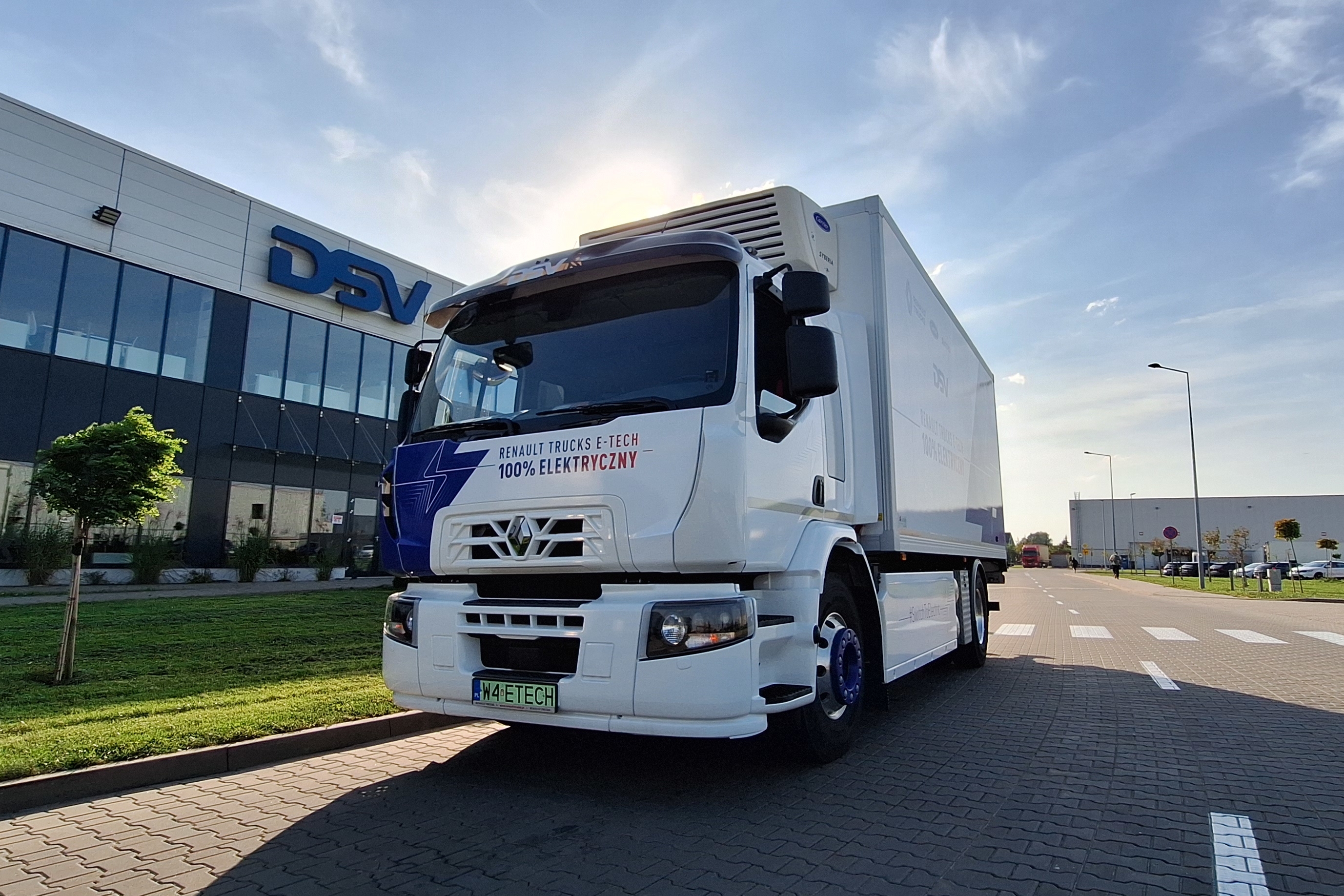
Is electrification the future of last-mile logistics? Experts from DSV – Global Transport and Logistics summarize the results of a test of a Renault Trucks electric heavy-duty vehicle, which supported the operator in carrying out distribution processes in the Warsaw metropolitan area for 31 days. The analysis of data from the trial provides two important conclusions for the logistics industry and thousands of professional drivers from Poland.
The transport and logistics (T&L) sector is responsible for approximately 20 percent of greenhouse gas emissions in the European Union. This means that the industry has a special role to play in the Community’s energy transition. An important element of the upcoming changes will be electrification, for which entrepreneurs in the sector are starting to prepare today.
One of the largest logistics operators in the world, DSV – Global Transport and Logistics, in cooperation with Renault Trucks, conducted a trial implementation of a 26t GVW electric heavy-duty vehicle, popularly known as a rigid truck, into regular distribution operations in the second half of last year. For 31 days, the vehicle performed routes between the DSV logistics center in Duchnice and the company’s clients in the Warsaw metropolitan area.
The vehicle covered a total of 1,727 km, supporting the execution of transport for clients in exactly the same mode as vehicles equipped with conventional propulsion. Importantly, during the test, we did not apply any preferences regarding the type of cargo placed in it. The goal of our pilot was to verify the efficiency of the electric vehicle in realistic logistics working conditions – and the conclusions may be surprising.
Piotr Czajkowski, Fleet Director at DSV – Global Transport and Logistics.
The key to transformation
Data analysis from the test conducted by DSV shows that the key to successful electrification lies not so much in the drive or the route profile, but in the hands of the drivers.
For all the test drivers who were invited to our pilot, it was the first opportunity in their careers to drive an electric-powered vehicle. However, at a certain stage, we conducted training for some of them on so-called eco-driving, i.e., the effective use of a vehicle powered by battery energy. The difference? Significant enough to change the entire business calculation. Proper use of vehicle systems, such as recuperation or cruise control, allows for a reduction in total energy consumption on the route by as much as 17 percent! This is a value that is visible in the costs of charging electric vehicles.
Piotr Czajkowski, Fleet Director at DSV – Global Transport and Logistics.
Due to the specifics of their operation, electric vehicles require a different driving style than classic diesel-engine vehicles. A good example is the recuperation mechanism, which allows for battery charging thanks to energy recovered while the vehicle is decelerating. To be able to fully utilize its potential, the driver must minimize the use of the brake and allow the vehicle to coast. For people who have worked on combustion engine vehicles their entire professional career, this means the necessity of changing very deeply ingrained habits.
How many chargers are needed on the route
Analysis of the data from the conducted test leads to one more important conclusion – distribution vehicles performing routes in urban areas do not require extensive battery systems or fast chargers. During the tests, the vehicle covered an average of 78.51 km per day, achieving energy consumption at the level of 94.15 kWh/100 km. While maintaining these parameters, even a vehicle with the minimum possible battery capacity for this vehicle model could operate for an entire working day on a single charge and replenish energy at night, after finishing work, without the need for fast charging.
This conclusion also means that for vehicles used in last-mile deliveries, there is no need to install an extensive battery system. This is significant because the battery is the most expensive and heaviest part of an electrified vehicle. Therefore, if operators and transport companies do not need large energy storage units in cities to guarantee the stability of supply chains, manufacturers such as Renault Trucks do not have to install them, which can reduce the cost of a new vehicle by approx. 10-15 percent. It is worth remembering that it is precisely accessibility — understood as the high cost of investment in a new means of transport and drivers’ concerns about convenient access to chargers — that is the main brake on the electrification of transport fleets.
Electrification is currently one of the most promising paths for the decarbonization of the road transport sector. As DSV’s experience shows, success in this area depends to a large extent on whether drivers master the technique of driving the new type of vehicle. This is a key aspect for the Polish road transport sector, which, thanks to electrification, can increase its competitiveness in Europe. For this to happen, the transformation must be carried out in such a way that the human being is at its center.
Source: DSV – Global Transport and Logistics