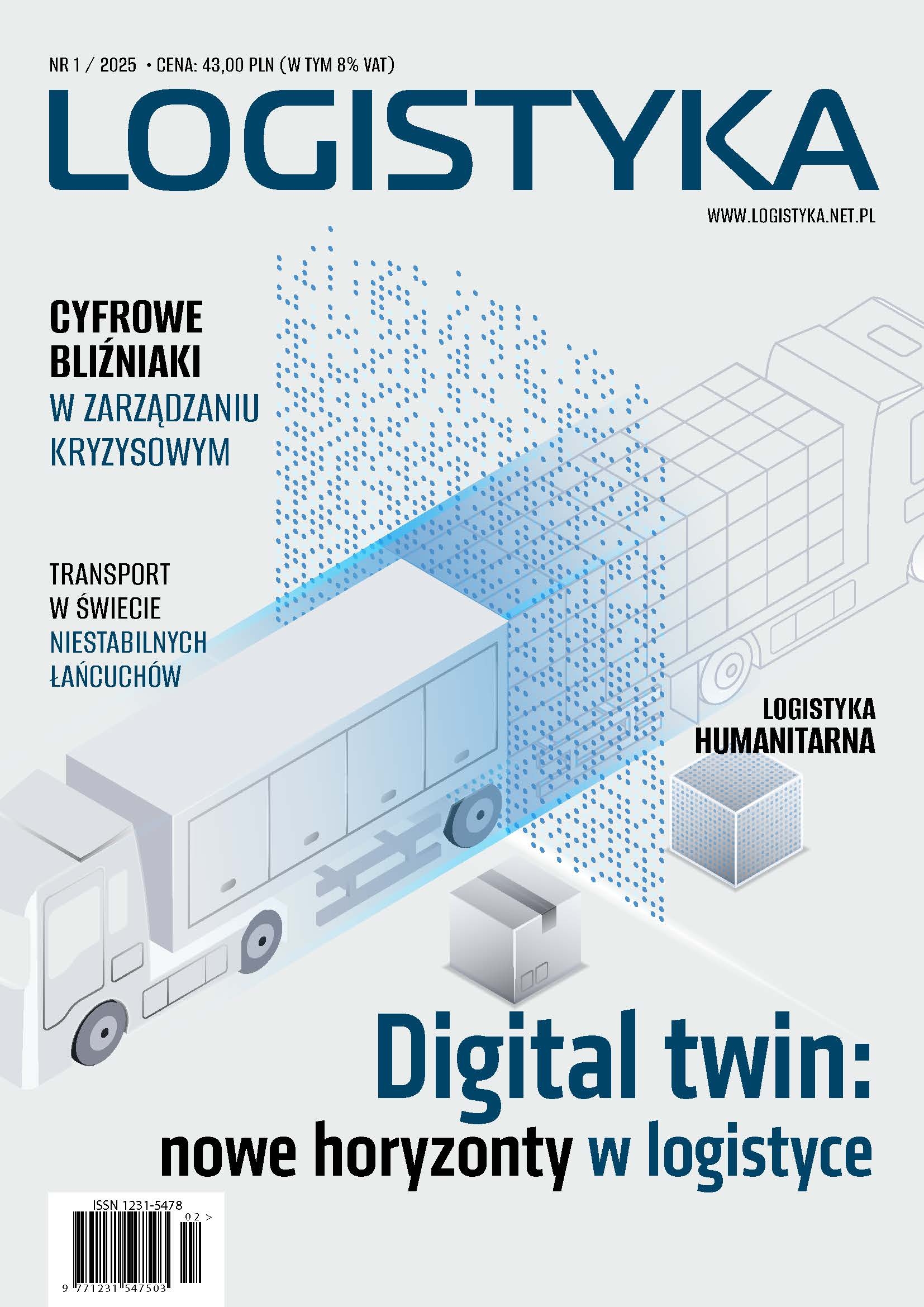
Recent years have clearly shown how sensitive supply chains are to unexpected disruptions – from the COVID-19 pandemic and the Suez Canal blockage to last year’s Red Sea crisis. In response to these challenges, the logistics industry is increasingly turning to advanced technological solutions, with the concept of digital twins coming to the forefront. In this issue of “Logistyka,” we examine how this innovative technology is revolutionizing crisis management in supply chains. We present concrete examples of implementations that confirm the effectiveness of this solution. A case study of Maersk shows how the use of digital twins allowed for a 20% reduction in container handling time and a 15% reduction in fleet operating costs. In turn, the story of the transformation of the American chain Kohl’s proves that this technology can also bring measurable benefits to the retail sector. It is particularly interesting that digital twins are no longer the domain of global corporations alone. The Polish market, although still at the beginning of this journey, is showing growing interest in this technology. The cooperation between PwC Poland and AWS (Amazon Web Services) is paving the way for further implementations that can significantly improve the competitiveness of domestic enterprises. In this issue, you will also find many other intriguing topics. We analyze the development prospects for ocean transport and seaports in 2025, look at the role of information management in humanitarian logistics in the article “People in the Spotlight,” and present the latest solutions in artificial intelligence for WMS systems using the Pinquark platform as an example.

Table of Contents
SUPPLY CHAIN MANAGEMENT
- Digital twins in supply chain crisis management
Global supply chains are extremely complex and sensitive to disruptions. - Retail transformation – how Kohl’s used a digital twin
The introduction of this tool completely changed the way the supply chain is managed. - Transport in a world of unstable chains
Transport routes in Europe have been under the strong influence of global turbulence for several years. - Ocean transport and seaports
Development prospects in 2025 - External employment as an answer to labor market challenges in logistics
Outsourcing or temporary work? - Deposit system in practice
An interview with ROBERT JANSEN, CEO of Deutsche Pfandsystem GmbH. - People in the spotlight
How information management supports humanitarian logistics. - The growing importance of parcel lockers in the global e-commerce market
Parcel lockers have become a key innovation, solving problems related to ecology and logistics efficiency.
DIGITAL TRANSPORT AND FORWARDING
- More precise and customized forwarding thanks to AI
We talk to ADAM OPOŃ, Vice President of InviNets Sp. z o.o. - Changes in the ETS system
Since January, shipping in EU waters has been subject to the obligation to purchase ETS certificates for 70% of generated emissions. - Durasweeper ST-200
An automated system for removing snow from truck trailer roofs. - Series: History of electromobility – part 3
Direction: sustainable development.
CONTRACT LOGISTICS AND E-COMMERCE
- Artificial intelligence is only as good as the data it “feeds” on
We talk to PRZEMYSŁAW KOŁODZIEJCZYK, CEO of Gecos.
INTELLIGENT SOLUTIONS IN LOGISTICS
- Cybersecurity in logistics
Challenges, threats, and best practices. - Improving warehouse management thanks to AI
Innovative chat on the Pinquark WMS platform - The logistics of the future is simple and paperless
Digitalization of the logistics industry, Estonian-style. - Is #XR the technology of the future?
Modern technologies are becoming a determinant of technological change and an integral part of our everyday life.
Where to find the new issue of “Logistyka”?