








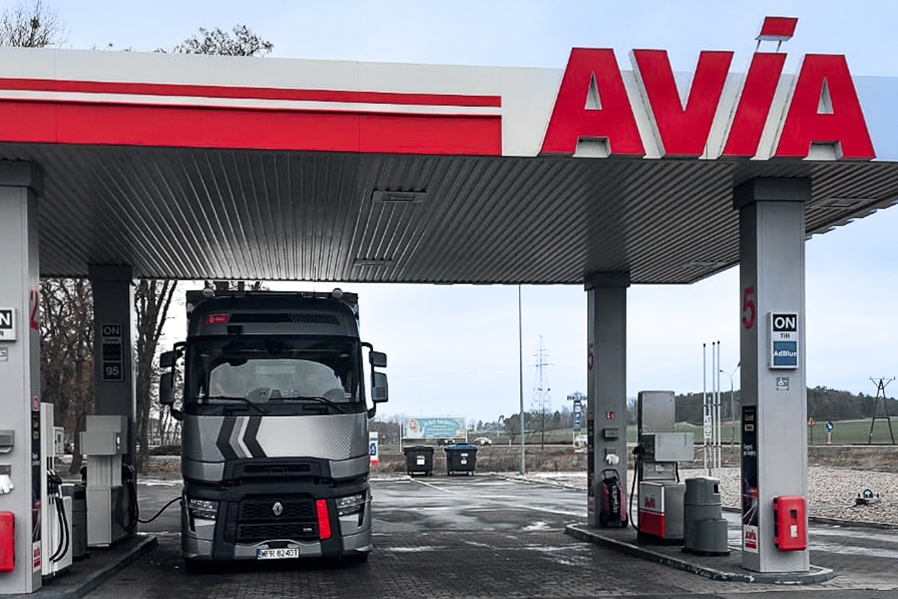
Hydrotreated Vegetable Oil (HVO) is a modern solution for reducing CO2 emissions in transport. It allows for a reduction in greenhouse gas emissions of up to 90% compared to traditional diesel fuel. Produced from renewable sources such as vegetable oils and animal fats, HVO enables companies to achieve their sustainability goals without the need to invest in a new fleet.
AsstrA-Associated Traffic AG, in cooperation with Renault Trucks Polska and the UNIMOT Group, is consistently implementing HVO in its daily transport operations. “We focus on innovations that realistically contribute to reducing our clients’ carbon footprint. By using this new eco-friendly fuel, we not only minimize environmental pollution but also support the transformation of the logistics industry,” comments Dmitri Krõlov, Sustainable Development Manager at AsstrA.
“The UNIMOT Group, as a leader among fuel importers in Poland and the exclusive distributor of HVO100 fuel at gas stations in Poland, actively supports the reduction of greenhouse gas emissions by offering this innovative alternative fuel. HVO fuel is an effective solution that allows for the reduction of the carbon footprint without the need to invest in a new fleet or modify it. It represents a practical and accessible alternative to traditional diesel fuel, thanks to which our partners can seamlessly achieve their environmental goals,” emphasizes Wojciech Iwulski, Climate Solutions Director at UNIMOT S.A. At the beginning of January, at the AVIA station in Myszęcin, AsstrA, together with Renault Trucks Polska, tested HVO100 by fueling a Renault Trucks T Diesel Turbo Compound truck.
Development of decarbonization
The development of such initiatives is an important step in the decarbonization of the transport sector, which is responsible for a significant portion of global carbon dioxide emissions. As Jarosław Zwoliński, Key Account Manager at Renault Trucks Polska, emphasizes: “The cooperation of companies such as AsstrA, Renault Trucks Polska, and UNIMOT shows that combining innovative technologies and a responsible approach to the environment can bring real results in the fight against climate change.”
Implementing alternative fuels such as HVO is not only a response to growing environmental requirements but also an opportunity to strengthen the competitiveness of transport companies.
HVO100 (Hydrogenated Vegetable Oil) is a technologically advanced synthetic fuel designed for vehicles with diesel engines*. Compared to traditional ON-B0 diesel fuel, HVO100 is characterized by up to 90% lower greenhouse gas emissions, including CO2, calculated over the entire life cycle of the fuel – from production, through transport, to combustion, which makes HVO100 an important tool in the decarbonization of the transport sector. This result is confirmed, for example, by the conversion factors adopted by the British administration in emission reporting** (Department for Environment, Food and Rural Affairs UK).
The reduction of greenhouse gas emissions results from the application of circular economy principles, i.e., the use of renewable raw materials such as used vegetable oils. The CO2 emission generated during the combustion of HVO100 is considered climate-neutral because it is offset at earlier stages of the fuel’s life cycle. In the face of global climate challenges and EU regulations regarding the reduction of greenhouse gas emissions, HVO100 is gaining importance, supporting efforts to minimize the carbon footprint of transport.
* Before using HVO100 fuel, ensure that the vehicle is adapted for it in accordance with the manufacturer’s recommendations.
** Department for Environment, Food and Rural Affairs UK – Conversion factors 2023: https://www.gov.uk/government/publications/greenhouse-gas-reporting-conversion-factors-2023
Source: Asstra Polska Sp. z o.o.