








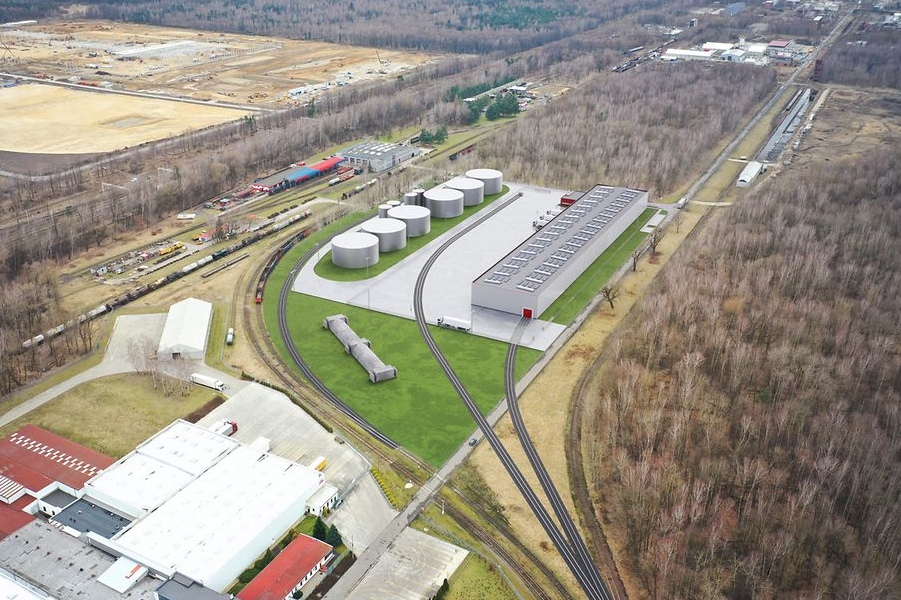
A modern railway port for the transshipment and storage of steel products is being built in Kędzierzyn-Koźle (Sławięcice). The terminal will handle approximately 4,000 wagons per year. This is one of the largest investments of its kind in Poland, with construction scheduled for completion in the first quarter of 2025.
Terminal operations will include the delivery, storage, and transshipment primarily of steel products. The investment includes a transshipment hall with an area of 7,100 m², equipped with two overhead cranes with lifting capacities of 35 and 47 tons, which allow for the handling of steel coils with a diameter of up to 2,700 mm, a width of up to 2,300 mm, and a weight of up to 42 tons.
Thanks to modern infrastructure, it will be possible to minimize the impact of external factors on stored goods, which guarantees their safety during storage and transport. The terminal will also feature two loading and unloading tracks and a maneuvering and storage yard, which enables efficient handling of goods in wagon-to-warehouse, warehouse-to-truck, and wagon-to-truck relations.
The Railport will be located at the Sławięcice HUB on the DB Cargo Spedkol siding, which has tracks with a total length of approximately 50 km. The siding also has access to railway scales and a truck scale, as well as the TEN-T (Trans-European Transport Network), which will ensure the connection of the Upper Silesia region via the Silesia, Mazovia, and Moravia liner trains with the south, north, and west of Europe. The location near the A4 and A1 motorways and national roads will also enable efficient road transport of goods within Upper Silesia, on east-west and north-south routes.
Minimal environmental impact
The construction process of the terminal began in 2023. The terminal was planned with a focus on minimal environmental impact, using energy-efficient technologies and an ecological heating system. Furthermore, the complex under construction is located in an industrial area, which reduces the impact on the local community. The investment is being carried out by DB Cargo Spedkol, a company belonging to the DB Cargo Polska Group. The general contractor is a consortium consisting of Infra SILESIA S.A., Polimex Mostostal S.A., and Polimex Infrastruktura S.A.
– The construction of the Railport is a key investment for DB Cargo Spedkol. It represents a significant step in the company’s development. The operation of the transshipment terminal will allow us to expand our service portfolio. We will be able to offer another complete, modern, and high-quality logistics solution that our customers expect. A major advantage of the Railport is its location, which enables regular transport using our flagship liner trains: Silesia, Mazovia, and Moravia, to Silesia, and to the south, north, and west of Europe – says Tomasz Iwański, CEO of DB Cargo Spedkol. – I hope that the Railport will strengthen our relationships with existing business partners and also attract new ones. In addition, we would like the provision of services at the emerging terminal to contribute to the increased popularity of the Kędzierzyn-Koźle agglomeration and the revitalization of local economic activity – he adds.
Advanced implementation process
The project is at an advanced stage of implementation, and construction is expected to be completed in the first quarter of 2025. Once commissioned, the Railport in Kędzierzyn-Koźle will be a key logistics point, supporting the development of rail transport and the storage of steel products. This is a strategic investment that not only supports the business development of the DB Cargo Group but also strengthens the economic potential of the region through the modernization of logistics infrastructure and the creation of new development opportunities for local enterprises, which will allow for the development of business cooperation on many levels.
– Transshipment terminals are an essential element of the entire Polish railway network system. The construction of the terminal generates not only another access point on the railway map of Poland, but above all, it is a development impulse for the region – says Marek Staszek, CEO of DB Cargo Polska. – Freight rail is currently facing a huge challenge of competing not only with road transport – which is obvious – but also with passenger rail, which uses the same network. According to current data from the Office of Rail Transport, almost 3,000 public stations and stops are available for passenger rail. Freight transport does not have this comfort – transshipment terminals and access points are almost completely privatized for the cargo segment. There are also several times fewer of them compared to passenger rail – we are talking about 45 private terminals and almost 850 private sidings. Our railport is therefore an answer not only to the needs of our organization and our customers, but also to the demand of the entire freight transport segment. It cannot be denied that such investments should ideally be a strategic goal and task of the state, and we, along with the entire freight industry, have been advocating for such moves for many years – adds CEO Staszek.
Source: DB Cargo Polska