









Geopolitics and cybersecurity are currently the most serious threats to global supply chains, which will certainly not subside in 2025. TSL sector specialists are working to mitigate risks on both fronts, and although the virtual world generates more room for preventive action, not all of them take advantage of it. On the other hand, movements on the global geopolitical arena are subject to less control, but they create opportunities for Poland and the logistics operators operating here.
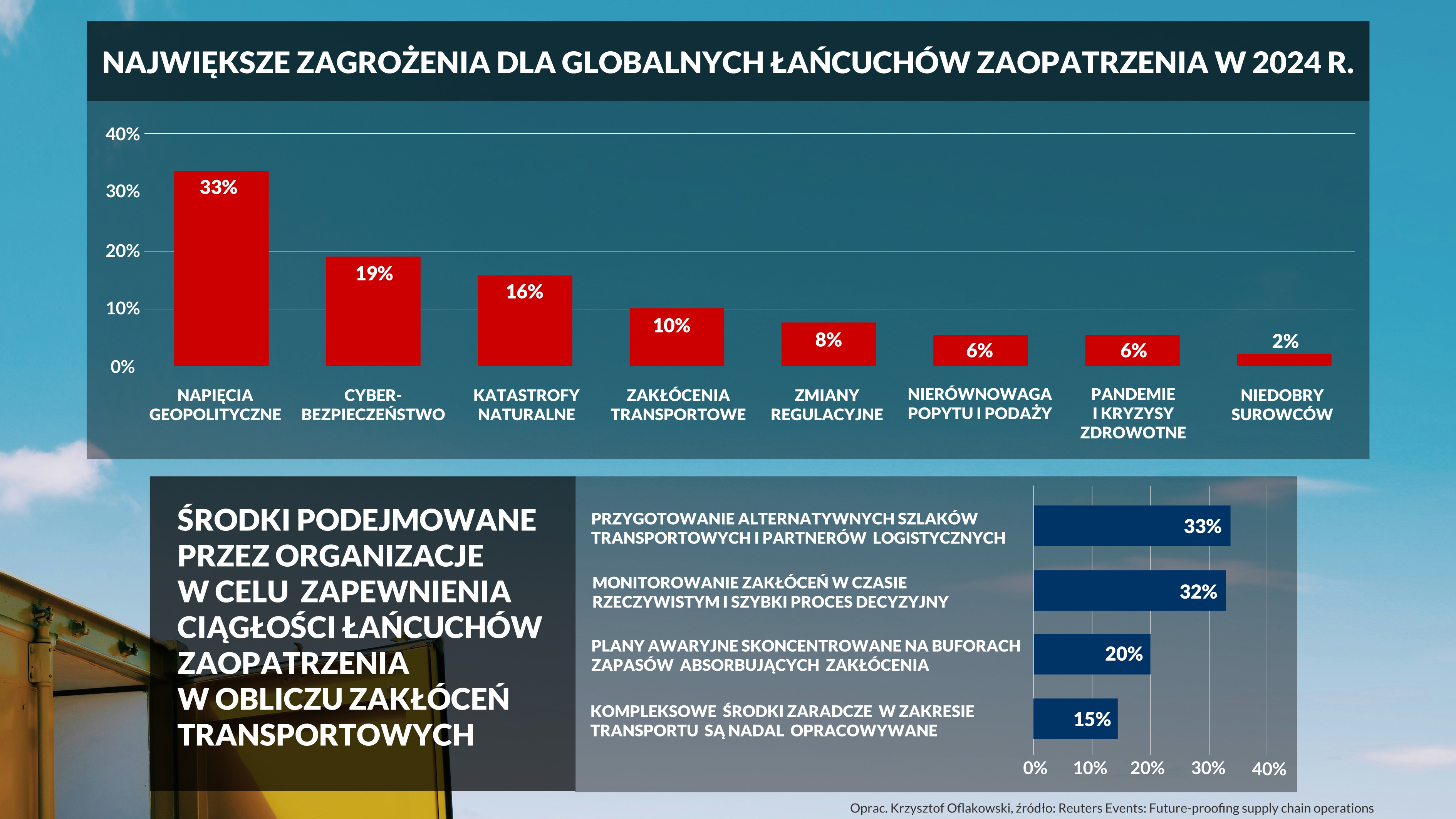
Geopolitical tensions pose the greatest threat to global supply chains. In 2024, as many as 33% of managers managing logistics and supply in major global markets, including Europe, North America, and the Asia-Pacific region, expressed concerns related to this area. In a Reuters Events analysis published at the end of October 2024, the authors emphasize that although logistics chains have always been accompanied by a significant dose of uncertainty, in recent years there have been disruptions on an unprecedented scale. As a result of the mounting problems, the traditional just-in-time production and delivery model has lost a significant part of its previous potential, and precise inventory planning has become much more demanding. The complicated situation is not helped by the increasingly clear divergence of interests of individual countries and economic blocs, which leads to protectionism, strict regulations, and trade wars. This forces logisticians to turn towards more flexible and diversified scenarios, including alternative sources of supply and shortening logistics chains, and product manufacturers to change their production base.
Cybersecurity follows geopolitics
In 2024, key threats to supply security are also seen in the cyber area, which is noted by 19% of the 450 logistics professionals surveyed. Interference in IT infrastructure very often leads to leaks of sensitive information, disruptions to delivery schedules, sometimes even paralysis of operations, and almost always to high costs. IBM calculations show that last year’s global average of financial losses resulting from cyberattacks on business ICT systems amounted to $4.45 million, which is an increase of 15% over the last three years. The current year is not over yet, and the average loss is already $4.88 million, which is an increase of 10% compared to 2023. We are therefore observing a worrying trend that shows no signs of weakening, and all indications are that it will continue in 2025 and subsequent years.
On the occasion of such calculations, IBM raises a very interesting point, namely that those organizations that use artificial intelligence and automation tools for the preventive protection of IT infrastructure were able to reduce the losses incurred by an average of $2.22 million compared to those companies that did not use such tools. Another IBM diagnosis emphasizes, however, that although AI tools can work for the cybersecurity of enterprises, only 24% of such initiatives have built-in cyber protection. This is important because the lack of protection at this level can ultimately lead to greater damage than the projected benefits resulting from the implementation of intelligent algorithms.
Preparations for transport disruptions are accompanied by digitalization in other areas
Not all threats can be avoided or significantly mitigated, especially in the area of geopolitical tensions, but some can be addressed, and it is clear that this is a topic of reflection, at least in some enterprises. In the case of transport disruptions, 33% of logistics operations managers declare that they have developed alternative delivery routes and, if necessary, are able to involve other partners and different transport models. Not much less, 32%, rely on real-time threat monitoring and a fast decision-making path aimed at solving a specific problem. Another 20% have contingency plans focused on a sufficiently high inventory buffer, but on the other hand, as many as 15% of professionals are only just developing comprehensive strategies to mitigate or counteract disruptions.
Logistics managers thinking about operational resilience also use other tools to increase their own efficiency, reduce losses, and improve security. Hence the constantly growing investments in digitalization appearing in analyses, which are intended to streamline these processes and mitigate the impact of crises. In the current Reuters Events study, key investments in the logistics area undertaken in the last 12 months included TMS systems (42% of indications), document digitalization (41%), warehouse automation (35%), as well as analytical tools for inventory management (31%) and investments in cybersecurity (31%). As in the case of research conducted by IBM, it was also noted here that an extensive digital background, the accumulation of large amounts of data on logistics operations combined with poor infrastructure security and other digital risk factors can in themselves be a source of risk. In this context, as many as 94% of the logistics professionals surveyed express reasonable concerns of varying degrees of intensity, of which 6% describe their concerns as extreme, 16% are deeply concerned, and 61% place their concerns at a moderate level.
– It is not without reason that the cybersecurity of logistics processes has become a source of concern, research, and the subject of public debate. The scale of the threats is truly large, and negligence can lead to very serious consequences, especially since transport and logistics are part of a narrow set of sectors classified as critical infrastructure. Cyberattacks aimed at such infrastructure can threaten not only individual companies but the entire society, the economy, and even national security. Their target is key healthcare systems, banking infrastructure, or transport networks. The scale of the challenges and dangers is evidenced by data collected by the European Repository of Cyber Incidents (EuRepoC), which provides evidence-based analyses of digital security breaches. Out of 3,318 total global cyberattacks registered in EuRepoC, as many as 1,324, or nearly 40%, were carried out on critical infrastructure, of which 186 were carried out on the transport sector. This is the fourth place out of 14 most vulnerable critical areas and almost 6% of all attacks since 2020. Globally, transport infrastructure is only surpassed by the healthcare, financial, and telecommunications sectors – says Marcin Czerwiński, IT Director at ID Logistics Polska, which provides comprehensive logistics and transport solutions and supply chain management in 18 countries.
The situation in the European Union is even more serious because critical transport infrastructure, including airlines, public transport, shipping companies, rail operators, and logistics companies, is the second most frequent target of attacks. In the EU, in terms of the number of attacks, transport is only surpassed by the healthcare sector, and in Poland only by the defense industry. This shows what serious challenges we are facing and how essential proper management of digital resources of TSL sector enterprises is becoming. The analysis we conducted, published in October this year, shows, among other things, that although Polish enterprises see very great potential in using innovation, including artificial intelligence, one of the concerns holding them back from implementation is the risk of data leakage and broadly understood security breaches, especially in the context of outsourcing AI-related projects – adds Marcin Czerwiński.
Not all organizations take threats seriously enough
It may be surprising, but even while witnessing the growing problems occurring in the global transport and logistics sector, not all organizations take the threats seriously enough. Only 32% of the companies surveyed by Reuters regularly engage in planning alternative crisis scenarios, creating hypothetical events, and simulating adequate responses, including the construction of multifunctional teams to increase overall organizational readiness. As many as 41% do this only sporadically or only when necessary, and 16% are considering certain solutions, but they are not part of the main organizational strategies. More surprisingly and alarmingly, 11% of enterprises do not undertake testing of responses to dangers at all, do not practice procedures, which in practice means a lack of preparation, increased susceptibility to financial losses, operational failure, and contractor dissatisfaction.
Similar threats and severe consequences
In 2024, shipping giant Maersk surveyed 2,062 of its European customers to determine, among other things, how companies react to disruptions and how important a role measures to increase operational resilience within supply chains play in organizations. The results of the analyses are largely similar to those presented by researchers from Reuters Events and confirm that geopolitical instability is currently the biggest risk factor disrupting supply operations. This is the opinion of 4 out of 5 surveyed companies, i.e., 80% of respondents. A great many companies (76%) also point to business disruptions resulting from logistics operation delays.
Over the last 12 months, only 20% of Maersk contractors were able to quickly deal with such problems, and more than half claimed that the delays were more severe than originally assumed. Moreover, in the case of 20% of companies, delays occurred more than 20 times in the last 12 months, significantly increasing delivery costs for over 50% of contractors.
Opportunities for the Polish economy and logistics operators
In the context of obvious and widespread threats, higher service costs, partly a derivative of improper preparation, should not be a big surprise, but the declaration of companies regarding the desire to shorten logistics chains and search for new sources of supply looks interesting in the Maersk study. More than 50% of respondents, i.e., at least 1,000 companies, want to do this, of which one-third intend to move to the immediate vicinity of Europe or look for their chance within the continent. Poland is unfortunately not their first choice, but it is high in the ranking and in a privileged position.
The most preferred near-sourcing option related to Europe is Turkey, which was indicated by 1 in 10 companies. In second place is Egypt (1 in 14 indications), followed by Poland, which was chosen by 1 in 16 respondents. This is the highest-ranked country among European Union states, which in itself opens up an extensive catalog of benefits for those organizations that decide to move their supply sources to the Vistula River. An obvious benefit in such a scenario will be the Polish economy, and within it the transport and logistics sector. In the remaining places on the list of preferred destinations in or around Europe is Morocco (1 in 33 indications), followed by Romania (1 in 50 companies), with which we will potentially have to compete.
Digital solutions remain high among tools building resilience
Regardless of relocation plans, the companies surveyed by Maersk are also thinking about ways to increase their own resilience, and one in three respondents claims that the answer to supply dangers can be, among other things, better communication and data exchange, technological solutions in the area of monitoring, tracking, and operational visibility. An equally important issue is also flexibility and speed of planning, which directly translate into the strength of supply chains. The same number, i.e., one-third of companies, believe that thanks to IT technologies, their organizations will achieve the ability to plan demand even more accurately, and 25% want to invest in tools that enable this.