








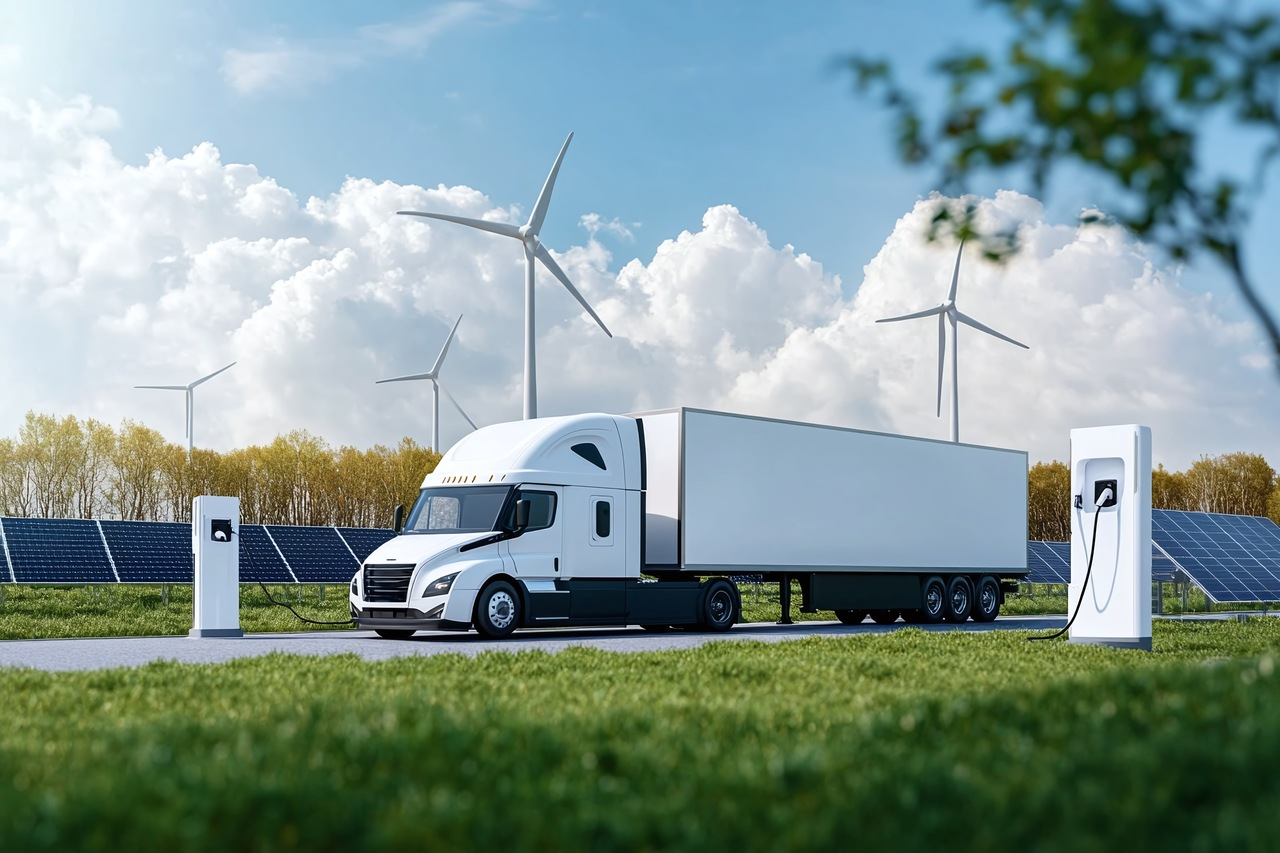
The Polish heavy-duty fleet must be electrified – such an obligation is imposed on the entire road transport sector by the EU’s Fit for 55 package. Its assumptions include reducing greenhouse gas emissions by 55% by 2030 and ending the production of vehicles powered by conventional fuels by 2035. This means that over the next decade, the Polish TSL (transport, shipping, logistics) industry faces a forced, zero-emission revolution that will permanently change the face of the market. However, the state of the sector’s and infrastructure’s readiness for this change currently raises mainly doubts and concerns.
Electric cars on Polish roads
According to data from the Polish Alternative Fuels Association (PSNM), the number of registered electric cars in Poland exceeded 52,000 in 2023. This is an impressive result considering that the growth compared to 2022 was as much as 70%. “Electrics” are gaining popularity not only among private users but also among companies using delivery vans. Last year, more than 5,700 low-emission vehicles of this type were in use, 86% more than in 2022.
– Against this background, eHDV vehicles, i.e., electric heavy-duty trucks, are a drop in the ocean. In our country, just over 100 were registered by the end of 2023, with a year-on-year increase of as many as 85 units. The growth rate in this area is therefore impressive, but in absolute numbers, we remain at the tail end of Europe. By September 2023 alone, 3,900 new electric trucks were registered on the Old Continent, including almost half in Germany, which is the undisputed leader in electrification in our part of the world – says Jakub Gwiazdowski, Head of Partnership & Relations at Transcash.eu.
In total, the number of eHDV vehicles on European roads reached 80,000 by the end of last year. This means that in 2023, electric trucks accounted for only 0.6% of all vehicles of this type owned by European transport companies (according to ACEA). It is worth adding that the Polish heavy-duty fleet is among the largest on the continent, numbering nearly 1.3 million vehicles. We also lead in terms of pollutant emissions. According to a study by the international consulting firm Oliver Wyman and the University of St. Gallen, the emission factor in Polish road transport is twice as high as the European average.
How much does an electric truck cost?
The fundamental problem associated with electrification is, of course, costs – eHDV trucks are even several times more expensive than those powered by standard fuel. On the Europa-ciezarowki.pl sales offer website, prices for used eHDV vehicles range from approx. 120,000 to over 700,000 PLN, depending on their condition and range. In the case of new ones, prices exceed even one million PLN. Data from the Dutch market, cited by the 40ton.pl website, shows that in 2022, the average price of a new electric truck purchased in that country was nearly 300,000 EUR.
According to Jakub Gwiazdowski, for most Polish transport companies, such amounts are out of reach:
– According to information from the Polish Institute of Road Transport, most heavy-duty vehicles in Poland are owned by individuals or small companies, and only 48% belong to medium or large enterprises. Electrification will therefore lead to a deepening of market polarization and increased competition, and in practice, to the pushing out of entities that cannot bear the costs of transformation – the expert comments.
There will be no change without subsidies
For the electrification of Polish heavy-duty fleets to happen, government support is necessary. In many European countries, including the aforementioned Netherlands and Germany, appropriate subsidy programs for the purchase of electric trucks have been operating or have operated for many years. In Poland, until now, only those willing to purchase electric passenger cars or delivery vans could count on help in this area through the “My Electrician” (Mój Elektryk) subsidy program, which was initiated in 2021.
If the government’s plans succeed, entrepreneurs in the heavy transport industry will soon benefit from similar support. We are talking about a program for the purchase or leasing of zero-emission trucks, the draft of which was presented by the National Fund for Environmental Protection and Water Management (NFOŚiGW). It will allow for obtaining a subsidy of up to 750,000 PLN for the purchase of an eHDV vehicle, and its size will depend, among other things, on its size and the type of company. Subsidies for large models will be higher, and smaller companies are expected to have better chances for funding. 1 billion PLN has been allocated for the implementation of the program over the next few years, but the date of its entry into force is unknown. Currently, the draft is in the phase of public consultations.
Chances for the development of charging infrastructure
The success of the eHDV vehicle subsidy program is closely linked to the improvement of charging infrastructure. Switching to electric trucks makes no sense without charging stations and points tailored to their needs, and in this respect, Poland is a desert. According to data collected by the Polish Alternative Fuels Association and the Polish Automotive Industry Association, between 2021 and 2023, there was not even one charging station for eHDV vehicles in Poland, which require chargers of the highest power. In March 2024, the Polish EV Outlook Index indicated 161 charging points with a power of over 150kW, which absolutely does not meet the needs of a country where the TSL sector is one of the key branches of the economy. For comparison, at the end of 2023, the electric car charging network in Poland numbered nearly 10,000 points, but the vast majority are AC stations and points, not adapted for charging trucks.
In this case, too, the government is expected to help. The aforementioned NFOŚiGW subsidy program also includes grants for the development of charging infrastructure for electric trucks. As much as 2 billion PLN has been earmarked for this purpose, and those willing to undertake the construction of a point or station can count on covering up to 100% of the costs allocated for this purpose. One of the conditions for obtaining funding, in addition to ensuring adequate charging power, is the location of the point along the TEN-T core network, i.e., the Trans-European Transport Network.
– The program is scheduled to start later this year and last until 2029. However, considering the realities, the implementation of its assumptions may take much longer. The Polish connection network is outdated, and the energy infrastructure along expressways also leaves much to be desired. After taking into account the formalities, launching a fast-charging point takes even several years. Improvements in this area are therefore necessary for Polish entrepreneurs to have a real chance for fleet electrification and their effective use in our country – says Jakub Gwiazdowski.
Source: Transcash