









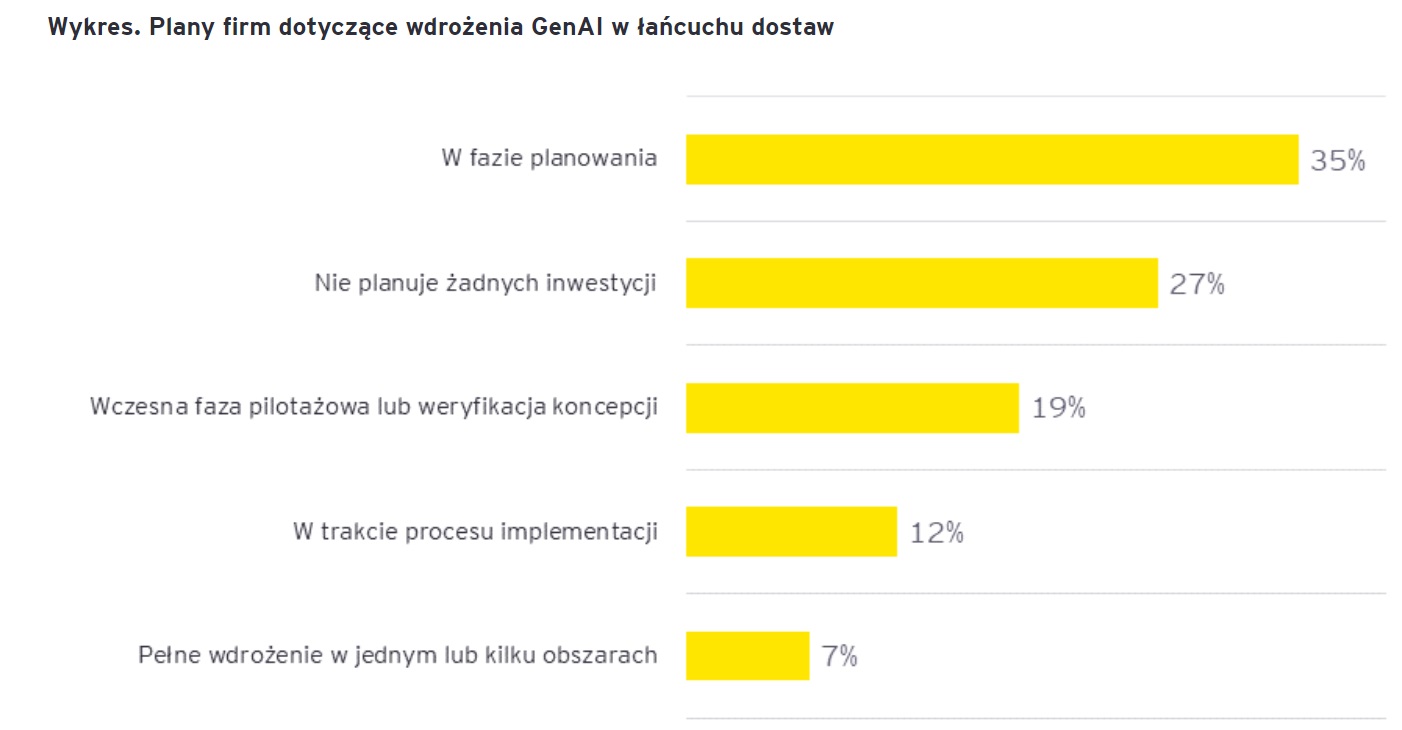
Global disruptions and changes, triggered by the Covid-19 pandemic, are forcing the construction of supply chain resilience against new risks. According to an EY study, generative artificial intelligence is proving to be a significant support in this mission – 73% of chief operating officers and supply chain managers plan to implement it. On the other hand, only 7% of them have successfully completed implementation. And the game is worth the candle, as organizations further along the path to full autonomous supply chain implementation are 5.2 times more likely to succeed thanks to GenAI. Moreover, according to 69% of respondents, the lack of integration of this technology with supply chains will weaken their company’s market position.
Logistics and operations experts surveyed by EY see GenAI as a key solution to help maintain competitiveness in the future. Nearly three-quarters of them (73%) plan to implement this technology in their supply chains, and 80% believe it can transform this area, which is why they give it high priority. Leaders in generative AI implementation use it to improve demand forecasting and operational efficiency. Importantly, 69% of respondents believe that failing to integrate GenAI into supply chains will expose their organization to losing a strong market position.
– AI-supported elements have been used in the supply chain area for years. But only the combination with GenAI is a breakthrough in building unmanned supply chains. AI is used not only to analyze and interpret vast amounts of data, but also to create new scenarios, generate innovative solutions, and remove friction in real time. In turn, GenAI can design new processes and forecast future requirements with greater accuracy to mitigate external shocks and seamlessly identify the most cost-effective routes in the event of disruptions. This is crucial for the development of supply chains that can dynamically adapt to changing market conditions and operate with limited human intervention – explains Marta Cicholska, Partner at EY Poland, Leader of the Supply Chain & Operations Team.
Graphic: EY
Implementation is not that simple
The EY study indicates that as many as 90% of experts have implemented GenAI in some form in their supply chains. However, over the last 12 months, 62% of respondents have evaluated their initiatives in this area, but only 7% have moved to full implementation. The two main reasons for this state of affairs are concerns and a lack of understanding of the risks posed by GenAI, as well as challenges associated with implementing this complex technology. In-depth interviews with supply chain and operations directors show that making the technical leap from proof of concept to large-scale GenAI implementation was more difficult than expected.
Achieving full logistics autonomy also remains a major challenge. Only 28% of companies that began preparing for GenAI implementation have created supply chains with low human involvement. A success factor for organizations at a higher level of advancement is a strong digital foundation, which enables them to quickly adopt and utilize GenAI. Leaders also show greater progress in implementing both AI and GenAI in the logistics area. They are 3.5 times more likely to have achieved significantly higher than expected success with AI, and 5.2 times more likely with GenAI.
– Over the next two years, we expect significant growth in the implementation of generative artificial intelligence. As a result, this will lead to an widening of the digital gap between organizations leading in the use of new technologies and those that are only at the early stages of adoption. However, it is worth emphasizing that access to AI is becoming increasingly democratized. Until recently, its use required training models, and therefore was limited by the need to have highly qualified experts and appropriate infrastructure within the organization. This generated additional costs and raised the barrier to entry. In the era of GenAI, as large pre-trained models become available through key technology platforms, the effort shifts to properly utilizing them within the organization, its data, and its processes and requirements. Technology as such is becoming more accessible, while the challenge remains its proper implementation, applying all elements related to regulatory requirements and cybersecurity – adds Ewa Nowakowska, Partner at EY Poland, Leader of the EY AI Lab.
Understanding challenges and success factors
Incomplete data and skill gaps were identified by respondents as the main challenges in the process of implementing AI in supply chains. The human factor will determine the speed of implementation, which is why organizations should develop solid plans for upskilling current employees and carefully consider future recruitment. Half of the leaders in GenAI supply chain implementation entrust the management of this technology to their teams – 51% compared to 33% in companies at the beginning of this journey. Such internal activation is important because, according to the results of the EY Work Reimagined Survey, 49% of employees are already using or expect to use GenAI within the next 12 months.
According to operations and supply chain experts, success in GenAI implementation is determined by support from leadership (67%), building support from third parties (65%), and the availability of technical talent (64%). Generative artificial intelligence is a new technology, and therefore, according to 40% of respondents, their organization does not fully understand the risks and challenges associated with it. In their opinion, the most important tasks in this area are maintaining data quality (38%) and access to it (33%). This applies especially to supply chains where data is scattered across various systems within the organization and among external entities.
About the study
The survey was conducted by EY in collaboration with HFS Research in February and March 2024 among 460 supply chain and operations experts who play a significant role in their organizations’ initiatives in this area. Responses were collected in 19 countries covering the Americas, Asia-Pacific (APAC), and Europe, Middle East, India, and Africa (EMEIA). Companies operating in the consumer, health sciences and wellness, energy and resources, technology, telecommunications, and manufacturing industries were taken into account. Respondents represented organizations with annual revenues exceeding USD 1 billion that were at least at the stage of planning GenAI implementation in their supply chain. In addition, in-depth qualitative interviews were conducted with supply chain and operations managers.
The fourth edition of the global EY Work Reimagined Survey was conducted between June and August 2023 on a group of 17,050 employees and 1,575 companies. They represented 25 market sectors and 20 geographic areas from the Americas, Asia-Pacific, Europe, the Middle East, India, and Africa.
Source: EY (Ernst & Young Global Limited)