










The greatest costs for companies are not generated by the best-paid employees, but by those who are not there. Staff shortages, especially in the area of non-specialized work, carry a series of consequences in the form of losses, the scale and multidimensionality of which mean that companies are usually unable to measure them.
The manufacturing industry can serve as an example here. According to an analysis by the Intelligence Group, in 2012 only 7% of European manufacturing companies were facing personnel shortages. Last year, this percentage rose to 26%. The situation is even more difficult in logistics. A study by the Descartes Systems Group proves that today, three-quarters of European logistics operators are suffering from a labor shortage.
The domestic perspective
In Poland, between 2012 and 2023, the number of companies in the industrial sector whose operations are hindered by a lack of employees has doubled. In the retail industry, there is currently a shortage of approximately 300,000 employees, according to recent media reports. As for the logistics sector, more than 320,000 job offers were published in this industry last year. Data from Statistics Poland (GUS) shows that the total scale of employment in this area of the economy is about 955,000 people, which clearly indicates the scale of the demand for personnel. And it can make one realize how much this sector can lose due to unfilled positions.
A very large, if not predominant, part of these advertisements concerned the role of a warehouse worker. In the case of the retail sector, we are dealing with the greatest shortage of personnel in positions for cashiers. In the manufacturing industry, as many as 3/4 of enterprises in Poland report a problem with a shortage of non-specialized employees, according to the study “Market for blue-collar workers 2024. Perspective for retail, manufacturing, and logistics” prepared by Tikrow.
– The conclusion? Widespread difficulties not so much in finding highly qualified specialists, but primarily employees performing non-specialized tasks that are fundamental to maintaining business continuity. Especially in the case of the three mentioned sectors of the economy. – One of the main topics of conversation with our clients is the issue of losses caused by personnel shortages specifically regarding non-specialized employees. And although companies usually do not have tools capable of precisely calculating how much they lose due to reduced productivity, they agree that we are talking about substantial amounts. These result from lost opportunities for higher revenues due to serving fewer customers, reduced production volumes, or delayed supply chains. Hence the somewhat perverse, yet accurate thesis that the most expensive employee is the one who is not there – explains Krzysztof Trębski, member of the board at Tikrow.
How much does a lack of employees cost?
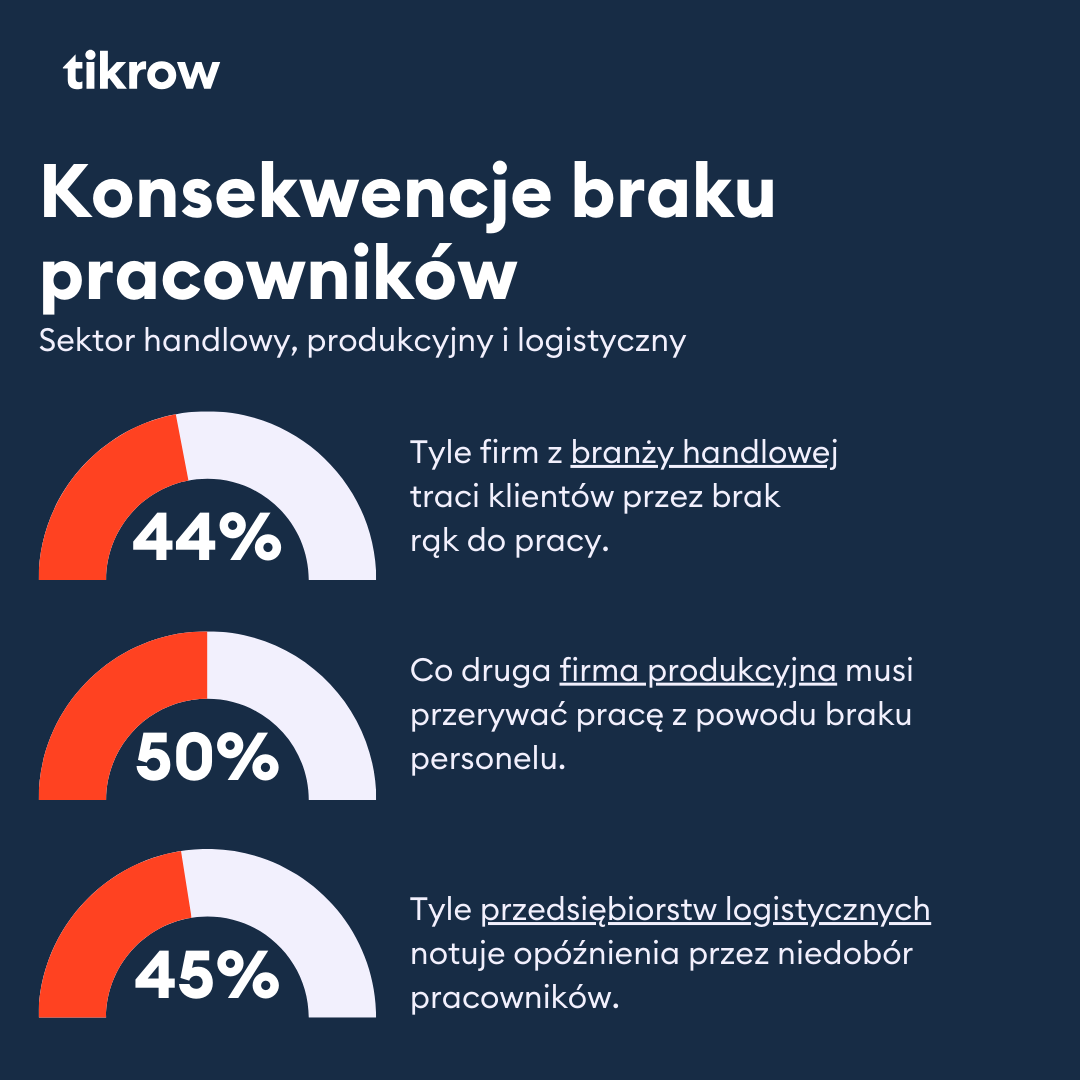
Losses should therefore be understood as the loss of opportunities and potential for achieving higher sales, production, or efficiency. This is confirmed by the companies themselves participating in the aforementioned “Market for blue-collar workers 2024” study. In the retail industry, as many as 44% of companies lose customers due to a lack of hands to work. In turn, 56% of enterprises note delays in order fulfillment due to staff shortages. In industry, 1 in 2 companies must interrupt work due to personnel shortages, while 41% have difficulties in acquiring new customers as a result. There is also logistics, where 45% of companies note delays due to personnel shortages.
Although the value of losses caused by a lack of hands to work will be different for every enterprise, one can attempt to identify the scale of costs associated with this problem in a broader perspective. Deloitte, in its report “Skills gap in manufacturing. Future of manufacturing: the jobs are there, but where are the people?”, calculated that in the 2018-2028 period, the US GDP could be deprived of as much as 2.8 trillion dollars, which will not be generated precisely because of labor shortages in the local manufacturing sector.
– Let’s look at an example much closer to us: Germany. At the end of last year, the local Chamber of Commerce and Industry reported that half of German enterprises have difficulty acquiring employees, which meant as many as 1.8 million unfilled vacancies. The announcement was accompanied by a calculation according to which the economy of our western neighbor will be deprived of more than 90 billion euros in 2023, which, to put it simply, will not be generated due to staff gaps. – This is therefore significant not only in relation to the condition of individual companies but also entire national economies, which are often deprived of very substantial funds due to the inability to implement planned goals and the necessity of reducing their productivity. Since it is usually very difficult to measure how much a specific company loses due to a lack of employees, it is worth looking at calculations on a macro scale to realize that we are dealing with a really big problem. However, the Gig Economy and the growing share of temporary work are increasingly resisting it, i.e., non-specialized employees ready to carry out orders from day to day – adds Krzysztof Trębski from Tikrow.
Gig Economy to the rescue?
Of course, temporary work cannot be a substitute for highly specialized employees, whose shortage is also felt in both the Polish and European economies. However, it has a chance to bridge the gaps among employees performing simpler tasks that do not require high competencies, while at the same time relieving working specialists, who can thus become more efficient in their field.
The quarterly published Tikrow Temporary Work Index proves that since the beginning of the year, interest in temporary work by retail, manufacturing, or logistics companies has not decreased. According to the latest edition of the study, 61% of companies will reach for the support of temporary workers this quarter. More than 1/3 of them admitted that they would go down this path due to great difficulties in finding permanent non-specialized staff.
Source: Tikrow