









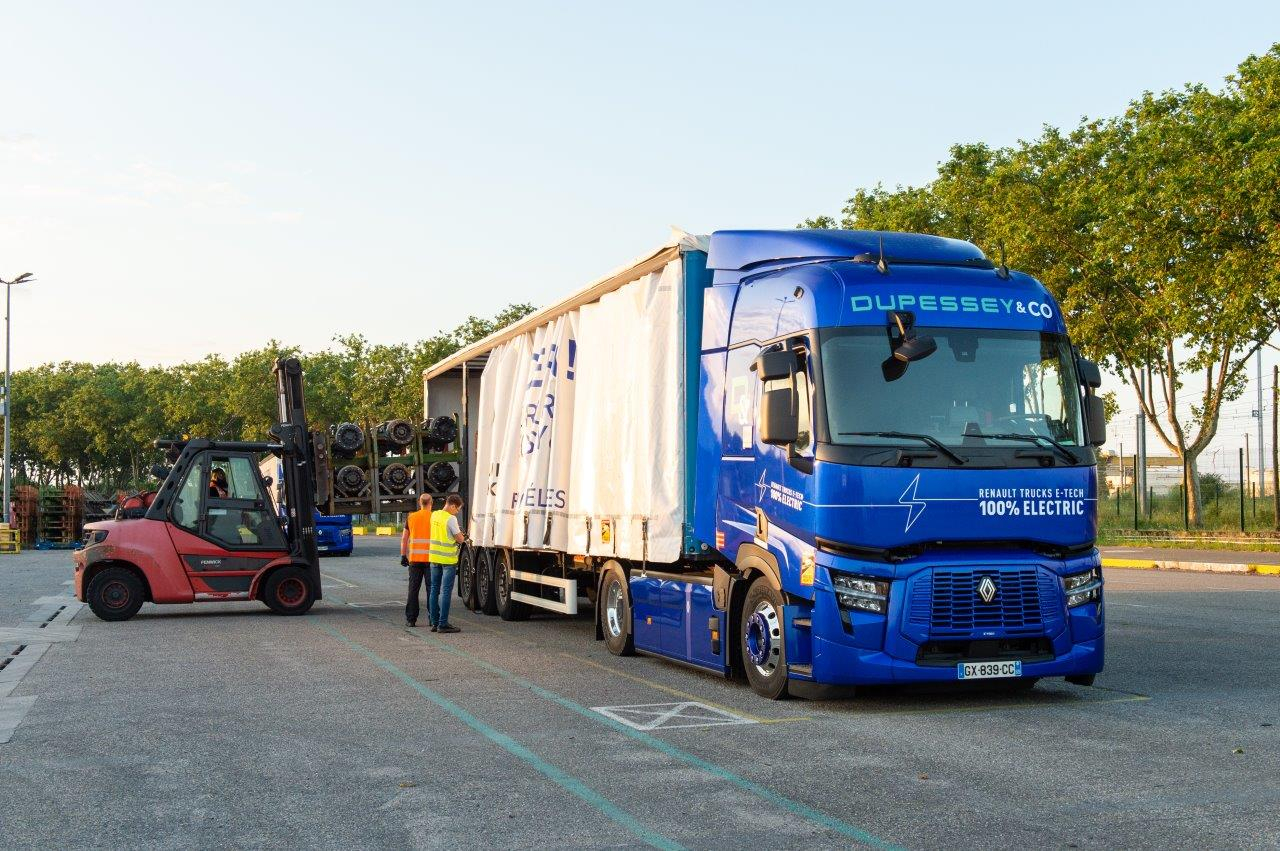
As a major player committed to reducing transport emissions, Renault Trucks is intensifying its efforts by electrifying its own logistics flows. The first stage of this project is the transition of vehicles handling axle transport between the plants in Lyon and Bourg-en-Bresse. Diesel-powered trucks previously used for this transport will be replaced by electric vehicles. The route, covering a total of 450,000 km each year between the two production sites, will be operated by Dupessey&Co and Transports Chazot using five electric Renault Trucks T E-Tech tractor units.
“At Renault Trucks, we apply the same solutions that we offer to our customers.” This summarizes the electrification of logistics flows launched at Renault Trucks production facilities.
The introduction of 44-tonne electric vehicle combinations is a step forward for regional and local electric transport, which is why the French manufacturer decided to change the way goods flow to the Bourg-en-Bresse plant, using Renault Trucks T 4×2 E-Tech tractor units.
Two partner transport companies, the Dupessey&Co Group and Transports Chazot, were selected to carry out this task over the next six years. Five electric vehicles, each carrying 22 tonnes, make two round trips per day, covering 360 km while transporting axles produced at the Lyon plant to the Bourg-en-Bresse plant, where heavy-duty trucks are assembled.
Depending on the volume of goods transported, the frequency of trips can be increased, and up to 7 combinations can be on the road in a single day. The vehicles are charged for 45–50 minutes once a day at the Lyon plant, where a special charging station has been installed. Further charging is carried out every evening at the depots of both carriers.
The electrification of logistics flows will enable 440,000 km to be covered by electric vehicles, which will reduce CO2 emissions by 375 tonnes per year.
Applying zero-emission solutions and methods offered to customers at Renault Trucks
The manufacturer has decided to become a model for the industrial sector and its customers by applying the low-emission mobility solutions it offers to its own operations.
Before electrifying its own logistics flows between Lyon and Bourg-en-Bresse, the feasibility of the project was studied. To this end, Renault Trucks teams used the same tool, the Range Simulator software, which the manufacturer offers to its customers. It allows for calculations of where, when, and for how long charging should take place, based on 4 main parameters: truck operation, load and equipment, outside temperature, and topography.
After conducting the diagnosis, the location of the charging infrastructure was determined to ensure optimal system operation. As a result, two 360 kW stations (each with 2 charging points) were installed at the Saint-Priest plant to allow various trucks to perform intermediate charging under optimal conditions.
– The electrification of this first logistics flow is the result of a long-term project. We chose axle transport between Lyon and Bourg-en-Bresse because it is one of Renault Trucks’ main transport flows, which is subject to very strong operational constraints, particularly in terms of speed and precision. The implementation of this project complements our expertise in reducing emissions in transport – explains Bruno Blin, President of Renault Trucks – At Renault Trucks, we use these types of projects to build a new transport model. By 2030, we have set ourselves the goal of electrifying our logistics on a massive scale, including 100% electrification of logistics between our production plants.
Renault Trucks is currently working on the electrification of about ten other logistics flows, which will be launched in the coming months and years, particularly thanks to the further development of technology that will enable the use of electric vehicles over increasingly longer distances.
Source: Renault Trucks