








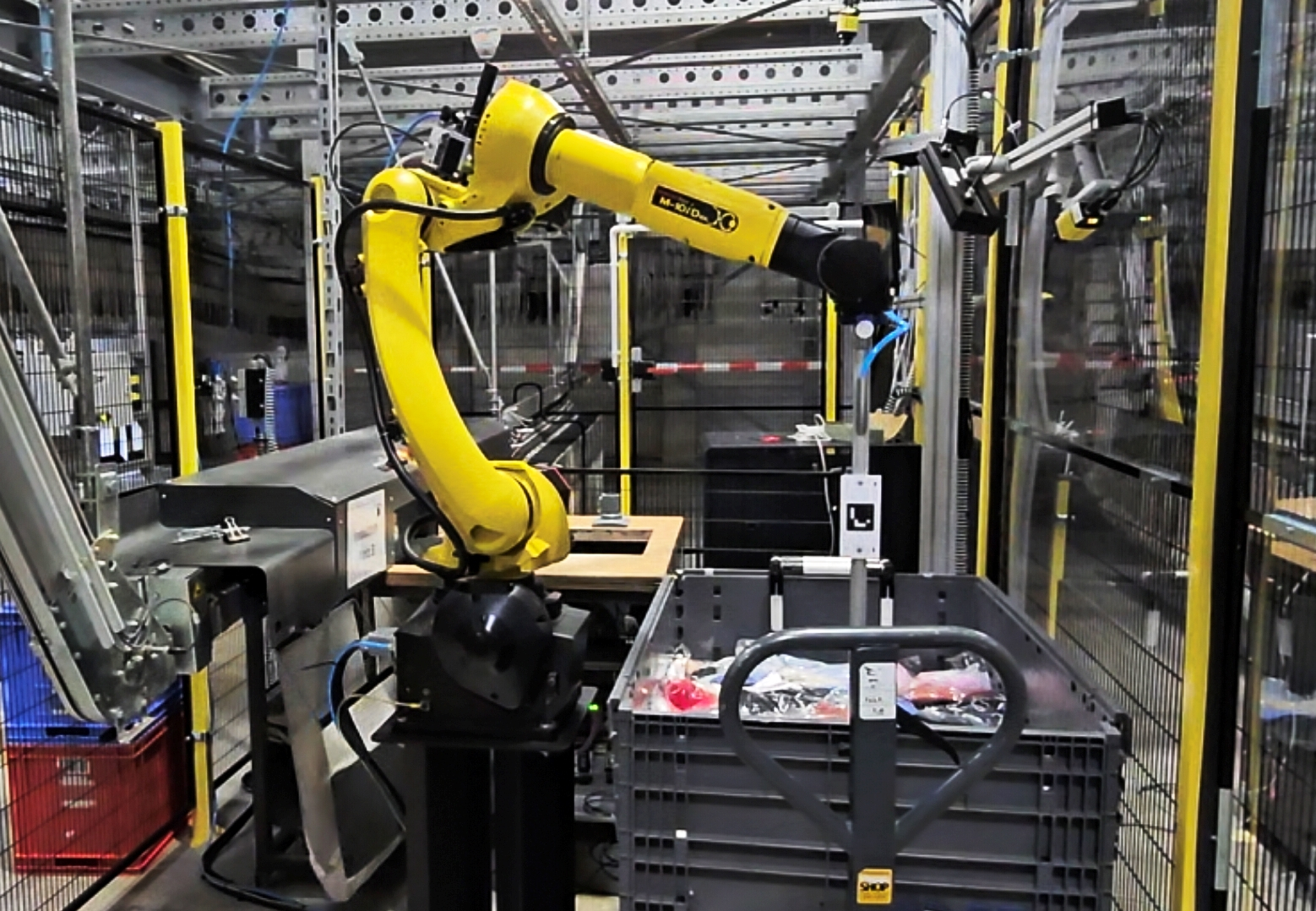
International logistics service provider Arvato has introduced an advanced robotic arm named Leleka, designed to automate the picking and sorting of fashion items in warehouse environments. The robot utilizes AI-powered vision capabilities to automate the process of unloading bulk containers containing hundreds of clothing items. The robot utilizes AI-powered vision capabilities to automate the process of unloading bulk containers containing hundreds of clothing items.
Thanks to high precision and decision-making accuracy, task execution is reliable and efficient. Integrated with the BagSorter system in Hanover, the robotic arm identifies the optimal gripping point for each product, ensuring safe and efficient movement. It checks product visibility, its current position relative to others, and barcode readability, handling products that are irregularly arranged randomly in containers. The main motivation for implementing Leleka was to relieve employees from the most monotonous and tedious tasks, such as transferring products in the warehouse, and in the face of growing volumes, recruiting new employees for basic logistics processes is becoming increasingly difficult. By combining the robotic arm with AI algorithms based on image processing, Leleka is designed to handle complex processes with exceptional precision, improving operational quality.
“Leleka offers long-term financial benefits, addresses labor shortages, and relieves employees by automating routine tasks. It increases operational stability and efficiency, supporting Arvato’s logistics processes even around the clock,” says Sławomir Grześkowiak, head of the Arvato R&D team that developed the Leleka system. Leleka operates with efficiency at least equal to human performance, but without productivity drops caused by fatigue. The system is optimized for 24/7 operation, ensuring operational continuity. It works autonomously, with minimal employee intervention in tasks such as replacing bulk containers, although plans are in place to automate this stage as well in the future. Technical staff receive specialized training in initial device startup, daily performance monitoring, and simple maintenance tasks.
“The development of Leleka posed significant challenges, especially when confronting theory with reality. Products are never perfectly arranged in bulk containers, which required adapting to new conditions based on multiple criteria. Thanks to rigorous testing and adapting the solution to existing conditions, our design team successfully met these challenges, gaining valuable experience and vast amounts of data for future implementations,” explains Grzeskowiak.
Source: Arvato