








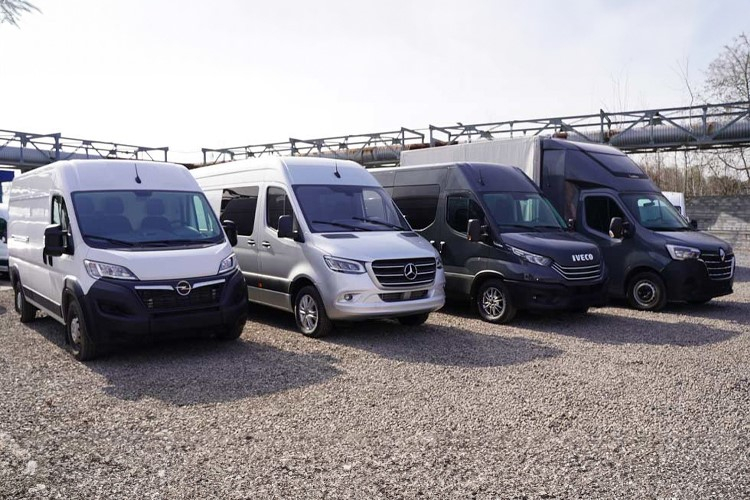
Buying a new delivery van brings many benefits to a company. Above all, it minimizes the risk of downtime and repairs, and consequently, allows for business continuity. Which models are best to invest in?
Regardless of whether a company has a fleet of passenger cars or delivery vans, generally, the younger it is, the lower the risk of breakdowns and associated downtime. For this reason, it is worth rejuvenating your fleet every few years.
How often do entrepreneurs rejuvenate their delivery vehicle fleets?
Entrepreneurs most often renew their vehicle fleet every 3 to 5 years. The change is usually influenced by the expiring manufacturer’s warranty and, consequently, preferential vehicle servicing conditions. Regularly replacing cars with newer ones ensures greater mobility and minimizes the risk of downtime and repairs. The situation was changed by the pandemic, as well as limitations in car availability and price turmoil.
– Even before the pandemic, entrepreneurs replaced their delivery vans after three to five years, which guaranteed them mobility. The pandemic and, a bit later, the war in Ukraine caused production breaks and significantly extended the production of new cars. For many entrepreneurs, this meant having to keep their fleet longer than they had planned. When the production time for new cars began to stabilize, a significant price increase was visible on the market. In the case of some brands, car prices soared by as much as 70 percent. Added to this were high interest rates, which translated into higher financing costs, which again prevented many entrepreneurs from replacing vehicles with new ones. It is known that having older cars in the fleet increases the probability of breakdowns and the associated more frequent repairs and higher vehicle servicing costs. We know that this phenomenon is quite common, because we receive information from more than one service center about long queues for repairs or inspections – comments Hubert Grzesiak, Director of the Commercial Vehicle Sales Department at Superauto.pl.
What factors determine the replacement of a fleet by companies?
Recently, however, there has been some stabilization in the delivery vehicle market and greater interest from entrepreneurs in rejuvenating their car fleet. This process is influenced by many factors, and currently, environmental and safety considerations are also playing an increasingly important role.
– In recent months, we have noticed that some brands have lowered their car prices. Fleet discounts have also appeared, which convinces many customers to purchase new vehicles. Rejuvenating a fleet is a process influenced by several factors. Companies decide on such actions for various reasons, which usually focus on economic, operational, environmental, and technological aspects. New vehicles are often more fuel-efficient and have lower operating costs. Rejuvenating the fleet can therefore contribute to a significant reduction in fuel and servicing expenses. It is known that older vehicles tend to have more frequent breakdowns and downtime, which can negatively affect the company’s operational activities. New vehicles are usually less prone to failure, which reduces the risk of downtime and associated costs. Added to this are strict emission regulations. By rejuvenating the fleet and introducing newer vehicle models, companies can more easily adapt to current environmental requirements and avoid potential penalties. Safety issues are also an important factor. New vehicles are often equipped with advanced systems that not only reduce the risk of accidents but also improve the overall safety of drivers and cargo – emphasizes Hubert Grzesiak.
Rejuvenating the fleet means savings in service
Rejuvenating the fleet also allows for greater savings related to vehicle servicing. Manufacturers are constantly improving the technical solutions used in their delivery van models and are trying to increase their lifespan. For example, in the Iveco Daily, the manufacturer boasts that thanks to the use of a new manual gearbox, it has been possible to extend the oil change interval to 350,000 km, and the clutch lifespan in the version with the 2.3 diesel engine has been improved by 18 percent. In turn, in the new Renault Master, a so-called dynamic braking system was used for the first time, thanks to which the number of components in the engine compartment was reduced, and an electric motor supporting the braking system was built into the body.
How do advanced technologies in delivery vans minimize the risk of downtime?
New delivery vans also offer more advanced technologies ensuring greater mobility and minimizing the risk of downtime. For example, thanks to equipping the latest delivery van models, e.g., the Fiat Ducato, with advanced multimedia systems with the possibility of remote software updates, manufacturers can remove certain faults related to, for example, multimedia operation without the need for a service visit. Furthermore, in its delivery models, Fiat offers a preventive maintenance package as standard. Using the Fiat application or the Fiat Professional internet portal, we can obtain information about the car, so we will not forget about periodic inspections. The Fiat application also allows for monitoring the vehicle’s location, and thanks to the “fit for mission” connectivity package, also reporting progress in task completion to the fleet manager, which also allows for streamlining operational processes.
Finally, there is safety and driver assistance equipment that reduces the risk of collisions, such as active cruise control, blind-spot monitoring, lane assist, parking assist, collision-avoidance braking, or driver fatigue detection. Furthermore, better lighting systems in new cars, e.g., IntelliLux LED headlights in the latest Opel Combo, which improve visibility and thus increase safety, as well as advanced parking assistance systems using cameras and sensors around the vehicle. An example of such a system is the Magic Mirror from the Fiat Doblo, which uses a digital rearview mirror and two cameras, which eliminates the blind spot and allows for safe maneuvering in tight corners. As a result, this reduces the risk of vehicle damage, and consequently – downtime associated with repairs.
The most and least reliable delivery vans
Ignoring the issues of equipment and newer technologies, investing in new delivery vans allows for reducing the risk of breakdowns. This is confirmed by the 2024 TUV report. According to it, the most unreliable delivery van aged 2 to 3 years is the Dacia Dokker, for which as many as 10.2 percent of cars failed the technical inspection in Germany. Its example shows that this percentage increases with age. Among 4-5-year-old cars, as many as 16.5 percent of Dacia Dokkers did not pass the inspection, and in the case of 6-7-year-old units, it is already 25.9 percent, which is every fourth car.
Of course, the reliability of a given delivery van depends on the way a given unit is operated and serviced, however, on the market, we can point to more or less reliable delivery van models, based on Dekra and ADAC rankings. These are two large German organizations examining cars for faults. DEKRA is the world’s largest non-listed expert organization in the TIC sector. In its case, the key role is played not by age, but by the vehicle’s mileage. In turn, the German automobile club ADAC, which has been conducting a car reliability ranking for 45 years, examined 155 passenger and delivery cars in 2022, and the starting point was the number of roadside assistance calls per 1000 units of a given model registered in Germany in a given year.
The least unreliable commercial vehicle up to 5 years old according to the DEKRA ranking is the Volkswagen Amarok, for which as many as 83.3 percent of units did not end up in the workshop due to a breakdown preventing further driving. The Mercedes Vito (78.8 percent), Fiat Doblo (76.8 percent), and Volkswagen Transporter (74.2 percent) also perform well, and among large delivery vans, the Renault Master (75.2 percent), Mercedes Sprinter (74.6 percent), Opel Movano (73.7 percent), and Volkswagen Crafter (72.1 percent).
Performing worse, however, are the Fiat Ducato (65.5 percent), Peugeot Boxer (66.3 percent), Iveco Daily (63.5 percent), and Ford Transit (59.8 percent). The worst performers were the Ford Tourneo (44 percent) and Opel Combo (36 percent).
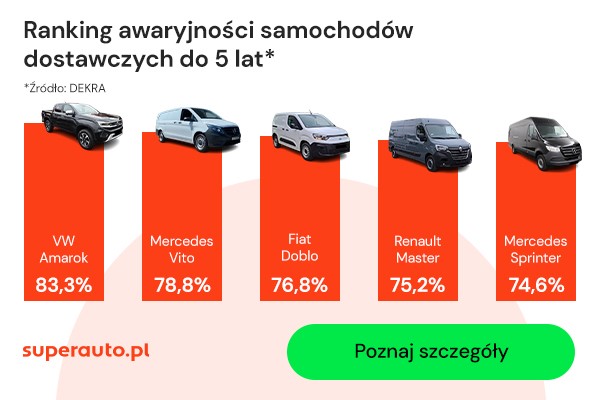 Reliable delivery vans ranking
Brief characteristics of selected models
We decided to briefly introduce selected delivery van models. We focused on currently available commercial vehicles included in the comparison, which showed the lowest failure rate.
All these cars are available in the Superauto.pl offer with flexible financing for companies and with attractive discounts, in various body and engine versions and in many conversions, as well as with discounts reaching even 30 percent relative to the catalog price.
 Renault Master III (since 2010)
The 3rd generation Master is the most popular delivery van in Poland. In 2023 alone, according to CEPiK data, 10,062 units of the Master were sold. Under its hood, we will find a 2.3-liter diesel with power from 110 to 180 HP, and the drive is transferred to the front, rear, or both axles via a 6-speed manual gearbox. An electric version, E-Tech electric, with 77 HP and a range of up to 204 km is also available. The Master comes in 4 body length variants (5075-6875 mm), 3 height versions (2307-2808 mm), and 3 wheelbase variants (3182-4332 mm), while the cargo space volume in the van ranges from 8 to 17m3. The GVW, depending on the version, ranges from 2.8 to 4.5 tons, and the payload reaches 1971 kg.
In terms of reliability, the most complaints concern thin sheet metal, weak brakes, a sticking gearbox, and fuel injection system failures.
Master prices start from 124,500 PLN net. In the Superauto.pl offer, a new Renault Master is available from 107,299 PLN net with financing for companies in the form of a lease or loan. By choosing a delivery van from the Superauto.pl offer, you gain an additional purchase discount of up to 29 percent.
Mercedes Vito III (since 2014)
We have known the Mercedes Vito since 2014, and in 2023 it underwent a facelift and received a new cabin. The car comes with a 2-liter diesel with power from 136 to 237 HP and with rear or all-wheel drive. It can be configured with a 6-speed manual gearbox or a 9-speed automatic gearbox. The Vito also comes in an electric version, the eVito, with 204 HP and a range of up to 370 km. The Vito comes in two length versions (5.14 and 5.37 m) and in two wheelbase variants (3200 and 3430 mm). The cargo space volume ranges from 6 to 6.6 m³, and the maximum payload is 1161 kg.
The most frequently mentioned faults of the Vito include problems with the braking system.
The Vito costs from 166,022 PLN net. In the Superauto.pl offer, you will find a new Mercedes Vito from 204,699 PLN net with financing for companies in a lease or loan. By deciding on a delivery van from the Superauto.pl offer, you gain an additional discount of 8 percent.
Volkswagen Transporter T6/T6.1 (since 2015)
The Transporter T6 has been valued for years for its reliability and utility features. The car comes with a 2-liter diesel with power from 110 to 204 HP, with a 5- or 6-speed manual gearbox or a 7-speed dual-clutch DSG transmission. The drive is transferred to the front or both axles. The Transporter T6.1 comes in 2 length versions (4904 and 5304 mm), with two wheelbases (3000 and 3400 mm), and in two height variants (1978-2508 mm). The cargo space volume ranges from 4.3 to 5m3. The payload reaches a maximum of 1400 kg.
The most frequently mentioned faults in the case of the Transporter are ignition coil and fuel pump failures. EGR valve failures also occur.
Transporter T6.1 prices start from 141,890 PLN net. Superauto.pl offers a new Volkswagen Transporter T6.1 from 189,999 PLN net with a discount of up to 5 percent when purchasing with financing in the form of a lease or loan.
Volkswagen Crafter II (since 2016)
The Volkswagen Crafter in its current edition is Volkswagen’s own project (it has nothing in common with the Sprinter) and is much more modern. The Crafter also has a twin model in the form of the MAN TGE, which also belongs to the VAG group. Under the hood, we will find a 2-liter diesel with power from 102 to 177 HP (currently 140 and 177 HP), cooperating with front, rear, or all-wheel drive. A 6-speed manual gearbox or an 8-speed automatic gearbox is responsible for power transmission. The electric version of the Crafter is available with a 136 HP engine and a range of up to 115 km. The car comes in 3 length versions (5986-7391 mm), with two wheelbases (3640 and 4490 mm), and three height variants (2355-2798 mm). Depending on the version, the GVW ranges from 3.5 to 5.5 tons, and the cargo space volume from 9.9 to 18.4 m³. The payload is a maximum of 3010 kg.
The most frequently reported faults by users include turbine failures and problems with the gearbox.
Crafter prices start from 146,920 PLN net. By choosing a model with financing for companies from the Superauto.pl offer, every buyer will receive a discount of up to 25 percent. In the offer, you will find Crafter units in many body versions and a full range of engines.
Mercedes Sprinter III (since 2018)
The 3rd generation Sprinter is Mercedes’ first proprietary project and, unlike its predecessors, has nothing in common with Volkswagen. It is also the first Sprinter also available with front-wheel drive. In the Mercedes offer, we will find models with classic rear-wheel drive and 4×4. The model is equipped with a 2-liter diesel with power from 114 to 190 HP, and a 6-speed manual gearbox or a 9-speed automatic gearbox is responsible for power transmission. The offer also includes an electric variant, the eSprinter, with 136 and 204 HP and a range of up to 420 km. The Sprinter comes in 3 length versions (5.93-7.37 m), 3 wheelbase variants (3640-4325 mm), and 3 height variants (2.35-2.83 m). The GVW, depending on the version, is from 3.5 to 5.5 t, while the cargo space volume reaches from 9.5 to 17 m³. The model’s payload is a maximum of 3070 kg.
Among the faults mentioned by users, it is worth mentioning bending connecting rods, which is caused by the accumulation of moisture in the intercooler. Furthermore, in 2023, the manufacturer announced a service campaign aimed at removing a potential fault in the internal blower fuse system.
The base Mercedes Sprinter 114 CDI with 114 HP costs from 158,031 PLN net, while in the Superauto.pl offer, Sprinter prices start from 141,699 PLN net. Among many cars, units are also available immediately. When planning a purchase for a company, at Superauto.pl you can take advantage of financing in the form of a lease or loan, which guarantees an additional discount of over 20 percent.
Summary
To sum up, systematically rejuvenating the fleet every few years by purchasing a new delivery van brings many benefits related to reducing downtime and repairs. Thanks to the use of advanced safety and driver assistance systems in new delivery vans, manufacturers are fighting to minimize the risk of collisions and vehicle damage. Technological progress and the solutions used by manufacturers allow for limiting faults related to vehicle maintenance, including active monitoring of the car’s technical condition. Finally, let’s remember that some models break down more and others less, however, especially in the case of delivery vans, it is the proper servicing of the car and the style of operation that will determine how often faults will occur in the car. Fleet rejuvenation is also favored by relative stabilization in the new car market. Of course, the needs and financial condition of a given enterprise play an important role in the decision to purchase a new delivery van. Of course, the needs and financial condition of a given enterprise play an important role in the decision to purchase a new delivery van. In order to ensure cost predictability in an organization, it is worth considering purchasing a new commercial vehicle from a company such as Superauto.pl, which offers attractive financing conditions.