








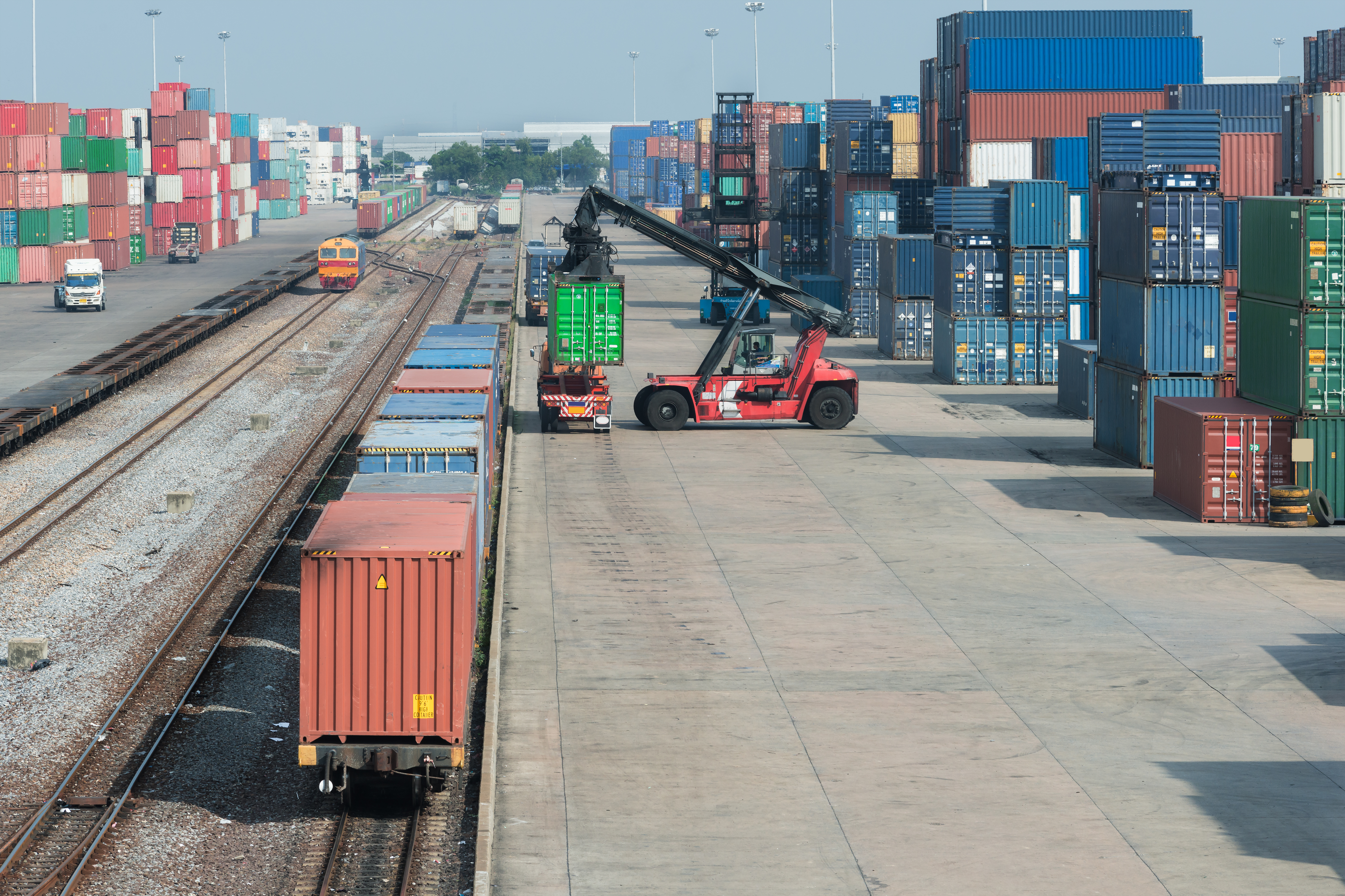
Intensive work on the Trans-European Transport Network (TEN-T), changes to the Combined Transport Directive, three new transshipment terminals in Poland launched last year, and plans to build a railway line from Poland to Lviv. These are just some of the elements of EU climate policy and national decisions aimed at developing intermodal transport. Together with Gopet Trans, we explain why this type of freight transport is gaining importance and is currently a topic of international discussion.
Why are EU officials working on an integrated rail network? The reason, according to EU Council calculations, is that rail transport accounts for only 1.9% of energy consumption in the EU and only 0.4% of greenhouse gas emissions from this mode of transport. Rail is ecological and could be a game changer for freight transport in the future. That is why nine core network corridors are to be created, connecting railways with roads, maritime and inland waterways, as well as ports and airports across the Union. Changes that support shifting freight transport to more ecological modes of transport are the goal and a clear direction taken by the TSL industry in Poland as well. However, the challenges that accompany them require our attention.
– It is very important to promote investment in transport infrastructure – this includes the expansion and modernization of transshipment terminals, improving the condition of roads and railway tracks, as well as the development of IT systems supporting supply chain management – comments Kamelia Vasileva, Chief Commercial Officer at Gopet Trans – It is necessary to create a coherent and clear legal framework that will take into account the specifics of intermodal transport and guarantee safety, environmental protection, and fair competition. These regulations should cover issues such as safety standards, charges for the use of transport infrastructure, insurance, and liability in the event of damage to goods or accidents. Additionally, they should aim to eliminate national restrictions and enable access to economic support measures – adds Vasileva.
The lack of adequate railway infrastructure makes the local transport market ineffective and uncompetitive in the long run. Poland is part of major European supply chains, and companies commissioning transport are paying increasing attention to decarbonization, which is why there is a noticeable greater openness to adopting intermodal transport as part of their long-term ESG policies.
– On the other hand, customers also require clear, accurate transit time indications, so the availability of goods for both further production and sales is crucial. With delays and even disruptions caused by infrastructure, we cannot be competitive. Ideally, by modernizing both roads and railways, we would be able to create the right mix of services, using these solutions effectively – comments Kamelia Vasileva, Gopet Trans.
This is being worked on by, among others, the European Commission, which has made further changes to the Combined Transport Directive (Directive 92/106/EEC). The revision of this document, which was intended to improve regulations, may ultimately discourage carriers and freight forwarders from choosing sustainable transport due to administrative barriers and overly complicated procedures. Comments on the amended directive were submitted in February this year by the IRU, the International Road Transport Union.
Rail emits less
According to the Office of Rail Transport, one train is needed to transport 1,000 tons of cargo, while at least 36 trucks are needed in road transport. This illustrates the scale at which rail could operate in the future. Why such a conclusion? According to data from the EC’s Directorate-General for Mobility and Transport, the transport sector is responsible for almost a quarter of greenhouse gas emissions in Europe. Almost three-quarters of this is due to road transport, of which trucks generate as much as a quarter. According to EU targets, only 26 years remain to achieve net-zero greenhouse gas emissions.
– The increase in emissions comes from the increase in road traffic resulting from economic development. The second factor may have been the neglect of investment in railway infrastructure compared to road projects. As a result, a significant portion of CO2 emissions may be the result of traffic congestion and idle times in road traffic. Shifting some traffic from roads to rail could contribute to real improvement. Furthermore, road traffic could be used more effectively for the first and last mile, while the longest part of the journey could be carried out by rail – notes Vasileva, Gopet Trans.
Focusing on intermodality is one of the ways to make sustainable choices in transport, and this direction of development for the TSL industry is currently one of the key ones. Electric trucks are no longer as distant a future as it might seem.
– However, they are still a costly investment that requires well-developed infrastructure. Therefore, we must act here and now. At Gopet, in 2022, we reduced carbon dioxide emissions by over 4.3 thousand tons compared to the previous year by using available intermodal solutions, and since 2013, this is over 206.5 thousand tons of carbon dioxide less. Furthermore, over the last nine years of operation, we have redirected over 565 thousand tons of cargo to rail transport. We also associate our next projects in Poland and Europe with intermodality. We already have several active solutions operating in Europe in cooperation with long-term suppliers and partners, and we are working intensively on developing more – comments Kamelia Vasileva.
There is potential
According to data from the Polish Development Fund for January 2024, road transport dominated freight transport in Poland (49.2%). Rail is in second place with a 41% share. At the same time, in December last year, the mass of goods transported by trains was 6.5% lower than a year earlier. In Poland, which ranks third in terms of the length of railway lines in the EU, over 80 thousand tons of cargo were transported in international transport in 2022. It is in rail that the potential is seen for freight transport to become more sustainable and, ultimately, to cooperate better with road carriers, and further investments are heading in this direction. It is worth mentioning that in the years 2014-2020, the EU allocated over 1.1 billion euros to support projects related to intermodality[1], and further EU initiatives are planned. The intensity of work on strengthening intermodality in Europe is also evidenced by the fact that Germany and Denmark have already started building a railway tunnel connecting Scandinavia with continental Europe.
[1] According to the report of the European Court of Auditors.
Source: Gopet Trans