









In the cost structure of Polish road freight transport companies, fuel expenses account for the largest share. According to research published in the scientific journal MDPI, these range from approximately 29% to 46% of total transport company costs, and can sometimes even reach as much as 49% of all expenditures. Since so much money is spent on fuel, and the prices of this commodity are volatile in the market, it seems important for transport companies to use tools that facilitate reasonable planning for diesel purchases. How do Transport Management Systems (TMS) help keep fuel costs in check?
Diesel prices up by more than 50% since 2020
Average diesel prices in Poland have been rising for 4 years. In 2020, they were at a level of about 1 EUR/liter, and in 2023 they were already at over 1.50 EUR/liter, which means an increase of more than 50%.[1] We will likely experience further price hikes, as diesel currently costs about 1.56 EUR/liter.[2] What is the reason for this dynamic? Undoubtedly, the ongoing war in Ukraine has a major impact. The EU ban on the import of Russian crude oil and petroleum products, as well as the unstable geopolitical situation, have caused supply disruptions and shortages, which inevitably had to translate into price levels.[3] Of course, price hikes affect transport companies the most as entities that use this raw material in their daily work. As a result, to maintain profit levels, they are forced to increase the prices of their services. However, it is worth knowing that the problem of rising fuel costs can also be fought in other ways.
More economical and easier with a transport management system
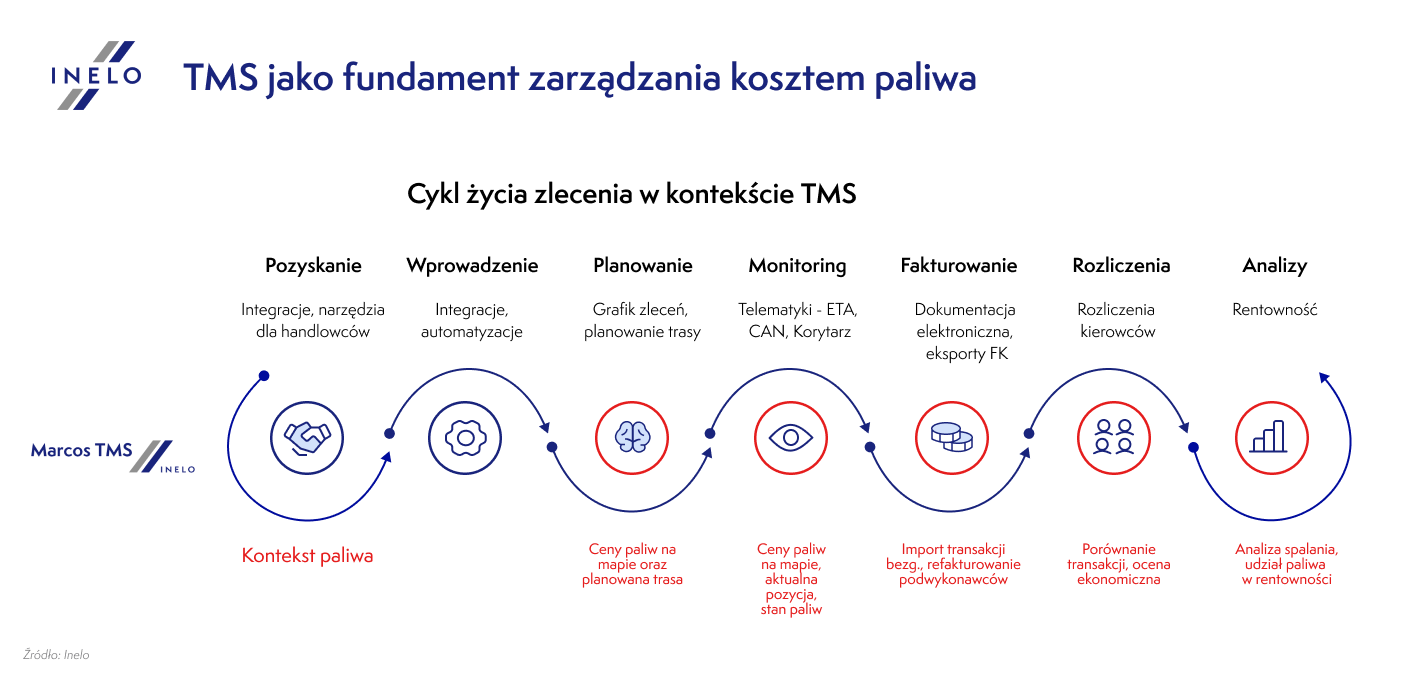
Transport Management Systems (TMS) are tools that every transport company should use. They facilitate control over every stage of a transport order, and in the context of fuel, they can significantly influence the level of costs.
Source: Inelo
– Already at the stage of planning an order, TMS systems, such as TMS Nawigator from Inelo, are very helpful because they reduce the risk of making costly mistakes. Above all, they support the selection of the optimal route, limiting unnecessary kilometers and empty runs. They also take into account fuel prices at individual stations located along the route and, thanks to integration with telematics solutions, such as GBox Assist, they monitor fuel levels in the vehicle in real-time to correlate these two factors and indicate the best refueling station at the right moment. Furthermore, thanks to integration with fuel cards, TMS systems support the order invoicing process by automating it and allowing for the avoidance of errors that often occur during manual settlement. Of course, their role in conducting analysis is also significant. Thanks to data from these systems, we can evaluate drivers in terms of their economical driving skills, but also analyze fuel consumption and thus calculate the profitability of a given order – explains Marcin Dudzik, Product Owner of TMS Nawigator, Marcos TMS.
What does a company using a TMS gain?
Transport companies using TMS systems in their work secure valuable information that would be difficult to obtain otherwise. Then, based on this information, they can improve their fuel policy, which translates into savings. They are also able to more precisely calculate the costs of executing a given transport order before it is even carried out, which in turn enables the preparation of more competitive offers and the acquisition of more orders.
– TMS systems compare fuel prices at individual stations in real-time, so thanks to them, a company can refuel where it is cheapest. Even seemingly small savings, on the order of a dozen or several dozen cents per liter of diesel, will mean substantial amounts over the scale of a year or several years, which can be invested in further development. Thanks to this, the transport company itself also becomes more stable in the market, because it can make more informed decisions and pay attention to various costs, as well as control them better – explains Tomasz Czyż, Chief Technology Solutions Expert, Inelo from the Eurowag Group.
Integration of the TMS system with fuel cards
Standard reports from fuel cards can be illegible because they contain not only fuel costs but also data regarding road tolls and other expenses incurred by the driver on the route. An important functionality of TMS systems is therefore the ability to import data from fuel cards into them. Thanks to this, freight forwarders gain selected information about fuel payments, and they can also easily sort and analyze them.
– The user has the ability to import data from a fuel card into the TMS system, but one must remember about configuration beforehand. First of all, the file must have the appropriate format so that refueling data is assigned to the correct vehicles in the program. You can also select other attributes, e.g., payment date or exchange rate information, to make it easier to group individual costs later. Such integration significantly speeds up work, as the person settling the accounts no longer has to retype this data manually. Instead, they can spend more time reviewing and analyzing the profitability of trips to draw potential conclusions for future orders – concludes Tomasz Czyż, Inelo expert from the Eurowag Group.
[1] Fuel-prices.eu, Poland
[2] As above.
[3] European Parliament, Ten issues to watch in 2023, ISSN: 2600-268X, January 2023, page 12
Source: INELO Poland