









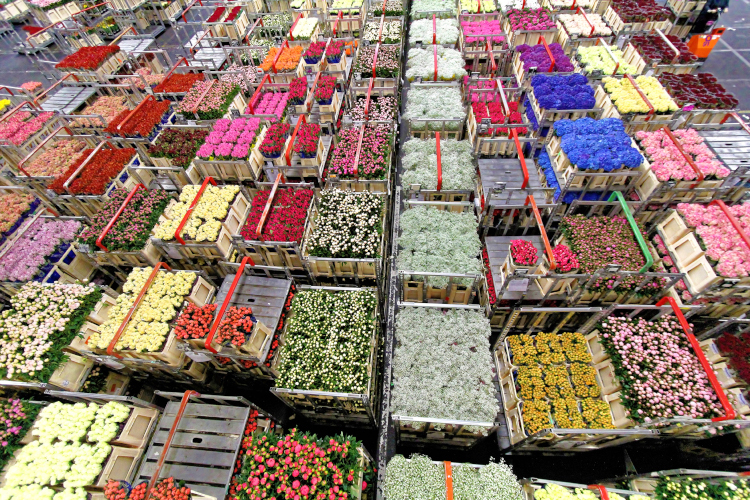
Global flower sales on Valentine’s Day are estimated to reach 250 million units. On February 14th, florists in Poland record up to a threefold increase in orders for red roses. During the Valentine’s season, not only florists but also the TSL sector face a major challenge: the fast and safe transport of a huge number of flowers from foreign, often very distant plantations. Representatives of the floral and transport industries share their Valentine’s experiences.
According to a PayPo study, as many as 66 percent of Poles plan to spend Valentine’s Day with their partner and exchange gifts with an average value of 50 to even 200 PLN[1]. Flowers have been among the most popular gifts for years. However, before a bouquet reaches the right person, the flowers must travel several or even tens of thousands of kilometers. Producers, sellers, and transport companies alike make every effort to ensure that the goods reach their destination in the shortest possible time, without any damage.
The long journey of a rose – from producer to consumer
The demand for red roses in winter is enormous – in America, Europe, and Asia, almost everyone wants to buy these flowers on Valentine’s Day. It is no different in Poland.
Red roses are mainly imported from Ecuador and the Netherlands. Shipments from the Netherlands take 1 to 3 days, and from Ecuador – even 4 to 6 days. Polish wholesalers place orders for Valentine’s deliveries as early as Christmas to ensure a competitive price and delivery date. The total cost of a single flower consists of a number of factors, including stem length, color saturation, variety, country of origin, and the currency exchange rate on the day of purchase. Florists admit, however, that producers are able to raise the price of a rose by up to 100 percent during the peak season. The increased prices remain in effect until Women’s Day – when tulips also start to become more expensive.
Before Valentine’s Day, wholesalers buy 50 to even 100 percent more flowers compared to regular days. Nearly 80 percent of the order consists of roses in the bud stage, as such specimens have a chance to maintain their freshness for a few more days after being arranged into a bouquet on February 14th.
According to wholesalers, transporting flowers in winter is one of the biggest Valentine’s challenges. A key aspect is choosing a proven, trusted supplier. Most florists admit that they have been working with the same transport company for many years, and a decision to change suddenly could result in the loss of entire pallets of goods due to insufficient protection against weather conditions.
– Flowers are transported in refrigerated trucks or isothermal vehicles. The sensitivity of some plants and their ability to absorb odors means that the vehicle should be very thoroughly cleaned before transport. Cut flowers are usually placed on so-called phytosanitary pallets. These contain holes that allow for airflow, drainage of residual water, and help keep the product cool during transport. However, the temperature itself cannot be too low, or the flower petals will turn black. It must be remembered that ensuring the proper transport conditions for the plants is the responsibility of the carrier, and they are liable for any potential damage – says Robert Głąb, Operations Manager at Geis PL.
Typically, transport takes place from foreign plantations to Warsaw, where the goods are picked up by local carriers and distributed to wholesalers and flower markets across the country. Retailers order roses for their flower shops from wholesalers no later than 2 weeks before Valentine’s Day.
What happens after Valentine’s Day?
Valentine’s Day is one of the biggest challenges for florists. It is a time full of risks and unknowns, which begins with determining the number of flowers needed. Although the floral industry is besieged on this day, and flower shop owners order up to three times more roses, they are never sure they will sell them all. They unanimously state that this is the biggest Valentine’s challenge for a retailer. Roses that were not purchased on Valentine’s Day are sold off without profit for the flower shop for a few more days. In other cases, florists decorate their own homes, church altars, give them to friends, or ultimately – throw them away.
Experienced florists therefore warn against the trap of quantity over quality and excessively high margins. As they claim, buying a more expensive rose from a plantation can be a guarantee of its freshness and durability. One must keep in mind that, in reality, retailers will buy fewer such flowers. What to do with the margin then? In the era of the Internet and social media, customers can very quickly verify a seller’s honesty and assess the quality of the products offered. It is therefore worth ensuring that the profit from the sale of a single flower is not artificially increased before peak seasons.
Losses in flower shops are inevitable. Nevertheless, the approach of these shop owners clearly indicates that they prefer to provide their customers with higher quality products rather than offering cheaper flowers that might only attract buyers for a moment.
[1] PayPo Valentine’s Day Study: Are Poles romantics? – PayPo Blog
Source: Geis PL