









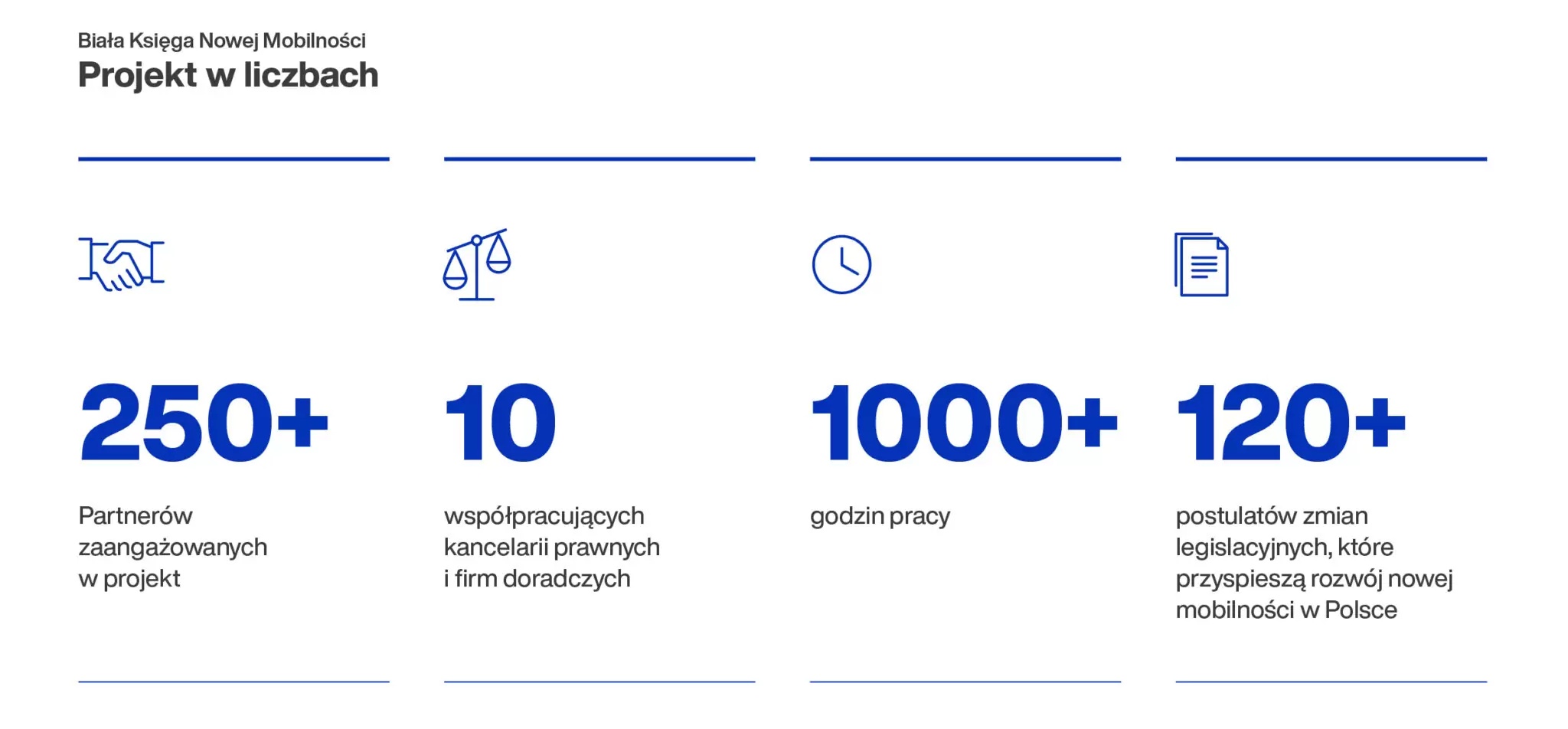
The PSPA “White Paper on New Mobility” is the first such comprehensive document in Poland aimed at removing the greatest barriers to the development of sustainable transport. More than 250 partners, including 10 law firms and consulting companies, have been involved in the project. The “White Paper” contains over 120 proposals for specific legislative solutions in 12 key areas of new mobility.
A document constituting a comprehensive plan for the development of new mobility in Poland has already reached the desks of government representatives – Minister of Climate and Environment Paulina Hennig-Kloska, Minister of Infrastructure Dariusz Klimczak, Minister of Development and Technology Krzysztof Hetman, and Minister of Science and Higher Education Dariusz Wieczorek. The “White Paper on New Mobility” includes over 120 postulates for regulatory and systemic changes, the implementation of which will lead to the removal of the main barriers hindering the electrification of Polish transport.
– In recent years, the development of new mobility has not been on the public administration’s priority list. In the face of global trends, it is necessary to set the automotive industry in Poland on a path of transformation towards zero-emission. Otherwise, we will lose a historic opportunity for the growth of the entire economy’s innovation and for strengthening the position of Polish companies in the global supply chain. Addressing these challenges, PSPA has prepared a collection of concrete, ready-to-implement regulatory solutions. Initiating the “White Paper” project, we assumed that the first step on the path to eliminating barriers to the development of electromobility should be their correct identification, followed by the active involvement in the project of those entities that are directly and indirectly affected by our postulates. The pace of implementation of the postulates included in the “White Paper” determines not only the pace of transport decarbonization and economic growth in the coming years, but also Poland’s fulfillment of the requirements set by EU regulations, such as the AFIR regulation – says Maciej Mazur, Managing Director of PSPA.
Global changes consisting of moving away from conventional drives in favor of electric ones could mean that the Polish automotive sector – which currently generates 8% of Poland’s GDP and creates about 400,000 jobs – will maintain a strong position in the national economy, and Poland will emerge as a new economic power in the automotive industry in Europe, or it will be excluded from the supply chain, which will contribute to job losses and a decline in GDP. The decisions made in the coming months and years will determine whether, on the path to long-term green transformation and climate neutrality in Europe, Poland will be among the economic leaders of the region or remain a passive observer of changes taking place in other member states. New mobility creates a unique, historic opportunity for dynamic economic development. For example, Poland is already a European leader in the lithium-ion battery sector, which accounts for 2% of national exports. However, without introducing comprehensive changes to the Polish regulatory system, we will not be able to take advantage of this opportunity.
– Why is it so important to take urgent action in this area? Poland is currently in one of the last places in the European Union in terms of the pace of sustainable transport development. The market share of new fully electric vehicles (BEV) in our country is about 4% and is more than three times lower than the EU average. A significantly higher BEV share is held by the vast majority of other CEE countries, including, for example, Bulgaria (4.8%), Hungary (5.4%), Lithuania (7.5%), Latvia (8.9%), or Romania (10.6%) – says Aleksander Rajch, Member of the PSPA Management Board.
Charging infrastructure is also developing more slowly than in most member states. As a result, the number of BEVs per charger has increased from about four in 2019 to almost ten this year. This calls into question Poland’s ability to meet EU targets, including obligations resulting from the AFIR regulation, under which the total power of charging stations in our country should double in just two years. One of the main reasons for the slow development of electromobility in Poland is imperfect law and numerous administrative barriers. Regulations very often do not take into account current market conditions, are implemented with significant delays, and decarbonization is still limited by a number of legislative gaps. In order to overcome the greatest regulatory challenges of sustainable transport and support public administration in implementing necessary changes, PSPA, in cooperation with e-mobility industry leaders, has published the “White Paper on New Mobility”. The study contains over 120 specific legislative proposals covering 12 key areas.
– More than 250 entities from the entire sustainable transport value chain worked on the “White Paper on New Mobility”. The project involved leading vehicle and component manufacturers, charging infrastructure operators and manufacturers, companies from the battery sector, financial institutions, companies from the new mobility and vehicle sharing area, the TSL and retail industry, energy concerns, and developers. The “White Paper” was created with the participation of 10 law firms and consulting companies. Its preparation took over 1,000 hours of work – says Wojciech Jakubczak, Director of Organization Development at PSPA.
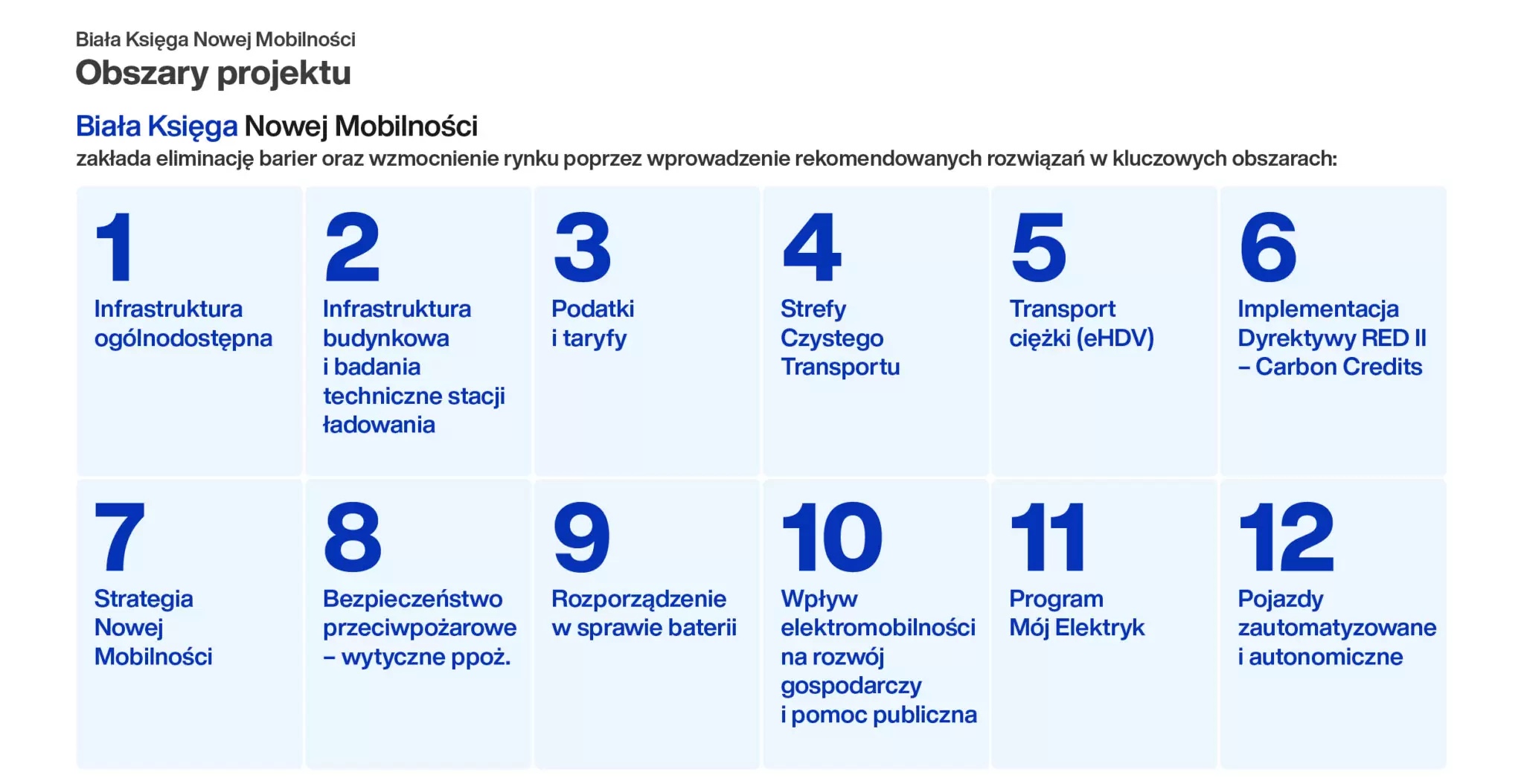
The regulatory change proposals included in the “White Paper on New Mobility” cover areas such as publicly accessible charging infrastructure, building infrastructure and technical inspections of charging stations, taxes and tariffs, clean transport zones, heavy-duty transport (eHDV), implementation of the RED II/III Directive, New Mobility Strategy, fire safety, battery regulation, the impact of electromobility on economic development, the “My Electrician” program, or automated and autonomous vehicles.
– More than 30 postulates of the “White Paper” concern public and private charging infrastructure. Currently, the launch of DC chargers in our country takes the longest in Europe (even more than 2 years). Therefore, the “White Paper” includes a number of solutions leading to a significant improvement in connection procedures for publicly accessible stations to the power grid. The postulates we propose in this area include, among others, the amendment of the Energy Law, the Construction Law, or the Act on Real Estate Management. We have also proposed changes, among others, in the regulation on detailed conditions for the functioning of the power system. Based on them, distribution system operators (DSOs) would be responsible for building the network and connection to a place located directly at the planned location of the charging infrastructure. This will allow avoiding the situation, common today, where connection points are located at a significant distance from the station (sometimes even several kilometers away), which makes the investment practically unprofitable – says Jan Wiśniewski, Director of the PSPA Research and Analysis Center.
In the area of non-public infrastructure, the proposals contained in the “White Paper” are intended to, among other things, facilitate the installation of private charging stations in multi-family residential buildings. The postulates include, for example, entitling the applicant to launch a charger if statutory requirements have been met. Currently, many managers refuse consent to install such a device without a legal basis. In order to make it easier for drivers to charge electric cars at home, the “White Paper” also includes proposals to exempt non-public charging stations with a power of up to 11 kW (and even up to 22 kW when such devices are connected directly to the distribution network) from the obligation of UDT technical inspections.
A lot of space in the “White Paper on New Mobility” has been devoted to tax issues. The most important postulates in this area include, among others, the introduction of the possibility of deducting 100% VAT on the purchase and operation of electric vehicles and on the purchase of energy used to charge vehicles. This is a key incentive to stimulate the electromobility market, which can cover a much larger number of potential beneficiaries than budget-limited subsidy programs. Postulates in the tax area also concern, among others, the exemption of charging stations and points from real estate tax, the abolition – under CIT/PIT – of the limit on operating expenses in relation to electric vehicles (in terms of including expenses in tax-deductible costs), or the deduction of expenses for the purchase and installation of a private charging station from income.
– The postulates described in the “White Paper” also refer to clean transport zones. Their goal is to encourage local governments to implement CTZs and facilitate supervision over compliance with the introduced restrictions. They concern the abolition of hourly restrictions on entry to CTZs and the resignation from limiting the possibility of collecting fees only to 3 years from the date of establishing the zone – says Albert Kania, Senior New Mobility Manager at PSPA.
The “White Paper on New Mobility” also contains postulates in the field of new mobility (including legal definition and codification of shared transport or privileging shared vehicles in urban space) and implementation into the Polish legal order of the assumptions of the RED II/RED III directive (introducing, among others, requirements regarding the minimum share of RES in the transport sector, as well as enabling operators of publicly accessible infrastructure to participate in the so-called “carbon credits” mechanism).
The postulates presented by PSPA also provide for undertaking work on regulations in the area of extended producer responsibility for batteries and the introduction of provisions enabling the fulfillment of obligations regarding the collection and processing of used batteries (corresponding to the assumptions of the new EU regulation 2023/1542 of July 12, 2023). The study also contains a catalog of instruments supporting the transformation of the Polish automotive industry towards products for electromobility (including lowering energy acquisition costs for recipients implementing European climate policies along with compensation for DSOs). An entire chapter of the “White Paper” is also devoted to regulations facilitating the testing of autonomous cars on Polish roads and conducting implementation work in this area (postulates include, among others, the introduction of a long-term permit for test drives, or moving away from the need to obtain consent for vehicle tests from all managers of the road section on which tests were planned).
PSPA is the largest economic organization in Poland and the CEE region creating the sustainable transport market. PSPA brings together over 250 entities representing many industries and sectors from the new mobility chain. They employ about 500,000 people and generate a total of about 16% of Poland’s GDP.
Source: PSPA