








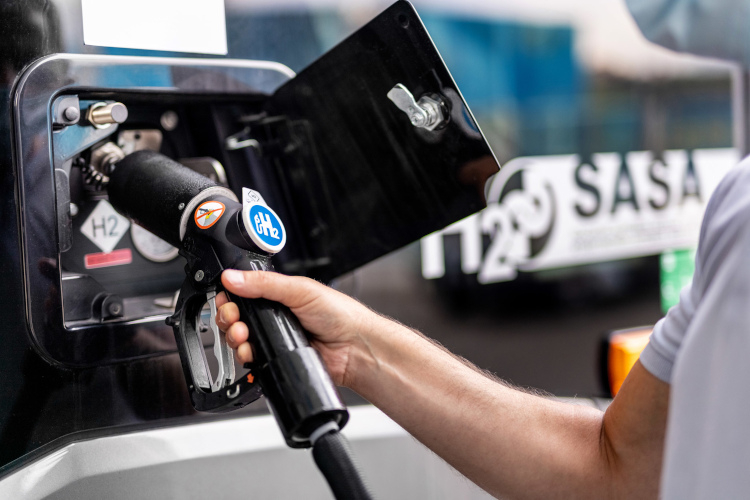
Solaris is implementing hydrogen technologies in the field of public transport. The company has already partnered with 40 clients from 10 European countries, with orders and deliveries exceeding 700 vehicles.
Starting from the decision to produce a prototype of a 12-meter bus powered exclusively by a hydrogen fuel cell, through the premiere of this model in 2019, and subsequently the articulated 18-meter version, the Urbino hydrogen model has been gaining new clients. The benefits of riding these state-of-the-art vehicles are appreciated by passengers, drivers, and transport operators in European cities. Today, Solaris is a leader in implementing hydrogen technology in public transport and an experienced partner for 40 operators. To date, the manufacturer has delivered nearly 200 hydrogen-powered vehicles. Moreover, Solaris is currently fulfilling orders for over 500 more vehicles, and hydrogen buses are becoming an increasingly significant value in the company’s production mix.
In recent months, Solaris has secured several particularly prestigious orders. In September 2023, the company signed the largest single contract in Europe for the supply of hydrogen buses. The municipal public transport operator TPER in Bologna purchased as many as 130 Urbino 12 hydrogen buses. Additionally, the ordering party has the option to expand the order by another 140 vehicles as part of a so-called option.
Another Italian public transport operator, Azienda Veneziana della Mobilita, has purchased 90 Urbino hydrogen buses: 75 in the 12-meter version and 15 in the articulated version. The zero-emission hydrogen buses will operate routes both on the mainland and in the Venetian Lagoon area. This contract also includes the possibility of expanding the order by an additional 23 vehicles.
The company also secured an equally important order in the German market. RVK Köln has decided to choose Solaris hydrogen buses for the third time. The impressive fleet of 35 hydrogen Solaris buses will now be joined by 18 articulated vehicles using hydrogen fuel cell technology. The Urbino 18 hydrogen model chosen by RVK will be equipped with the latest systems to support the driver’s work.
Recognizing the steady development of the hydrogen vehicle market and the resulting growing number of orders for hydrogen-powered buses, Solaris is strengthening this specific area of its business. One of the company’s latest investments in hydrogen facilities is the construction of the Hydrogen Hall. This is a part of the production line dedicated exclusively to hydrogen drives.
Solaris’s impressive order portfolio from clients in Austria, Switzerland, Germany, Spain, France, Italy, the Netherlands, Poland, Sweden, and Slovakia is reflected in market data. In 2022, 99 urban hydrogen buses were registered in European countries. While awaiting data for the full year 2023, this result can currently be compared to the first three quarters of 2023. At that time, 137 new hydrogen fuel cell buses hit the roads. This is a 38% increase compared to 2022, and the data for the last quarter will certainly only improve this result. For comparison, just a few years earlier, in 2018, not a single hydrogen bus was registered in Europe.
As expected, the size of the zero-emission bus market will show an upward trend in the coming years. European countries have ambitious goals for reducing pollutant emissions, and hydrogen buses have been recognized as a viable solution to help achieve these goals and improve air quality in cities[1]. According to the current position of the Council and the European Parliament, by 2035 all new buses in the EU will be exclusively zero-emission[2].
As for hydrogen refueling stations, there are currently over 230 such points in use in Europe, with another 120 in preparation[3]. Hydrogen infrastructure will continue to grow – in accordance with the AFIR regulation coming into force in April, hydrogen refueling stations are to be built every 200 km along the most important EU transport corridors by the end of 2030[4].
There are a number of arguments in favor of hydrogen. First and foremost is its absolute cleanliness in use and the lack of carbon dioxide emissions. Also significant are such advantages as long range, high energy density, fast refueling process, flexibility in managing a fleet of hydrogen vehicles, and remarkably quiet operation. The mission of Solaris goes beyond just producing hydrogen vehicles – the goal is also to be a partner in implementing this technology in public transport.
[1] https://www.fortunebusinessinsights.com/hydrogen-buses-market-108502
[2] https://www.consilium.europa.eu/en/press/press-releases/2024/01/18/heavy-duty-vehicles-council- and-parliament-reach-a-deal-to-lower-co2-emissions-from-trucks-buses-and-trailers/
[3] https://h2.live/
[4] https://eur-lex.europa.eu/eli/reg/2023/1804/oj