








Up to PLN 750,000 in subsidies for the purchase of zero-emission heavy-duty trucks is provided for in a draft program announced today by the National Fund for Environmental Protection and Water Management (NFOŚiGW). A total of PLN 1 billion will be allocated for grants. “Support for the eHDV market is essential to maintain the competitiveness of the Polish road freight transport industry. Subsidies should be accompanied by regulatory changes,” assesses PSPA.
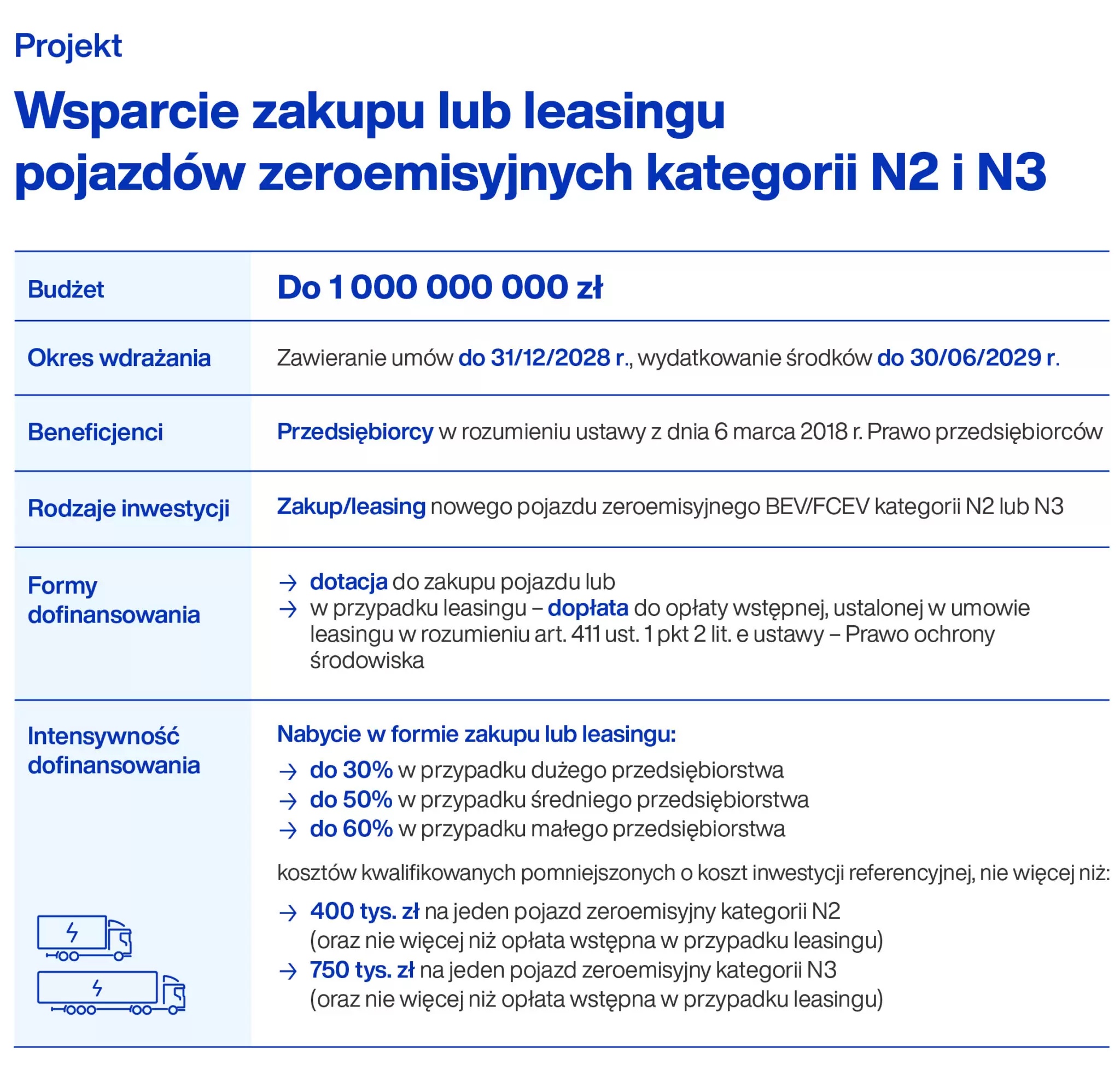
NFOŚiGW submitted today for consultation the draft of the priority program “Support for the purchase or leasing of zero-emission vehicles of categories N2 and N3”. According to the Fund’s proposal, the program’s budget is to amount to PLN 1 billion. This is more than the amount allocated for supporting buyers of electric passenger and delivery vehicles reserved under the “My Electrician” program (PLN 800 million). Applications will be accepted on a continuous basis between 2024 and 2028 or until the allocation is exhausted.
Funding is to be provided in the form of a grant (purchase) or a subsidy for the initial payment (leasing). The program’s beneficiaries will be entrepreneurs. Subsidies will cover only new, zero-emission (i.e., fully electric or hydrogen) vehicles of category N2 (with a gross vehicle weight of over 3.5 t up to 12 t) and N3 (with a GVW of over 12 t). The minimum annual mileage of a subsidized vehicle should be at least 50,000 km.
The amount of subsidies is to depend on the size of the enterprise applying for support and the category of the subsidized vehicle. In the case of a purchase, it will be up to 30% of eligible costs (large enterprises), up to 50% (medium-sized enterprises), and up to 60% (small enterprises). At the same time, the amount of the subsidy for a purchase will not be able to exceed PLN 400,000 (category N2) or PLN 750,000 (category N3). If the beneficiary chooses leasing, the subsidy amount will not be able to exceed the initial payment.
“Based on the draft, eligible costs in each case should be reduced by the cost of the reference investment, i.e., the purchase of a comparable combustion-engine vehicle. This means that, in practice, the subsidy applies to the difference between a conventional and a zero-emission vehicle. This is a model used in most countries that have introduced subsidies for eHDVs. On the other hand, taking into account the size of the enterprise when determining the amount of the subsidy for a zero-emission heavy-duty truck is a mechanism that has been implemented by, among others, the Netherlands and Spain,” says Piotr Ziółkowski from PSPA.
As PSPA points out, the transport industry is one of the pillars of the Polish economy. The TSL sector in Poland is responsible for generating 6% of GDP, bringing together 125,000 companies employing approximately 750,000 people. Taking into account the breakthrough changes taking place in this area in the European Union, the development of electromobility is a necessary factor for protecting the competitiveness and innovation of the Polish market. This is determined by both the strategic goals of the EU, subsequent proposals to tighten emission standards for heavy-duty vehicles (including those expressed in the draft amendment to Regulation 2019/1242 or the announced Euro 7 standard), as well as the efforts of many companies to decarbonize supply chains, which will also include the stage of goods transport.
“If Polish entrepreneurs are to remain competitive on the European market, they must electrify their heavy-duty vehicle fleets. Due to the differences in purchase prices compared to combustion-engine vehicles, this will not be possible without the introduction of subsidies. Such instruments have already been implemented in 4 out of the 5 largest heavy-duty transport markets in Europe (in Germany, France, Spain, and the Netherlands). The only exception is Poland. That is why the program announced today is a step in the right direction. PSPA has already begun consultations on this project with leading representatives of the new mobility industry. The assumptions of the program will also be the subject of discussion at the next meeting of the PSPA Committee on Logistics and Transport,” announces Jan Wiśniewski, Director of the PSPA Research and Analysis Center.
In its analyses and reports, PSPA has repeatedly pointed out that mass electrification of the Polish truck fleet, currently the largest in Europe (numbering approx. 1.2 million units), requires the introduction of other support instruments in addition to vehicle purchase subsidies. Subsidies should also cover high-power charging infrastructure dedicated to eHDVs. At the same time, it is necessary to amend the law to, among other things, streamline the protracted process of connecting ultra-fast chargers to the power grid. This is particularly important in the context of the requirements of the EU AFIR regulation, which imposes very ambitious goals on every member state regarding the expansion of charging infrastructure for eHDVs along the TEN-T network. Other legislative changes advocated by the industry include the abolition of road tolls for zero-emission trucks, allowing such vehicles to enter restricted traffic zones, or increasing the gross vehicle weight of eHDVs. Electrification of truck fleets in Poland would also be accelerated by the introduction of tax breaks for entities investing in ecological means of transport.
“A full set of proposals for specific regulatory and systemic changes, the introduction of which will significantly facilitate the development of electromobility in heavy-duty transport, will be presented by PSPA in the ‘White Paper on New Mobility’. This study contains over 120 legislative change proposals. More than 250 entities from the entire e-mobility value chain worked on it, including manufacturers of zero-emission heavy-duty vehicles, leading charging infrastructure operators, and top carriers. Given the importance of the road heavy-duty transport sector for the Polish economy and the number of people employed in this sector, we hope that our proposals will meet with the fastest possible positive reaction from the public administration,” says Aleksander Rajch, Member of the PSPA Board.
Source: PSPA